Loss Prevention Job Description
Protecting stock, cash and people in clothing retail — shrink, investigations, security technology and store safety
Loss prevention is the function that protects a fashion retailer's stock, cash and people from loss. Its central measure is shrinkage — the share of stock that disappears between delivery and sale through shoplifting, employee theft, supplier fraud, damage and plain administrative error. A retail security officer's main job is to keep a watchful eye on stock, staff and customers, and loss prevention teams combine that visible presence with surveillance, security technology, stock audits and investigations. In clothing retail the stakes are concrete: garments are small, desirable and easy to resell, which makes apparel a permanent target.
More Miscellaneous Job Descriptions by Letter:
What Loss Prevention Work Involves
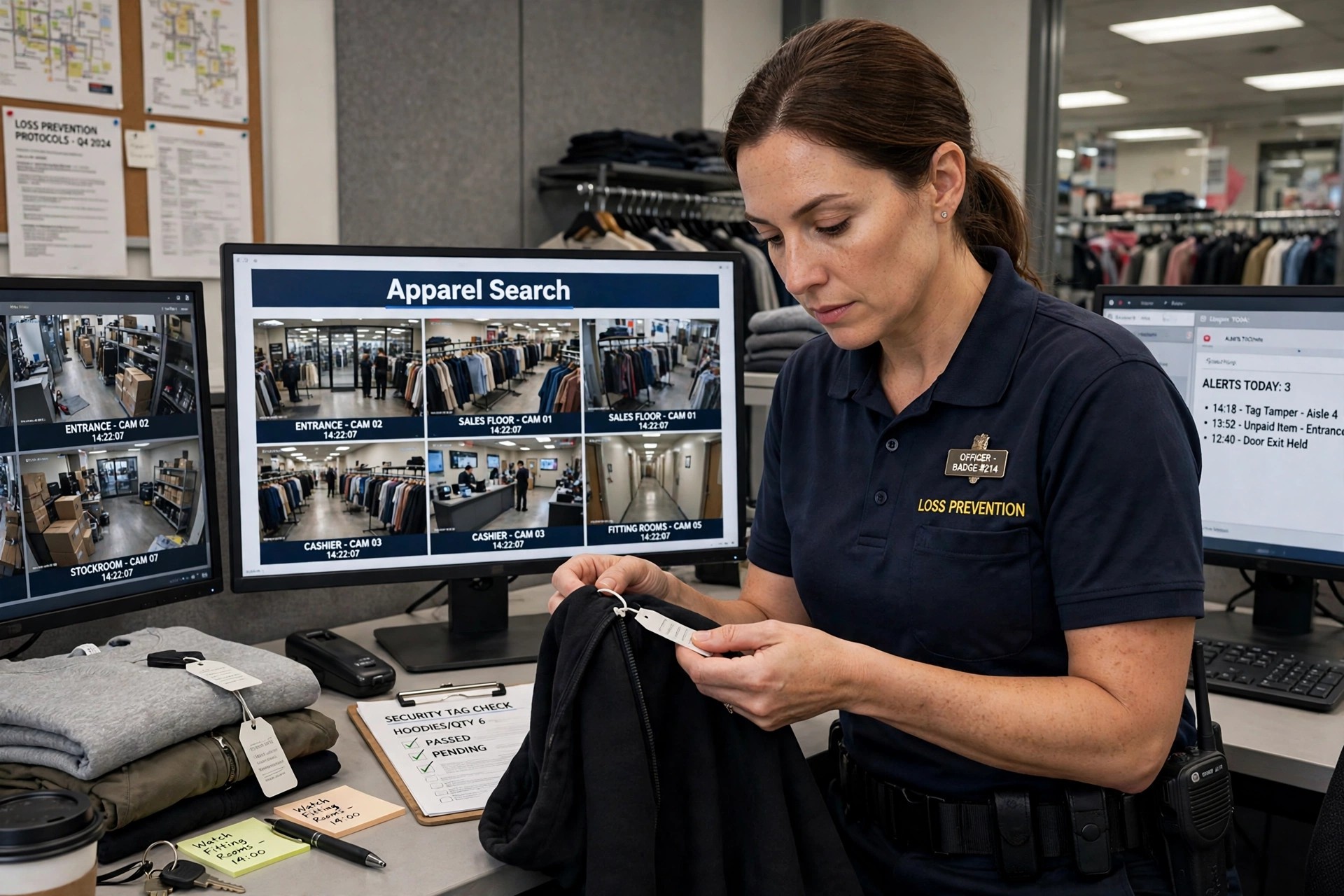
Prevention starts on the sales floor. Loss prevention officers and store detectives observe customer behaviour, monitor fitting rooms and high-value departments within the law and company policy, and act as a visible deterrent in uniform or a discreet one in plain clothes. Store teams are trained by loss prevention to greet and engage customers, keep exits and tag procedures tight, and report the patterns — repeat visitors, tampered tags, suspicious returns — that suggest organised theft rather than impulse.
The second half of the work is systematic. Loss prevention analyses shrinkage results by store and department, audits stock movements and refund and discount records for irregularities, reviews delivery and warehouse documentation, and investigates the exceptions the data exposes. Findings turn into procedure changes: a fitting-room count system tightened, a refund authorisation moved up a level, a delivery check added. Prevention in the job title is literal — the function's success is measured in losses that stop happening.
Security Technology: EAS, RFID and Store Systems
Electronic Article Surveillance (EAS) has helped apparel retailers detect and prevent theft for decades, protecting everything from designer jeans and handbags to leather jackets and intimate apparel, through tags and labels that alarm at store exits unless deactivated at the till. Merchandise visibility via Radio Frequency Identification (RFID)-based solutions provides detailed insight into the location and quantity of apparel and footwear from the manufacturing source to the store, in order to reduce out-of-stocks, reduce inventory costs and increase sales and margins — and the two technologies have converged, with RFID applied as an EAS solution that identifies the specific item leaving, not just that something is.
Loss prevention staff work daily with this equipment and with the wider security systems of a store: CCTV and its lawful retention, alarm and access systems for stockrooms and cash offices, and the security labels and tags attached to clothing in the warehouse or at the store. Choosing tag placement, training staff in tagging standards, and reading what exit alarms and RFID counts reveal about a store's weak points are all part of the role.
Investigations, Audits and Safety
When losses point to a person, loss prevention investigates. That means gathering and preserving evidence properly — surveillance records, transaction data, stock documents — interviewing within policy and legal limits, and presenting findings to management, the police or prosecutors in a form that holds up. Internal investigations, into employee theft or refund fraud, demand particular care: the evidence standard must protect both the company's property and an innocent employee's reputation, and sloppy work in either direction is costly.
Safety completes the remit. Loss prevention owns or supports store safety and emergency procedures — evacuations, cash handling and banking security, opening and closing protocols, and the protection of staff facing aggressive behaviour. Store audits check all of it together: security, safety and procedure compliance scored on visits the loss prevention team schedules and sometimes does not announce.
Skills, Qualifications and Career Path
Observation and judgement lead the skill list: watching a floor for hours and knowing which behaviour matters, then acting proportionately and lawfully when it does. Integrity is absolute — the role handles evidence, cash discrepancies and accusations, and is trusted only while its own conduct is beyond question. Report writing matters more than newcomers expect, because an investigation's value is its written record; calm communication, including de-escalation with detained or aggressive people, matters daily.
Entry routes include store security officer and loss prevention associate posts, often with retail or security experience and any locally required security licence; employers train in their systems, law and procedures. Investigators and managers are usually promoted from those ranks or recruited from police and military backgrounds. Progression runs to loss prevention manager for a store group or region, and to head of loss prevention or asset protection, where budgets, technology choices and company-wide shrink strategy are owned.
Common Questions
What is shrinkage in fashion retail?
Shrinkage (or shrink) is stock lost between delivery and sale — through shoplifting, employee theft, supplier fraud, damage and administrative error — measured as a percentage of sales at stock counts. Reducing it is loss prevention's central job.
What is the difference between loss prevention and a security guard?
A guard's role is visible presence and response. Loss prevention is broader: shrink analysis, audits, investigations, security technology such as EAS and RFID, procedure design and staff training, alongside floor surveillance and apprehension work.
How do you get into loss prevention?
Common routes are store security or loss prevention associate roles with retail or security experience, or police and military backgrounds for investigator posts. Employers train staff in their systems, legal limits and interview procedures.