Order Entry Job Description
The order entry clerk — turning customer orders into accurate instructions the warehouse, factory and accounts can act on
Order entry is where a clothing sale becomes an operation. When a retailer orders garments from a brand or wholesaler — by phone, email, order form, sales representative or electronic data interchange — an order entry clerk receives that order and turns it into a precise internal instruction: the right styles, colours, sizes and quantities, at the agreed prices and terms, for the right delivery date and address. Every later step in the business — picking, packing, shipping, invoicing — works from what order entry recorded, which makes this apparently clerical role one of the most consequential in the building: an error entered here is an error delivered, invoiced and argued about later.
More Miscellaneous Job Descriptions by Letter:
What Order Entry Clerks Do
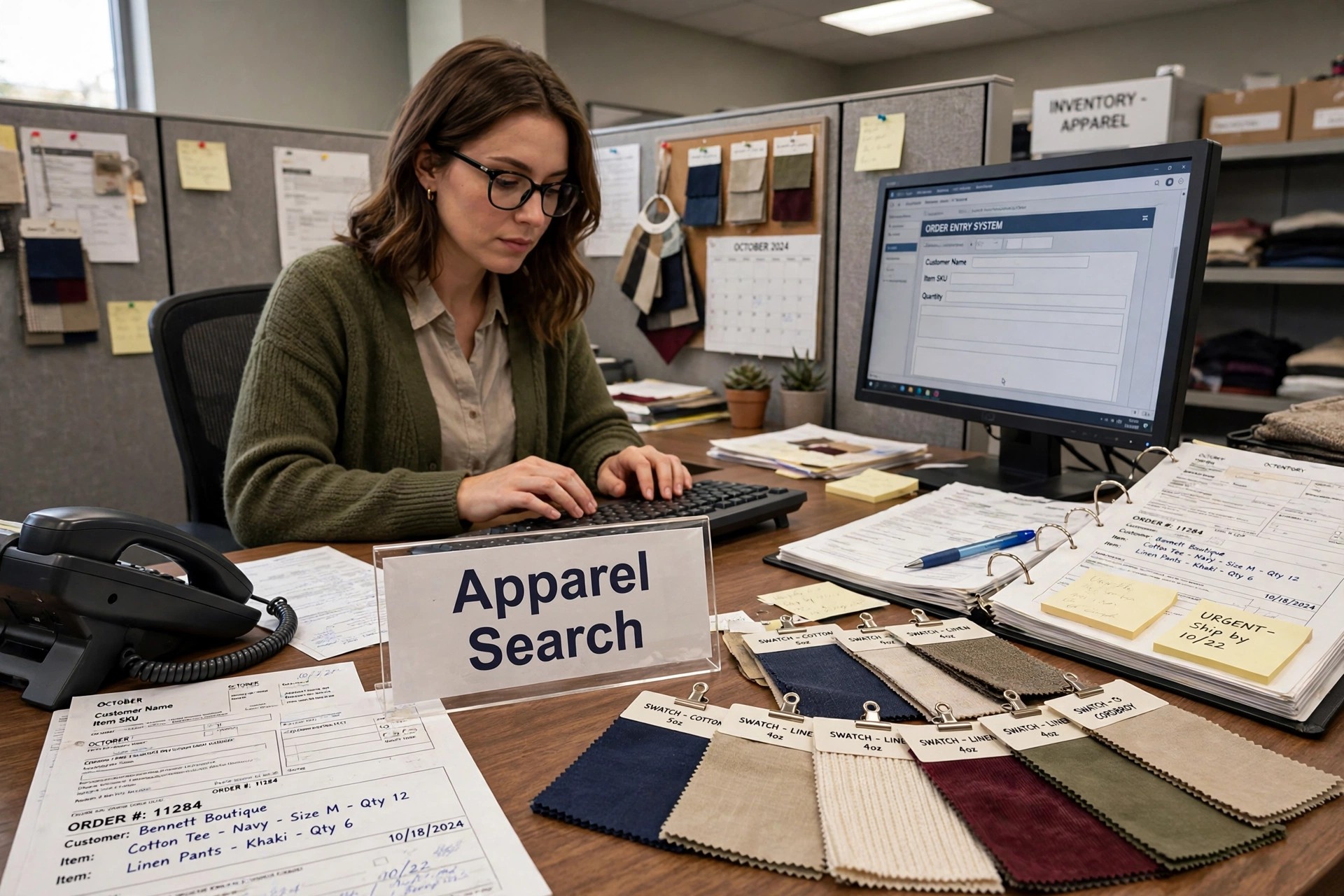
The daily work begins with intake. Orders arrive in many forms — a buyer's purchase order, a representative's call report, a reorder phoned in by a store, an EDI transmission — and the clerk keys or imports each into the order management system, translating the customer's language into the company's: style numbers, colour codes, size scales and pack ratios. Each line is checked as it is entered — Does this style exist in this colour? Is the size run complete? Does the price match the customer's terms, the season's price list and any agreed discount? An order that cannot be fulfilled as written is not simply entered and forgotten; the clerk queries it while the customer can still correct it.
Confirmation and maintenance complete the cycle. The clerk issues order confirmations, notes requested delivery windows against production and stock availability, and flags orders that cannot be met in full or on time to sales and customer service. Changes and cancellations are processed with the same care as new orders, because a cancellation keyed wrongly ships goods nobody wants, and an amendment missed produces exactly the dispute the system exists to prevent. Throughout, the clerk answers customer and representative queries about order status from the record they maintain.
Accuracy Under Fashion's Volume and Calendar
Clothing multiplies order complexity in a way few industries match. A single style may be ordered in six colours and nine sizes, in pre-packs and in singles, for several delivery drops across a season — hundreds of lines from one customer's one decision. Order entry clerks work at that volume to seasonal deadlines: orders taken at selling appointments and trade shows arrive in surges, cut-off dates for production are fixed, and a clerk's backlog in order week is measured in customers waiting, not paperwork waiting.
The defences are method and verification. Good clerks work in a fixed checking order, read back critical fields, use the system's own validations instead of overriding them, and keep clean notes of every customer agreement so a query months later can be answered from the record. They also learn the product — seasons, size conventions, which styles run together — because product knowledge catches the errors a screen cannot: the colour that was discontinued, the size run that style never came in. Supervisors audit accuracy because the business cost of entry errors, in returns, credits and lost customers, is counted and known.
Skills and Abilities the Role Requires
Typing speed with accuracy is the mechanical foundation — fast and wrong is worse than steady and right — together with confident use of order, stock and customer systems, spreadsheets and business email. Attention to detail under repetition is the core ability: the four-hundredth line of the day needs the same checking as the first, and clerks who sustain that standard are valued accordingly. Numeracy covers quantities, ratios, prices, discounts and taxes without hesitation.
The human skills matter more than the job's back-office image suggests. Order entry clerks speak daily with buyers, store staff and sales representatives — confirming, querying, explaining delays — and a calm, exact telephone and email manner prevents small misunderstandings becoming formal disputes. Teamwork within the order office and with warehouse, production and accounts colleagues keeps information flowing, and discretion with customer pricing and terms is assumed. Seasonal composure completes the profile: order weeks are pressured by design, and the clerks who thrive treat the surge as the job's main event rather than its interruption.
Qualifications, Training and Career Path
Order entry posts usually ask for a secondary-school education with competent English and mathematics, proven keyboard and computer skills, and office or customer-service experience; fashion knowledge is welcomed but the product range, systems and procedures are trained on the job, typically by shadowing an experienced clerk through one full order cycle. Employers test accuracy at interview for good reason, and a probationary period of checked work is standard before a clerk's entries go live unchecked.
Experienced clerks progress to senior order entry and order-office supervisory roles, and outward along the paths their accuracy opens: customer service and key-account support, sales administration, EDI coordination, inventory and allocation assistance, and operations coordination — every one of which runs on the order data this role creates. In wholesale and brand businesses the order desk is also a recognised route into sales itself, because nobody in the company knows the customers' buying patterns better than the people who key their orders season after season.
Common Questions
What does an order entry clerk do?
An order entry clerk receives customer orders for clothing and enters them accurately into the company's order system — styles, colours, sizes, quantities, prices, terms and delivery dates — issues confirmations, processes changes and cancellations, and answers order-status queries.
Is order entry the same as customer service?
They overlap but differ. Customer service handles the customer's whole relationship and problems; order entry is the precise processing discipline at its centre — turning orders into accurate, fulfilable instructions for warehouse, production and accounts.
What skills matter most in order entry?
Accurate, fast keyboard work; close attention to detail sustained at volume; numeracy with prices, ratios and discounts; confident use of order and stock systems; and a calm, exact manner with customers and sales representatives.