Distribution Manager Job Description
Running the clothing distribution operation — service, cost, people and peak seasons
A distribution manager runs the operation that stands between the clothing a company has bought and the customers waiting to buy it. Whether the title covers a single distribution centre or a small network, the manager owns the whole result: goods received, stored, picked and despatched accurately and on time; stores stocked and online orders fulfilled; transport spent wisely; and a large, shift-working team kept safe, trained and productive through the violent volume swings of the fashion calendar. It is the senior operational role of the apparel warehouse world, and one of the most accountable jobs in the business.
More Transportation & Warehouse Job Descriptions by Letter:
Service, Cost and the Whole Operation
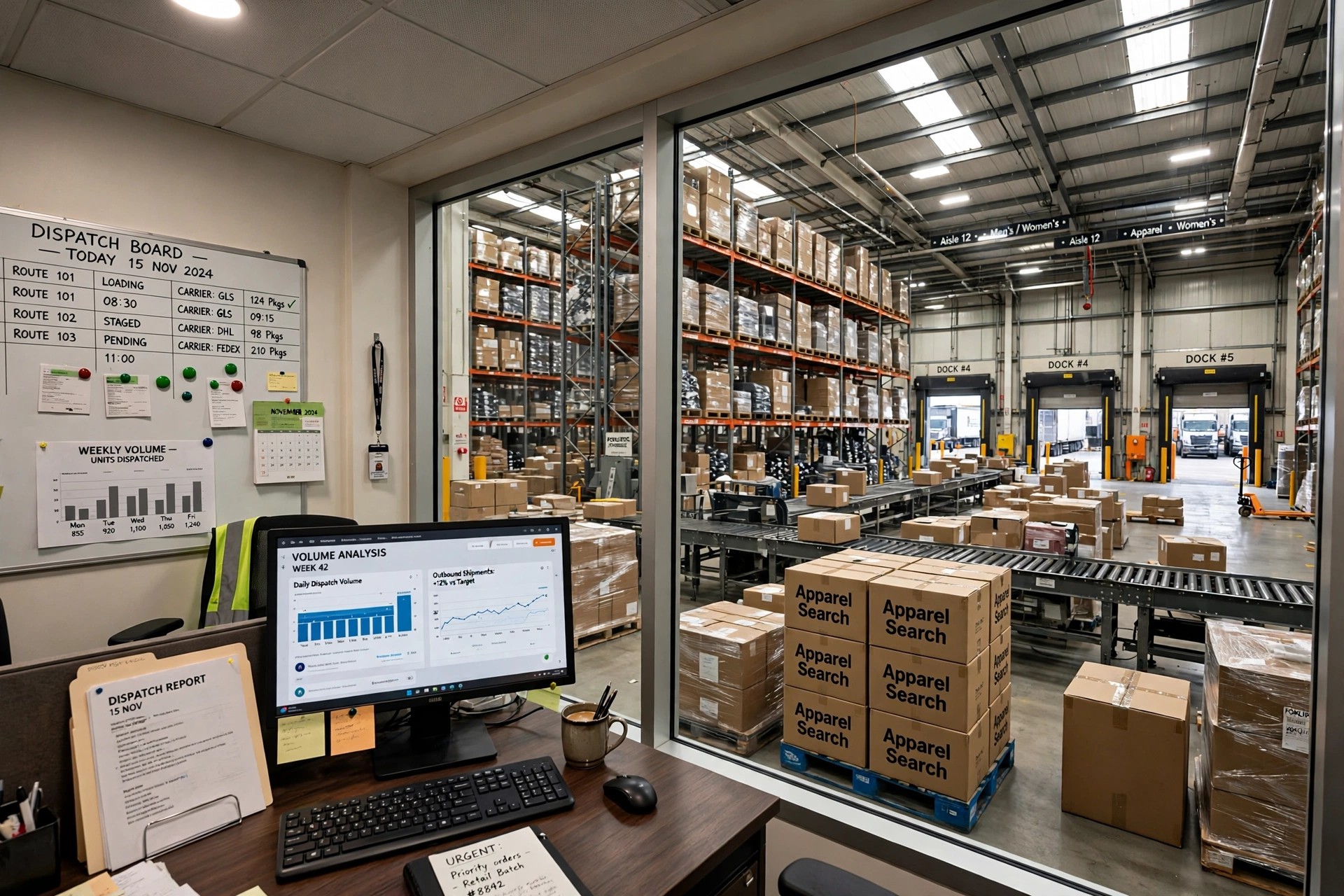
The manager is judged on a pair of numbers that pull against each other: service and cost. Service means the right garments reaching the right store or customer at the promised time, complete and in saleable condition; cost means the labour, space, equipment and transport consumed to do it. Every decision trades between them — an extra shift before a launch, a cheaper carrier with a slower transit, more stock held forward in the building — and the manager's skill is making those trades deliberately, with the figures in view, rather than discovering them in the month-end results.
Retailer and internal service agreements give the targets their shape: despatch accuracy, order turnaround, delivery windows, returns processing times. The manager builds the daily and weekly operating plans that meet them — wave structures, shift patterns, dock schedules — and reviews performance against them with the supervisors, acting on the causes of failure rather than the symptoms. A centre that only counts its mistakes repeats them; the manager's routines exist to find the torn label process, the badly slotted size range, the training gap behind the errors.
People, Shifts and Peak Seasons
Distribution is a people operation wearing a systems costume. The manager leads through supervisors and team leaders across shifts, sets staffing to a volume forecast that apparel makes unusually spiky, and plans the year's peaks — autumn intake, promotional surges, the holiday despatch mountain, January returns — months ahead: recruitment and training of temporary staff, extended hours, equipment servicing done before it is needed, carrier capacity booked while it still exists. Peak is where distribution managers earn their reputation, in both directions.
Between peaks, the work is development and discipline: supervisors coached to run their areas without escalation, cross-training so absence does not stop a function, safety standards enforced as a daily habit rather than a poster — housekeeping, equipment checks, pedestrian discipline in a building full of moving vehicles — and honest conversations about pace and accuracy with the individuals whose work the whole centre's numbers rest on. The assistant warehouse manager described under A in this category is the classic deputy inside this structure, and the manager develops exactly that bench deliberately.
Inventory Flow, Transport and Improvement
Stock is the manager's second balance sheet. Clothing arrives in size and colour depth and leaves the same way, and inventory accuracy at that variant level decides whether stores can sell and websites can promise. The manager owns the cycle-counting regime, the treatment of damaged and problem stock, the returns stream, and the end-of-season clearance of space for the next range — and works with buying and merchandising on the flow decisions that prevent the building drowning: delivery phasing, pre-packing and ticketing at source, direct-to-store shipments where they genuinely help.
Transport completes the role. The manager oversees outbound carrier performance and inbound scheduling, the routing of store deliveries, and the cost of the network's miles, and reviews whether the network itself still fits the business — volumes, store geography and online growth all move, and distribution that was right three years ago quietly taxes every order today. Continuous improvement is therefore structural, not decorative: layout, systems and methods are re-examined each season against the numbers the centre actually produced.
Skills, Qualifications and Career Path
Distribution managers are made on warehouse floors. The typical route runs through the operational grades — warehouse roles, supervision, the assistant and deputy management jobs — with a record of accuracy, safety and peak delivery, increasingly supported by logistics and supply chain qualifications and deep fluency in warehouse management systems and the data they produce. Financial competence is essential at this level: the manager builds and defends a budget, reads a cost-per-unit the way a merchant reads a margin, and makes investment cases for equipment and systems.
The role should not be confused with its neighbours in this directory. The distribution assistant under D is the entry-level support desk inside the operation this page's manager runs; the assistant warehouse manager under A is the deputy within a centre. The distribution manager carries the operation's full accountability — service, cost and people — and progresses from a single centre to multi-site and network leadership, head of distribution and wider supply chain direction.
Common Questions
What does a distribution manager do in apparel?
Runs a clothing distribution centre or network end to end: receiving, storage, picking and despatch to stores and online customers, transport, staffing and shifts, inventory accuracy and returns — accountable for both the service levels delivered and the cost of delivering them.
What qualifications and experience lead to distribution manager?
A floor-built operations record — warehouse and supervisory roles, deputy management, proven peak seasons — plus warehouse systems fluency and budget competence. Logistics and supply chain qualifications support the case, but employers weigh delivered operations most heavily.
How is a distribution manager different from an assistant warehouse manager?
The assistant warehouse manager deputises inside one building, running shifts and floor operations. The distribution manager owns the operation's results overall — budget, service agreements, staffing structure, transport and improvement — which may span more than the warehouse floor alone.
More to Explore
Distribution Resources
Transportation & Warehouse Directory Pages by Letter
References & Further Reading
More Job Description Categories
- Buying Job Descriptions
- Design Job Descriptions
- Marketing & PR Job Descriptions
- Miscellaneous Job Descriptions
- Planning & Allocation Job Descriptions
- Production & Sourcing Job Descriptions
- Sales & Selling Job Descriptions
- Transportation & Warehouse Job Descriptions (current)