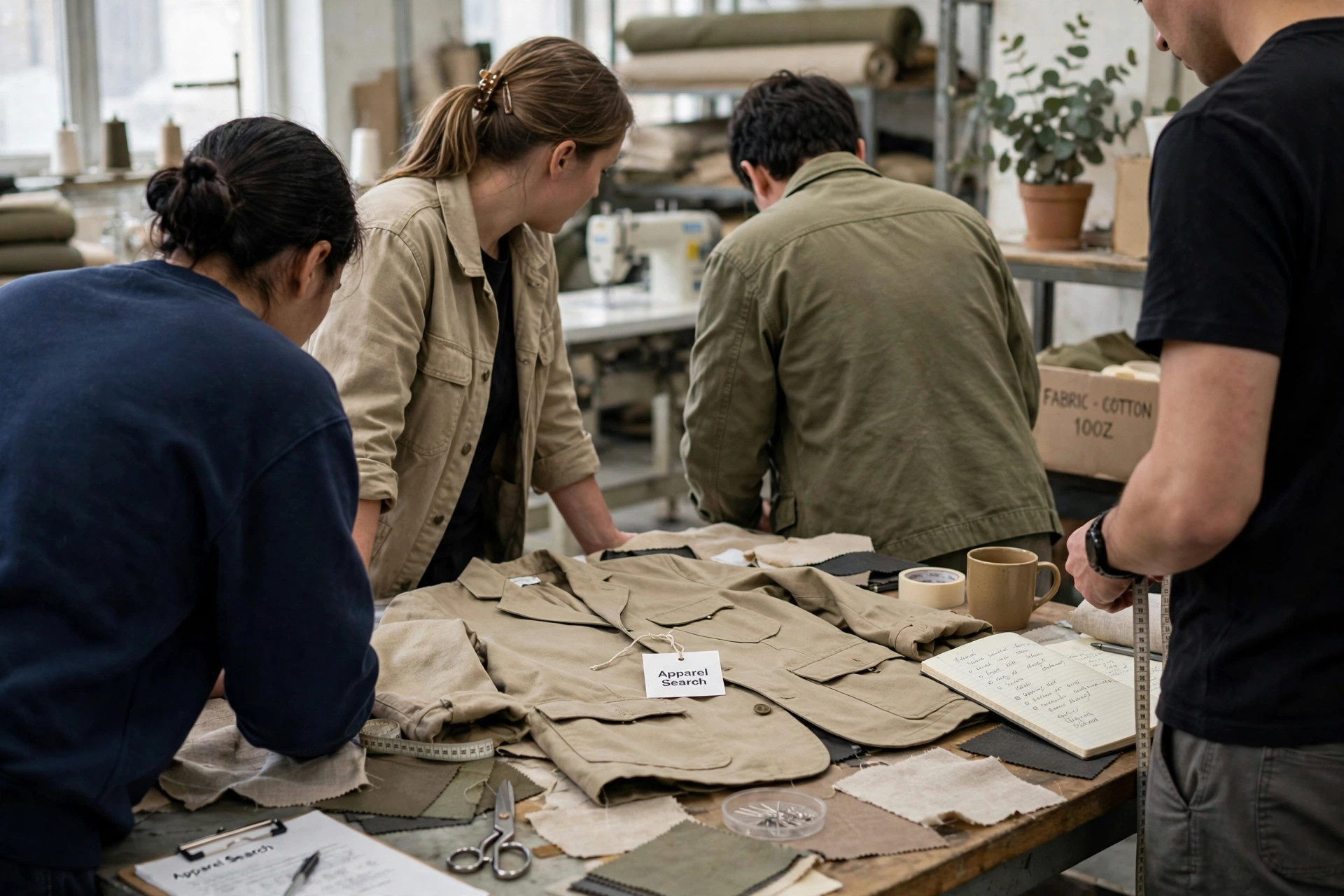
Collaboration between a fashion brand and a manufacturer is a working method, not a sentiment: the factory’s construction, costing and capacity knowledge enters product development while decisions can still change, instead of after the tech pack is final and every suggestion becomes a delay. In a pure ordering relationship the brand issues a purchase order and a specification, and the factory’s job is silent compliance. In a collaborative one, both sides share calendars, cost breakdowns, problems and post-season evidence, and the garment that results is measurably different — fewer sample rounds, fewer surprises in bulk, and costs engineered openly instead of argued over. This guide covers the method itself: how the two teams actually work together, week by week and season by season. None of it requires goodwill speeches; it requires shared documents, shared numbers and kept appointments.
Collaboration vs Ordering
The difference shows up in small, concrete behaviors. In an ordering relationship, the brand sends a finished tech pack, requests a price, approves samples by comment, and hears about problems when they are already late. The factory, given no context and no early sight of the product, protects itself the only way it can: conservative pricing, literal compliance with the specification even where the specification is wrong, and silence about risks it noticed but was never asked about. Neither side behaves badly; the structure produces the outcome.
Collaboration changes the structure at four points. The factory sees styles during development, not after. Calendars are built jointly, so dates reflect real capacity and real material lead times. Costs are worked through openly, line by line, so both sides engineer the same garment instead of negotiating blind. And problems are raised as shared work the moment they appear, with root-cause analysis replacing blame. The commercial framework that sits underneath a relationship like this — choosing the partner and the terms that govern it — is covered in manufacturing partnerships; what follows assumes that framework exists and deals only with the daily working method built on top of it. Everything in the sections that follow is observable in a single working week of a well-run program: who sees what, when it is seen, and what happens next.
Joint Product Development
Joint development means the factory’s technical knowledge is used while the product is still fluid. In practice the brand shares sketches, reference garments and draft specifications at proto stage, and the factory responds with construction input: a seam moved off a stress point, a cheaper operation that achieves the same look, a fabric whose behavior will fight the design, a trim that will not survive the wash standard. This is early supplier involvement, and its value is timing — the same suggestion costs nothing at proto stage, a pattern revision at fit stage, and a season at bulk stage.
What brands must share to get real input is equally concrete: the target retail and wholesale price, the intended fabric and its honest alternatives, the quality standard the garment will be inspected against, and the volumes realistically expected. A factory designing blind — no price target, no volume indication — can only guess, and its guesses protect its own risk. Run joint development as a rhythm, not an event: a standing development review, in person or by video, where new styles are walked through with the pattern and production staff who will actually make them, comments are recorded on the shared specification, and each side leaves with dated actions. Sample rounds typically fall from four or five to two or three when construction problems are designed out at this table instead of discovered sample by sample. Keep a simple log of factory suggestions and what each one saved or prevented; the log is evidence, visible to both sides, that early involvement pays, and it protects the practice when staff change on either side.
Shared Calendars and Planning
A shared calendar is a single critical path that both sides build and both sides can see: development milestones, material order and delivery dates, sample rounds, production slots and shipment dates, each with an owner and a date that was agreed rather than imposed. The discipline is in the building. The brand brings its fixed points — selling periods, delivery windows, approval turnaround it can genuinely staff — and the factory brings its real constraints: material lead times from its mills, line capacity by week, holiday closures, and the other commitments already booked against that capacity.
Forecast sharing is what makes the calendar more than a wish. Brands share rolling volume forecasts by category — updated monthly or quarterly, honestly labeled as forecasts rather than orders — and factories use them to reserve capacity, order long-lead materials and plan staffing. In return the factory shares its capacity picture: where the tight weeks are, which processes bottleneck first, and what a volume swing of 20 percent either way would do to dates. Both sides then manage changes against the shared document: a slipped fabric date moves the sewing slot visibly and immediately, and the conversation becomes how to recover the delivery, not whose fault the slip was. The week-to-week operating routine that runs inside this calendar is detailed in production management.
Open Costing Sessions
An open costing session works through one garment’s cost breakdown together, line by line, with both sides looking at the same numbers: fabric consumption and price, trims item by item, cutting and sewing minutes at an agreed minute rate, finishing, packing, overhead and margin. The session’s purpose is engineering, not haggling. With the breakdown visible, the productive questions appear: consumption drops if the marker is re-planned or the fabric width changes; sewing minutes fall if two operations combine or a construction simplifies without changing the look; a trim substitution saves real money here and nothing there.
Transparency has working rules that keep it honest on both sides. Figures are stated in the same format every time, so seasons compare cleanly. Each side may question any line, and the answer is evidence — a consumption figure from the marker, a minute count from a timed operation — rather than insistence. Savings found jointly are recorded against the style, and how they are shared is a relationship matter settled outside the session; inside it, the shared goal is a garment that hits its target price at the required quality, because a style costed above its market dies for both sides. Brands that open their target price at the start of the session get engineered solutions; brands that hide it get padded estimates, because the factory prices the uncertainty instead. Sessions work best on a garment both sides have in hand, with the marker plan and a timed operation list on the table; costing from a photograph produces theatre, not engineering.
Problem-Solving Protocols
Production problems are certain; the protocol decides whether they cost hours or weeks. A working protocol has four elements. Early surfacing: either side raises a problem the day it is seen — a fabric failing a wash test, a fit issue in the size set, a material date slipping — through one named contact on each side, in writing, with photographs or test evidence attached. Joint root cause: the two teams work the cause before the remedy, using a simple structured pass — what changed, where the specification, material, machine or method contributed — so the fix addresses the source rather than the symptom.
Agreed remedy and owner: the session ends with one corrective action, one owner and one date, recorded on the shared file for the style; parallel unilateral fixes are how two halves of a problem get solved twice and the middle not at all. No-surprise rule: a problem may be bad news, but it is never delivered late on purpose — both sides treat early bad news as professionalism and late bad news as the actual failure. Fit problems illustrate the method: instead of comment rounds traded by email, the brand’s technical lead and the factory’s pattern maker review the garment together, on a form or a fit model by video, agree the pattern correction once, and confirm it on one revised sample rather than three.
Shared Reviews and Improvement
Collaboration compounds through the post-season review: a structured session, held while the season’s evidence is fresh, where brand and factory examine the same record together. The shared KPIs are few and factual — sample approval rate and average rounds per style, on-time delivery against the shared calendar, final inspection results and defect rates by category, cost targets hit and missed. Neither side grades the other; both grade the season, including the brand’s own performance on approval turnaround, specification clarity and forecast accuracy, which factories experience as directly as brands experience late shipments.
The review’s output is a short list of experiments for next season, not a catalogue of complaints: trial a new construction on one style group, move a material decision two weeks earlier, test a revised size-set routine, adjust the shared specification format where comments repeatedly misunderstood it. Each experiment has an owner and a measure, and the next season’s review opens by checking them. Over several seasons this loop is what turns a supplier relationship into a capability: the factory learns the brand’s fit and quality expectations deeply enough to anticipate them, the brand learns the factory’s real strengths and plans product into them, and both sides spend their management time on the product instead of on the friction. The documents that carry this shared knowledge between seasons are managed as described in tech pack management. Start the loop with one season and one honest scorecard; the habit matters more than the format.
FAQs
- What is the practical difference between collaborating and just ordering?
- Ordering sends a finished specification one way and expects silent compliance. Collaboration brings the factory’s construction, costing and capacity knowledge into development while decisions can still change, shares calendars and cost breakdowns, and solves problems jointly — typically cutting sample rounds from four or five to two or three.
- What must a brand share for joint development to work?
- The target price, realistic volumes, the intended fabric and honest alternatives, and the quality standard the garment will be judged against. Without a price target and volume indication, the factory can only guess, and its guesses price in its own risk.
- How does an open costing session work?
- Both sides work through one cost breakdown together — fabric, trims, sewing minutes, finishing, overhead — questioning lines with evidence such as marker consumption and timed operations. The goal is engineering the garment to its target price, not haggling line by line.
- What should happen when a production problem appears?
- Surface it the same day, in writing, with evidence, to one named contact. Then work the root cause jointly, agree one corrective action with one owner and one date, and record it on the style file. Late bad news is treated as the failure, not the problem itself.
- What belongs in a post-season review with a factory?
- Shared factual measures: sample rounds and approval rates, on-time delivery against the joint calendar, inspection results and defect categories, and cost targets hit and missed — including the brand’s own approval turnaround and forecast accuracy. The output is a short list of owned experiments for next season.
More Supply Chain & Manufacturing Guides
This guide belongs to the Apparel Search production series. Browse the companion guides below, or start from the manufacturing guides hub.
Sourcing & Suppliers
- Fabric Sourcing Guide
- Sourcing Fabric at Trade Shows
- Trade Show Follow-Up
- Low-MOQ Clothing Manufacturers
- Factory Verification
- Supplier Verification
- Supplier Technical Evaluation
- The Global Apparel Supply Chain
Production & Factory Operations
- Production Management
- Sample Development Process
- Fabric Inventory Management
- Flexible Manufacturing Workforce
- Manufacturing From Synthetic Fabrics
- Garment Construction Techniques
- Textile Waste in Factories
Materials, Dyeing & Trims
- Fabric Dyeing Services
- Specialty Dyeing & Finishing
- Fabric Innovation
- Custom Trim Hardware
- Trim Development Management
- Smocking Techniques
Business & Retail
- Brand–Manufacturer Collaboration (this guide)
- Retail Technology
Search Apparel Search
Apparel Search: explore the manufacturing guides hub and production & sourcing resources for the fashion industry.