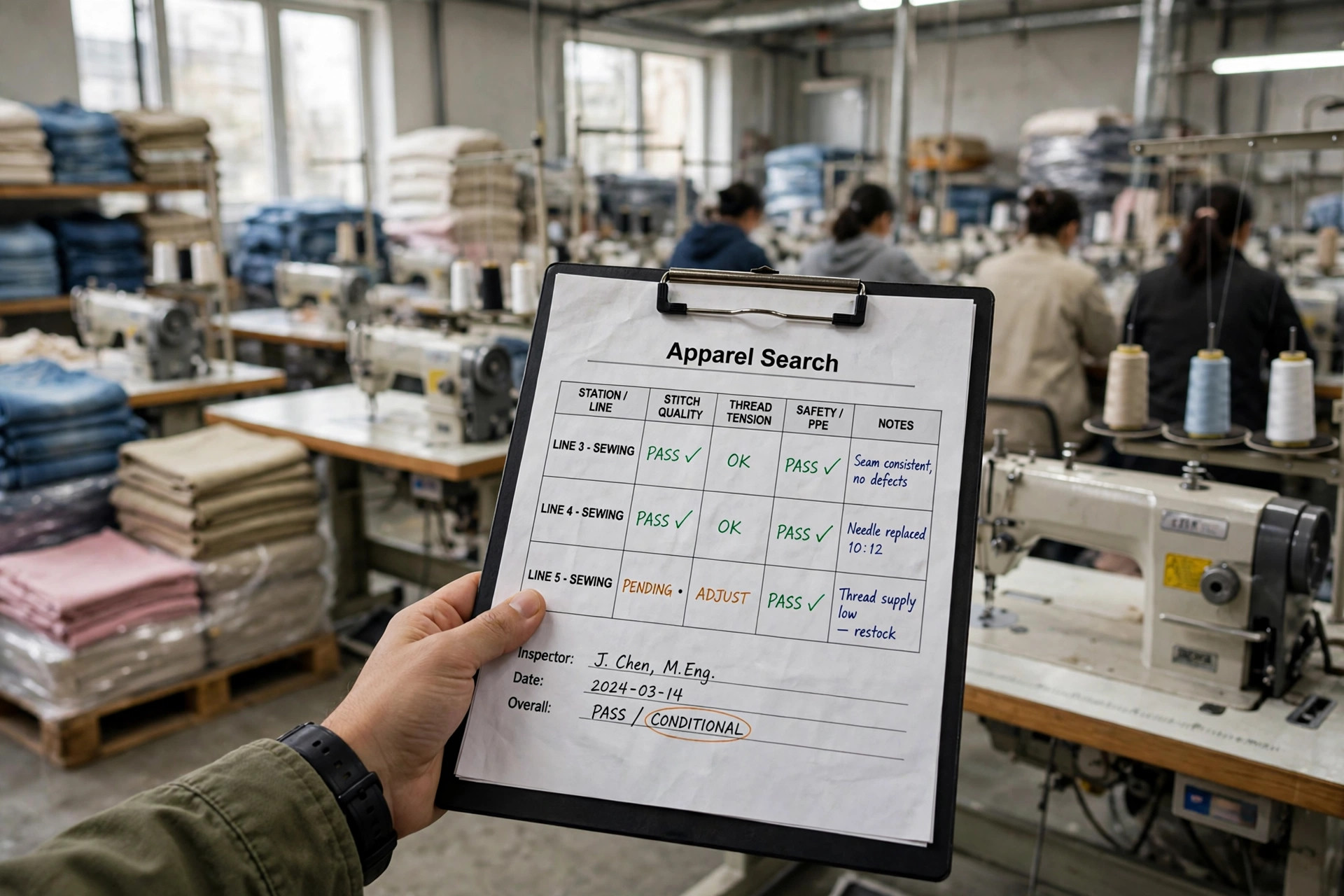
Supplier technical evaluation tests one question in depth: can this factory, mill, or workshop actually make your product, to your specification, at your volume, repeatedly? It sits after basic existence and document checks and before any serious order. Instead of impressions from a showroom visit, it collects measurable evidence — machine inventories, scored samples, defect records, and capacity figures checked against the work you really place. A supplier that passes is not guaranteed perfect, but a supplier that fails on machinery, skills, or quality systems will fail in bulk, where the same weaknesses cost a season instead of a sample. The evaluation is product-specific: approval for knit polos does not approve a supplier for tailored jackets, and the file should state plainly which product families the score covers, at what volumes, and when it expires. Treat it as a dated technical passport, renewed as equipment, staff, and product mix change on either side of the relationship.
What Technical Evaluation Measures
Technical evaluation covers four measurable families. Machinery: does the supplier own, on its own floor, the machines your product needs — not a borrowed list, but serial-plated equipment you can see running? Skills: can its operators and technicians execute your hardest operations, from tailored lapels to bonded seams, at production speed? Quality systems: are inspection, measurement, and rework organized processes with records, or good intentions? Capacity realism: does claimed monthly output match lines, operators, and working hours, with room for your orders alongside existing customers?
Each family is scored from evidence, not conversation. A claim of 50,000 units a month means little until line count, operators per line, and standard minutes per garment support it. This deep technical pass complements the broader supplier evaluation checklist, which weighs commercial, compliance, and service criteria alongside capability. Keep the two separate in your files: a supplier can be commercially attractive and technically wrong for a specific product, and mixing the scores hides exactly the risk this evaluation exists to expose.
Record the evaluation against your own product, not the supplier’s easiest work. Bring your operation breakdown, target volumes, quality level, and delivery pattern, and test claims against those numbers. A factory excellent at 500-unit fashion runs may be technically wrong for 50,000-unit basics, and the reverse is equally common in practice.
The Machinery and Process Audit
Walk the floor with your product’s operation list in hand and audit machine by machine. Record, for each operation, the machine type, quantity, age, and condition: lockstitch, overlock, coverstitch, bartack, buttonhole, fusing press, cutting equipment, and any specialized unit your category demands — seam-sealing for waterproofs, loopers for fine knits, pocket setters for denim. Two working machines and three awaiting repair is a capacity of two, whatever the inventory sheet says.
Maintenance signals tell the truth quickly. Look for oiled, clean machines with needles changed on schedule, spare-parts stock, a mechanic on staff or on call, and downtime logs. Ask how work flows: is cutting in-house or subcontracted, are patterns made by hand, CAD, or outside, and which processes leave the building? Subcontracted stages are not automatically disqualifying, but they must be declared, because your quality plan has to cover them. Photograph the floor with permission and date every record. A factory that has already passed factory verification for existence and identity still needs this audit: being real and being capable of your product are different tests, passed independently.
Note utilities and environment as well: power stability, lighting at inspection points, pressing and finishing capacity, and space to segregate your materials from other customers’ work. Crowded floors where bundles from three buyers share one table produce mix-ups that no later inspection fully catches, however carefully the final audit is run.
Evaluating Samples as Evidence
Samples are the strongest evidence a supplier can offer — if they are scored ruthlessly and the scoring is written down. Commission samples in your actual fabric or the closest available equivalent, because construction that works in a substitute cloth may fail in yours. Score each sample against a fixed sheet: construction (seam types as specified, stitch density, seam allowances), measurements (every point of measure against spec and tolerance), finishing (pressing, trimming, thread ends, cleanliness), and materials (correct trims, labels, and components).
Score each category 1 to 5 and record why any point was lost, with photographs of defects. A sample at 4 out of 5 with honest notes is worth more than a perfect-looking sample nobody examined. Watch how the supplier responds to corrections: a capable factory returns the next round with the listed faults fixed and no new ones introduced. Repeat faults, or faults that migrate around the garment, signal weak process control that bulk production will magnify. Keep scored samples and sheets in the supplier file; they become the baseline for trial orders and for the pre-production stage covered in the guide to pre-production samples.
Keep the physical samples, tagged with supplier, date, round, and score. When bulk later drifts, the scored evaluation sample is the reference that settles whether the factory fell below its proven standard or the brand’s expectation quietly rose. Without that retained evidence, every quality discussion becomes a contest of competing memories.
Quality Systems in Practice
Ask to see the quality system working, not described. A functioning system has defined checkpoints: fabric inspection on arrival, in-line inspection at set intervals during sewing, measurement audits of finished garments, and a final inspection before packing, each with a named person responsible. Ask what standard the final inspection follows — many factories work to an AQL sampling level such as 2.5 for major defects — and ask to see recent inspection reports, including failed ones. A factory that shows only perfect reports is showing you marketing, not records.
Defect handling reveals maturity. Where do defective units go, who decides rework versus reject, and are defect counts logged by type and operation so recurring faults get fixed at source? Check measuring tools: tapes, templates, light boxes for shade, and calibrated equipment where relevant. Check also how specifications are controlled on the line — is there a sealed reference sample and a current spec sheet at the workstation, or operators sewing from memory of the last order? Score what you observe. Strong quality systems are the best predictor that a good trial order becomes good bulk, order after order.
Also test traceability inside the system: pick one packed carton and ask the factory to show which line, which day, and which fabric lot produced it. Mature systems answer in minutes from records; immature ones reconstruct a plausible story. That single exercise often separates documented quality from performed quality faster than an hour of interviews.
The Scorecard
Bring the evidence together in a weighted scorecard so different evaluators, visiting different suppliers, produce comparable verdicts. Score each category 1 to 5, multiply by its weight, and total out of 100. A workable weighting for most garment categories:
- Machinery and process capability — 25 points: equipment match to your operations, condition, maintenance.
- Sample performance — 25 points: construction, measurement accuracy, finishing across rounds.
- Quality systems — 20 points: checkpoints, records, defect and rework control.
- Capacity and reliability — 15 points: realistic output, staffing depth, subcontracting transparency.
- Technical communication — 15 points: spec comprehension, comment response, problem reporting.
Set decision thresholds before you visit, not after: typically 80 and above approves for trial orders, 65 to 79 is conditional approval limited to simpler styles or smaller volumes with named weaknesses to re-check, and below 65 declines for this product family. Any single category scored at 1 — for example, no functioning final inspection — should cap the result at conditional regardless of the total. File the completed scorecard with the document checks from supplier verification so the supplier’s full onboarding record sits in one place.
Have two people score independently where possible, then reconcile any difference above one point on a category by re-examining the evidence together. Divergent scores usually mean one evaluator saw something the other missed — a repaired machine, an unrecorded subcontractor — and the reconciliation conversation is often the most informative part of the whole visit.
Trial Orders and Re-Evaluation
A trial order converts evaluation into proof. Design it deliberately: a real style, in real fabric, at a meaningful but survivable quantity — often 300 to 1,000 units, or roughly 10 to 20 percent of a normal order. Include the operations you most doubt, set a firm delivery date, and inspect the shipment as strictly as any bulk order, measuring a sample of garments against spec and logging every defect by type. Judge three things: quality against the scorecard’s predictions, delivery against the promise, and communication when problems appeared.
Passing a trial earns approved status for that product family only; a factory proven on woven shirts is not thereby proven on tailored jackets. Re-evaluate on a rhythm — annually for active suppliers, and immediately after ownership changes, major equipment or capacity changes, a failed bulk order, or a long gap since the last order. Re-evaluation can be lighter than the first pass: refresh the machine audit, score one current sample, review the year’s defect and delivery records, and update the scorecard. Suppliers that know capability is re-measured tend to keep it measured themselves, which is precisely the behavior the system is designed to reward.
Record trial results on the scorecard itself, adjusting the original predictions where production proved them optimistic or harsh. Over several suppliers, those adjustments calibrate the whole system: categories that repeatedly over-predict get more weight or harder evidence requirements, and the evaluation steadily becomes the reliable filter it was designed to be.
FAQs
- What is the difference between technical evaluation and supplier verification?
- Verification confirms a supplier is real and its documents and credentials are genuine. Technical evaluation confirms it can make your specific product to standard, using machinery audits, scored samples, quality-system checks, and a weighted scorecard. Both are needed, in that order. One without the other leaves a known gap in the onboarding record.
- What score should a supplier need to pass?
- On a 100-point weighted scorecard, 80 or above typically approves a supplier for trial orders, 65 to 79 gives conditional approval for simpler work, and below 65 declines. Set your thresholds before evaluating, and let any critical category scored at the minimum cap the result. Publish the scale internally so every supplier is judged identically.
- How many sample rounds should an evaluation include?
- Usually two to three rounds. The first shows current capability, the second shows whether listed corrections were actually made, and a third, if needed, confirms stability. Endless rounds without improvement are themselves a failing result worth recording. Rounds beyond that should trigger a decision, not another sample.
- Who should carry out a technical evaluation?
- Someone who knows garment construction and measurement: a technical designer, production manager, or an experienced third-party inspector briefed with your operation list and scoring sheet. Sales impressions alone are not an evaluation. A general manager’s tour commentary is no substitute for measurement and scoring.
- Does a passed evaluation guarantee good bulk production?
- No guarantee exists, but it removes the commonest causes of failure: missing machinery, unproven skills, absent quality systems, and unrealistic capacity. Trial orders and annual re-evaluation keep the prediction honest over time. Re-evaluation keeps that protection current as staff and equipment change.
More Supply Chain & Manufacturing Guides
This guide belongs to the Apparel Search production series. Browse the companion guides below, or start from the manufacturing guides hub.
Sourcing & Suppliers
- Fabric Sourcing Guide
- Sourcing Fabric at Trade Shows
- Trade Show Follow-Up
- Low-MOQ Clothing Manufacturers
- Factory Verification
- Supplier Verification
- Supplier Technical Evaluation (this guide)
- The Global Apparel Supply Chain
Production & Factory Operations
- Production Management
- Sample Development Process
- Fabric Inventory Management
- Flexible Manufacturing Workforce
- Manufacturing From Synthetic Fabrics
- Garment Construction Techniques
- Textile Waste in Factories
Materials, Dyeing & Trims
- Fabric Dyeing Services
- Specialty Dyeing & Finishing
- Fabric Innovation
- Custom Trim Hardware
- Trim Development Management
- Smocking Techniques
Business & Retail
Search Apparel Search
Apparel Search: explore the manufacturing guides hub and production & sourcing resources for the fashion industry.