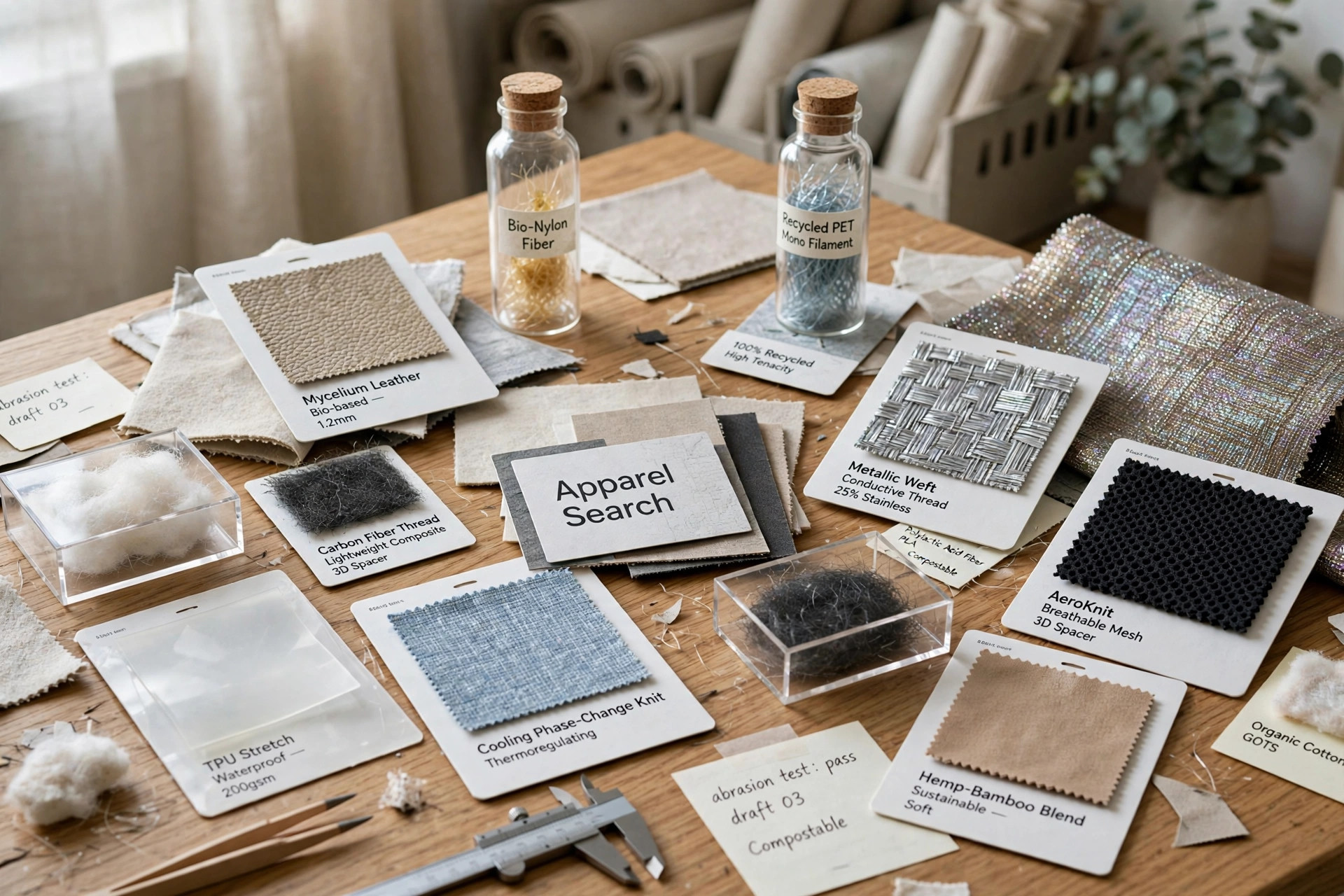
Fabric innovation is where new fibers, new chemistry, and new structures enter apparel: mushroom-based leather alternatives, yarns spun with algae, fabrics that warm, cool, or sense the wearer. For a brand, the landscape is exciting and noisy in equal measure — every season brings launches announced as revolutions, most of which will never reach a second production run. The buyer’s job is not to predict which technologies win, but to evaluate each one at the stage it has actually reached: what it is made of, what it does in testing, what it costs at real minimums, and what happens to a product line if the supplier behind it disappears. Innovation bought on that discipline adds genuine difference to a range; innovation bought on press releases adds cost, delay, and claims that cannot be substantiated.
The Main Innovation Fronts
Four fronts account for most current fabric innovation. Next-generation fibers replace conventional feedstocks: regenerated cellulosics made from recycled pulp, recycled and bio-attributed synthetics, and fibers grown rather than synthesized. Bio-based materials build sheet goods and yarns from biological inputs — fungal mycelium, algae, fruit waste, bacterial cellulose — aiming mainly at leather and coated-fabric territory. Recycled inputs keep moving up the quality ladder, from bottle-derived polyester toward fiber-to-fiber recycling of blended garments, the industry’s hardest material problem. Functional chemistry innovates at the finish and fiber level: phase-change temperature regulation, durable odor control, and finishes that deliver performance without the chemistries now being regulated away.
Two honest observations organize the map. First, innovation concentrates where the pain is: leather’s footprint, polyester’s fossil origin, cotton’s water, and the unrecyclability of blends attract the money because they are the industry’s largest material flows. Second, most launches are material innovations sold to an industry that buys fabrics — a novel fiber still has to be spun, woven or knitted, dyed with existing dye classes, cut, and sewn on existing lines before it is a product. The fronts that respect that chain commercialize; the ones that require the chain to rebuild around them mostly do not. A working rule for buyers: an innovation is only as real as the fabric data sheet behind it — construction, weight, width, test results, and a price at a stated minimum.
Bio-Based and Next-Gen Materials
The bio-based family is the most publicized and the least mature. Mycelium materials grow fungal root networks into sheets finished to resemble leather; the best have reached capsule collections with major brands, at prices and volumes far from commodity leather. Algae enters as yarn components, foams, and pigments rather than whole fabrics. Bio-based polyurethane substitutes part of the fossil content in coatings and synthetic leathers with plant-derived feedstock — a percentage improvement in a familiar material, which is precisely why it scales more easily than wholly new substances. Plant-waste materials from pineapple leaf fiber, apple pomace, and cactus blend biological content with synthetic binders in varying proportions.
Readiness must be stated plainly, because the gap between a runway sample and a supply chain is where brands get hurt. Most bio-based sheet materials today sit at pilot to early-commercial stage: limited widths, limited colors, minimums that suit capsules rather than core lines, prices several times the conventional equivalent, and durability data measured in seasons rather than decades. That is not a reason to ignore them — capsule programs, statement pieces, and brand collaborations are legitimate uses at exactly this stage. It is a reason to write purchase commitments sized to pilot reality, to test wear independently rather than trusting supplier data sheets, and to check what a material actually contains before repeating its marketing: several ‘plant-based leathers’ are majority polyurethane, which changes both the claim and the end-of-life story. Ask for the percentage of biological content and the identity of the remainder on every bio-based quote; the answer separates material innovation from material marketing in one line.
Functional and Smart Textiles
Functional innovation works today at production scale, and its claims can be tested. Phase-change materials absorb and release heat as microencapsulated waxes melt and solidify near skin temperature, buffering temperature swings in base layers and workwear; the effect is real, modest, and exhaustible within a wear cycle — a buffer, not air conditioning. Heated textiles integrate conductive yarns or printed elements with battery packs, delivering genuine warmth in gloves, jackets, and medical garments at the cost of weight, wash restrictions, and electronics in the returns stream. Conductive and sensor textiles measure heart rate, muscle activity, and movement in sports and clinical garments, where the textile is the comfortable part and the electronics module does the computing.
The evaluation questions are unglamorous and decisive. Does the function survive washing — and for how many cycles, tested how? What fails first, the textile or the technology? Can the garment be repaired, and who services the electronics? Is the benefit one the wearer can feel in a single use, or only in a laboratory average? Smart textiles genuinely work in defined niches — monitored rehabilitation, elite sport, heated workwear — and disappoint when sold as general magic. A brand’s credibility survives saying exactly where a function works; it does not survive a season of returns from customers promised more. Pilot any smart textile with the returns process designed first: who tests a returned heated jacket, and who pays when the textile is fine and the battery is dead?
How Mills Develop and Launch New Fabrics
Understanding how mills launch fabrics explains most innovation outcomes. A mill’s development cycle runs from fiber sourcing through spinning, construction trials, dyeing and finishing trials, and testing, typically across two to four seasons before a fabric is offered commercially. At launch, the mill protects its investment with exclusivity windows: a developing brand or a launch customer may hold a fabric, a color range, or a territory exclusively for a season or two, in exchange for volume commitments. Brands should ask directly what is exclusive, for how long, and what the fabric becomes when the window closes — the answer decides whether an innovation can anchor a multi-season program.
The mortality factor in fabric innovation is cost. A new fabric must clear the mill’s existing range on some combination of performance, story, and price, while being dyed, finished, and sewn with the industry’s installed equipment. Innovations die when the cost premium exceeds what the end product can carry — a fiber at three times the price must win a garment whose fabric cost is a small share of its retail price, or a luxury garment where material cost is the point. They also die quietly at the dye stage: a fiber that no standard dye class colors evenly is a laboratory success and a commercial orphan. Sourcing conversations about new fabrics belong with mills’ development calendars, which the global fabric sourcing guide maps by region and specialty. Brands that join a mill’s development calendar early — commenting on trial fabrics two seasons out — see innovations while exclusivity is still available, rather than at launch when it is priced.
Evaluating a New Fabric Like a Buyer
Evaluate a new fabric the way a buyer evaluates any fabric — with a test battery, not a story. Hand and drape first, judged against the garment the fabric must become. Then the measurable battery: durability (abrasion resistance and tensile and tear strength against the conventional fabric it would replace), wash behavior (dimensional change, appearance after repeated laundering, and whether any claimed function survives it), pilling grade after standard testing, and colorfastness to washing, rubbing, light, and perspiration in the shades you will actually buy. An innovation that wins on one axis and fails two basics is a sample-room fabric, however good its press.
Then the commercial battery, which kills more candidates than the laboratory does. What is the MOQ per color, and is it a pilot minimum or a production one? What is the lead time, and does it fit your calendar with the fabric’s own trial rounds included? What is the cost at your real volumes — not the launch quote — and what premium must the finished garment carry? Who else buys this fabric, and what happens to your program if the supplier pivots or closes, as young material companies regularly do? Finally, can your existing factories cut and sew it, or does the fabric demand new equipment and skills? A fabric that passes the laboratory battery and the commercial battery has earned a capsule. Scale follows evidence, in that order. Keep the trial small and the records complete: a failed capsule with full test data is a cheap education, while a failed core line is a season.
Claims Discipline
Innovation attracts claims, and claims are regulated. A fabric described as recycled, bio-based, biodegradable, or carbon-neutral carries a substantiation duty: what percentage, measured how, certified by whom, and biodegradable where — industrial composting and a home wardrobe are different planets. The discipline is documentary. Percentages come from transaction certificates and chain-of-custody records, not brochures; certification claims are checked against the certifier’s own records, because certificates expire, get scoped to other products, and are occasionally borrowed. The checking method is the one set out in the supplier verification guide: verify the document with its issuer, match its scope to the material in front of you, and file the evidence.
Two habits protect a brand. First, write claims at the strength the evidence supports: ‘made with 62 percent recycled content, certified’ survives scrutiny that ‘eco fabric’ does not, and regulators in the US, EU, and UK now pursue vague environmental claims as a category. Second, keep the innovation claim and the sustainability program separate in your own management: an innovative fabric inside an otherwise conventional program is a product story, while program-level commitments belong to the discipline covered in the sustainable apparel manufacturing guide. Single-material stories also have their own depth — the hemp clothing fabric guide follows one fiber completely — and a brand that can show that level of evidence for its headline materials rarely has to argue about the rest. File the evidence with the style record, so the claim printed on the hangtag can be re-proven at any point in the garment’s selling life.
FAQs
- What counts as a fabric innovation?
- Any fiber, material, structure, or finish that changes what a fabric is made from or what it does: next-generation and bio-based fibers, fiber-to-fiber recycled inputs, phase-change and conductive textiles. A new color or weave pattern on a conventional fabric is design, not material innovation.
- Are bio-based leather alternatives ready for core product lines?
- Mostly not yet. Mycelium and plant-waste materials are at pilot to early-commercial stage: limited widths and colors, capsule-scale volumes, and prices well above conventional leather. They suit statement pieces and collaborations now; core lines should wait for durability data and production capacity to mature.
- How should a brand test a new fabric before committing?
- Run the standard battery against the fabric it would replace: abrasion, strength, wash shrinkage and appearance, pilling, and colorfastness in the actual shades. Then the commercial battery: MOQ, lead time, cost at real volumes, supplier stability, and whether your factories can cut and sew it.
- Why do most new fabrics fail commercially?
- Cost and compatibility. A fabric costing several times the conventional equivalent must fit a garment that can carry the premium, and it must dye, finish, cut, and sew on the industry’s existing equipment. Fibers no standard dye class colors evenly die at the dye stage, whatever their laboratory promise.
- How can a brand verify an innovation claim?
- Document by document: percentages from chain-of-custody transaction certificates, certifications checked with the issuing body for scope and expiry, and performance from independent test reports. Write the consumer claim at exactly the strength the evidence supports — vague green claims are now a regulatory target.
More Supply Chain & Manufacturing Guides
This guide belongs to the Apparel Search production series. Browse the companion guides below, or start from the manufacturing guides hub.
Sourcing & Suppliers
- Fabric Sourcing Guide
- Sourcing Fabric at Trade Shows
- Trade Show Follow-Up
- Low-MOQ Clothing Manufacturers
- Factory Verification
- Supplier Verification
- Supplier Technical Evaluation
- The Global Apparel Supply Chain
Production & Factory Operations
- Production Management
- Sample Development Process
- Fabric Inventory Management
- Flexible Manufacturing Workforce
- Manufacturing From Synthetic Fabrics
- Garment Construction Techniques
- Textile Waste in Factories
Materials, Dyeing & Trims
- Fabric Dyeing Services
- Specialty Dyeing & Finishing
- Fabric Innovation (this guide)
- Custom Trim Hardware
- Trim Development Management
- Smocking Techniques
Business & Retail
Search Apparel Search
Apparel Search: explore the manufacturing guides hub and production & sourcing resources for the fashion industry.