Garment production management is the week-to-week operating routine that turns placed orders into shipped garments: tracking work in progress, running the production meeting, clearing bottlenecks in the right order, communicating with factories under change control, and protecting ship dates when reality pushes against them. It is unglamorous, repetitive, and decisive — the difference between brands whose deliveries drift and brands whose deliveries land is usually this routine, run consistently, rather than any single brilliant decision. It applies equally inside a brand’s production office and on the factory floor, because both sides run the same orders — and most delivery failures happen in the handover between them, where each side assumed the other was watching a date, a delivery of cloth, or an unanswered approval sitting in an inbox. What follows is the routine itself, as practiced on both the brand side and the factory floor.
The Production Manager’s Week
A managed week has a fixed rhythm. Monday: order review. Every open order is checked against its critical path — fabric status, trim status, approvals outstanding, sewing start date — and flagged green, amber, or red. Midweek: WIP check and factory calls, working the amber and red list in priority order. Friday: shipment review, confirming what actually shipped, what slipped, and what next week’s shipments require to stay on date. Approvals, lab dips, and sample comments are batched into the rhythm rather than handled as interruptions, because a comment sent two days late moves a sewing start by two days, every time.
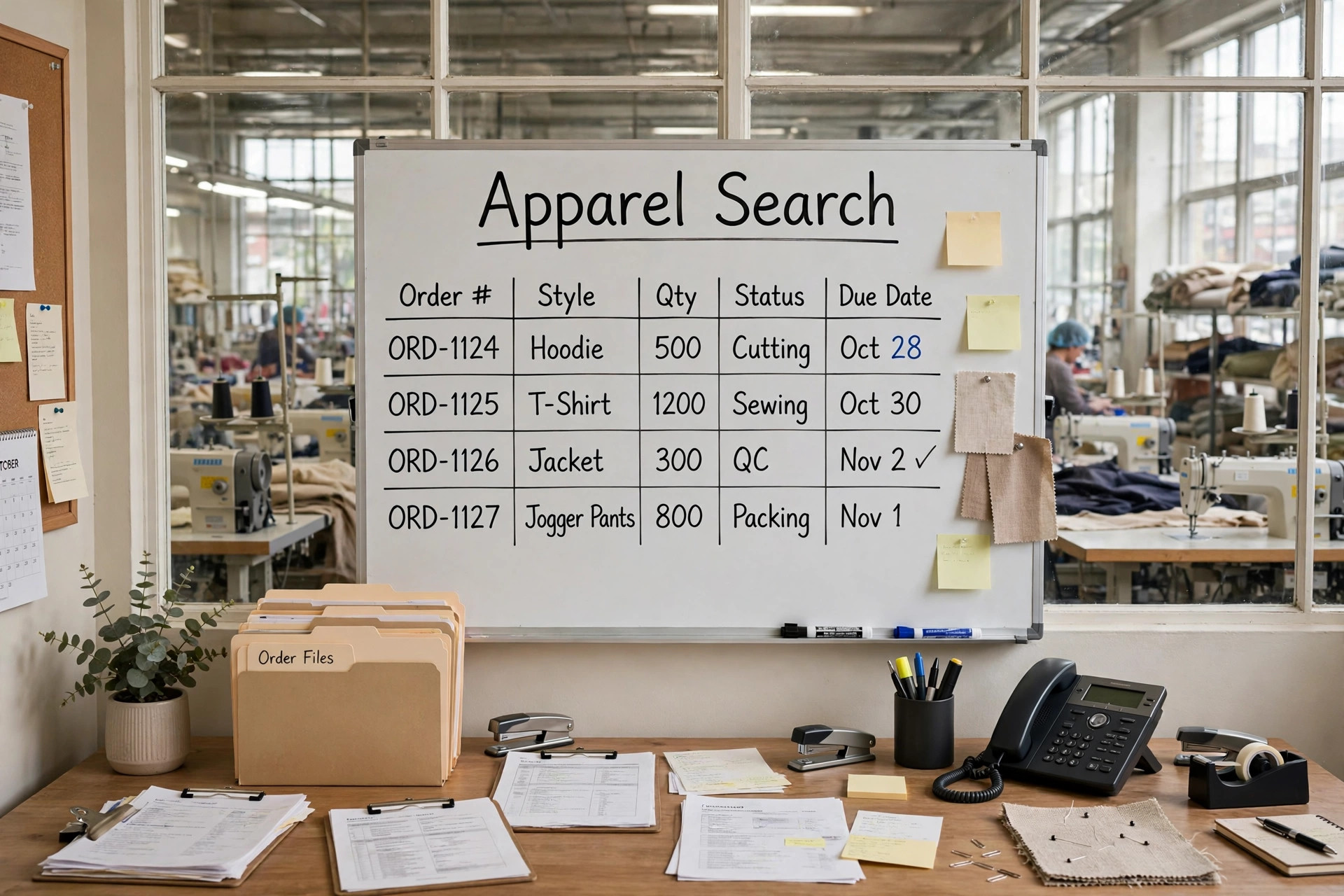
The rhythm matters more than its exact shape. Factories plan around customers who ask the same questions on the same days: predictable attention gets honest answers and early warnings, while sporadic attention gets reassurance. Keep one master order list as the single source of truth — style, quantities, ex-factory date, status, next action, owner — and let every meeting, call, and report work from it. When the list and the factory’s list disagree, reconciling them is the first job, not an administrative detail.
Protect the rhythm from the calendar’s noise: sample emergencies and management requests enter through the order list, ranked against ship dates, rather than displacing the checks. A week in which the WIP review was skipped for urgent tasks is reliably followed, two or three weeks later, by surprises that the review existed to catch.
Working With WIP
WIP — work in progress — is the state of every order between fabric arrival and packing, and managing it means knowing real quantities at real stages: fabric received and inspected, panels cut, bundles in sewing (and at which operation), garments in finishing, units packed. The numbers that matter are input versus output per stage and days of work queued at each stage. A line that received 5,000 cut units and has finished 1,200 in a week is telling you its true rate, whatever the plan said.
Stalled orders show a signature: WIP stops moving between stages while reported progress stays vague. Ask for stage quantities, not percentages — “60 percent complete” is unfalsifiable, while “2,800 of 4,000 sewn, 900 in finishing” can be checked next week against movement. Compare this week’s numbers with last week’s: no movement in cutting means a material or marker problem; movement in sewing but none in finishing means a bottleneck downstream. The software options for capturing this data are covered in the guide to production tracking systems; the discipline of asking, recording, and comparing is the management part, and it works with a spreadsheet or a notebook.
Photograph WIP when visiting: bundle counts, packed cartons, and the cutting table tell the same story as the numbers and settle later disagreements about what was true on a given date. Pair every WIP report with one forward question — what finishes this week, and what could stop it — so reporting turns into early warning.
Running the Production Meeting
The weekly production meeting exists to make decisions, not to read reports aloud. Circulate the order list beforehand and run a tight agenda: orders at risk first, in ship-date order, each with the specific blocker and the decision needed; material readiness for orders due to cut in the next two weeks; capacity conflicts, where two orders want the same line, fabric, or approval slot; and decisions logged — every item leaves with an owner, an action, and a date, recorded in the meeting note and reviewed at the start of the next meeting.
Keep it to the people who can decide: production, sourcing or buying, technical, and logistics as needed. Forty-five focused minutes weekly beats a two-hour monthly post-mortem, because most production problems are cheap in week one and expensive in week four. Separate the meeting’s two tempers: fact-finding on status, which should be blunt and number-based, and problem-solving on blockers, which should generate options before blame. A meeting that punishes bad news soon stops receiving it — and a production manager without bad news is managing blind.
Publish the decision log where factories can see their own actions confirmed; a factory that reads its commitments back, with dates, treats them as binding. Keep a parking list for strategic topics — new capacity, price reviews — so they get their own meeting instead of inflating the weekly one beyond usefulness.
Bottlenecks and Firefighting
The choke points repeat across factories and seasons. Fabric delays head the list: late, short, or off-shade fabric stops cutting entirely. Trim delays are crueler — garments fully sewn but unshippable for want of buttons, zippers, or labels. Line imbalance slows sewing when one operation cannot keep pace and bundles pile up in front of it. Approval queues on the brand’s own desk — unreturned comments, unsigned standards — stall factories as surely as any machine breakdown, and are the bottleneck least often admitted.
Escalate in order. First, confirm the facts: what exactly is short, late, or blocked, and since when? Second, work the local fix: resequence orders, split the style, move a trim by courier, authorize an alternate approved component. Third, involve the factory’s management with a specific request and deadline, not a general complaint. Fourth, protect the ship date commercially: partial shipment, style substitution, or a renegotiated date agreed before it is missed. Firefighting that jumps straight to pressure skips the fixes that actually work. The line-level methods behind imbalance are covered in the guide to manufacturing efficiency.
Keep a short escalation ladder written down, with names: merchandiser, factory manager, owner, agent principal. Everyone should know which rung a problem has reached and what response time each rung owes. Problems escalated by shouting reach the top rung emotionally and the bottom rung practically, which is why ladders exist.
Communication Protocols With Factories
Most production confusion is communication failure wearing a disguise. Run factories on clear protocols. Single point of contact on each side for each order, so instructions never arrive from three people with three versions. Written confirmation of every agreement: dates, quantities, prices, and changes confirmed by email the same day, however friendly the call. Change control: any change to spec, quantity, or date after order confirmation goes through one numbered change note, acknowledged by the factory before it acts — verbal changes are how two versions of a garment get made.
Set response expectations explicitly: routine queries answered within one working day, problems reported when found, not when solved. Ask factories directly what format they want data in — a clean order sheet beats a forwarded email chain — and mirror their discipline back. Keep the full correspondence for an order in one file, so any colleague can reconstruct what was agreed without archaeology. When a dispute arises, the file settles it: the brand and factory that can both produce the same written record rarely stay in dispute for long.
Agree a small shared vocabulary for status — cut, in-line, in-finishing, packed, shipped — with definitions both sides use identically. Half of all “communication problems” in production are two parties using the same word for different stages, each honestly reporting a different reality.
Delivery Management
Ship dates are protected by buffers placed where risk actually lives. Build the calendar backwards from the required delivery: freight time, consolidation and customs, packing and final inspection, sewing, cutting, and material arrival — then put explicit buffer days before the two least controllable events, usually fabric arrival and vessel departure. A plan with no buffer is not optimistic; it is a promise that nothing will go wrong anywhere in three countries.
When slippage comes anyway, decide with numbers. Split shipments — sea-shipping the balance while air-freighting enough units to cover launches or key accounts — often rescue a season at a fraction of full air cost. Air freight itself is justified by margin at risk, not by embarrassment: compare the freight premium against the gross margin of the goods and any late-delivery penalties. Agree in the order terms, in advance, who pays for air freight caused by factory delay, mill delay, or brand-side changes; deciding liability mid-crisis poisons the relationship and the schedule alike. Finally, close every order with a short review — planned versus actual at each stage — feeding the next season’s buffers. That review loop, plus the approval discipline in the guide to pre-production samples, is where delivery performance actually improves.
Finally, communicate slippage to sales and retail the moment it is probable, not the day it is certain. Early bad news can be merchandised around; late bad news becomes empty rails and cancelled orders. Production management’s real product, in the end, is reliable information as much as shipped garments.
FAQs
- What is WIP in garment production?
- Work in progress: the quantities of an order at each production stage — fabric received, panels cut, units in sewing, in finishing, and packed. Managing WIP means tracking real stage quantities weekly and comparing movement week to week, which exposes stalled orders early. Percentages alone hide stalls; stage quantities expose them.
- How often should production status be checked?
- Weekly as a minimum rhythm: an order review, a midweek WIP check with factory calls, and a shipment review. Orders flagged at risk, or inside four weeks of shipping, usually need twice-weekly contact until they are back on plan. The agenda matters less than never skipping the rhythm.
- What belongs on a production meeting agenda?
- Orders at risk in ship-date order with their specific blockers, material readiness for orders cutting in the next two weeks, capacity conflicts, and a review of decisions logged at the previous meeting. Every item leaves with an owner, an action, and a date. Status reporting without decisions is correspondence, not management.
- When is air freight worth paying for?
- When the margin and penalties at risk exceed the freight premium. Often a split shipment — air-freighting launch quantities and sea-shipping the balance — rescues the season for far less. Agree in advance who pays when delay is caused by the factory, the mill, or the brand.
- What is the most common cause of late garment deliveries?
- Material problems: fabric arriving late, short, or off-shade, and trims missing at finishing. Approval delays on the brand’s own desk rank close behind. Both are visible weeks ahead in a disciplined WIP and readiness check, which is why both belong on the weekly readiness list.
More Supply Chain & Manufacturing Guides
This guide belongs to the Apparel Search production series. Browse the companion guides below, or start from the manufacturing guides hub.
Sourcing & Suppliers
- Fabric Sourcing Guide
- Sourcing Fabric at Trade Shows
- Trade Show Follow-Up
- Low-MOQ Clothing Manufacturers
- Factory Verification
- Supplier Verification
- Supplier Technical Evaluation
- The Global Apparel Supply Chain
Production & Factory Operations
- Production Management (this guide)
- Sample Development Process
- Fabric Inventory Management
- Flexible Manufacturing Workforce
- Manufacturing From Synthetic Fabrics
- Garment Construction Techniques
- Textile Waste in Factories
Materials, Dyeing & Trims
- Fabric Dyeing Services
- Specialty Dyeing & Finishing
- Fabric Innovation
- Custom Trim Hardware
- Trim Development Management
- Smocking Techniques
Business & Retail
Search Apparel Search
Apparel Search: explore the manufacturing guides hub and production & sourcing resources for the fashion industry.