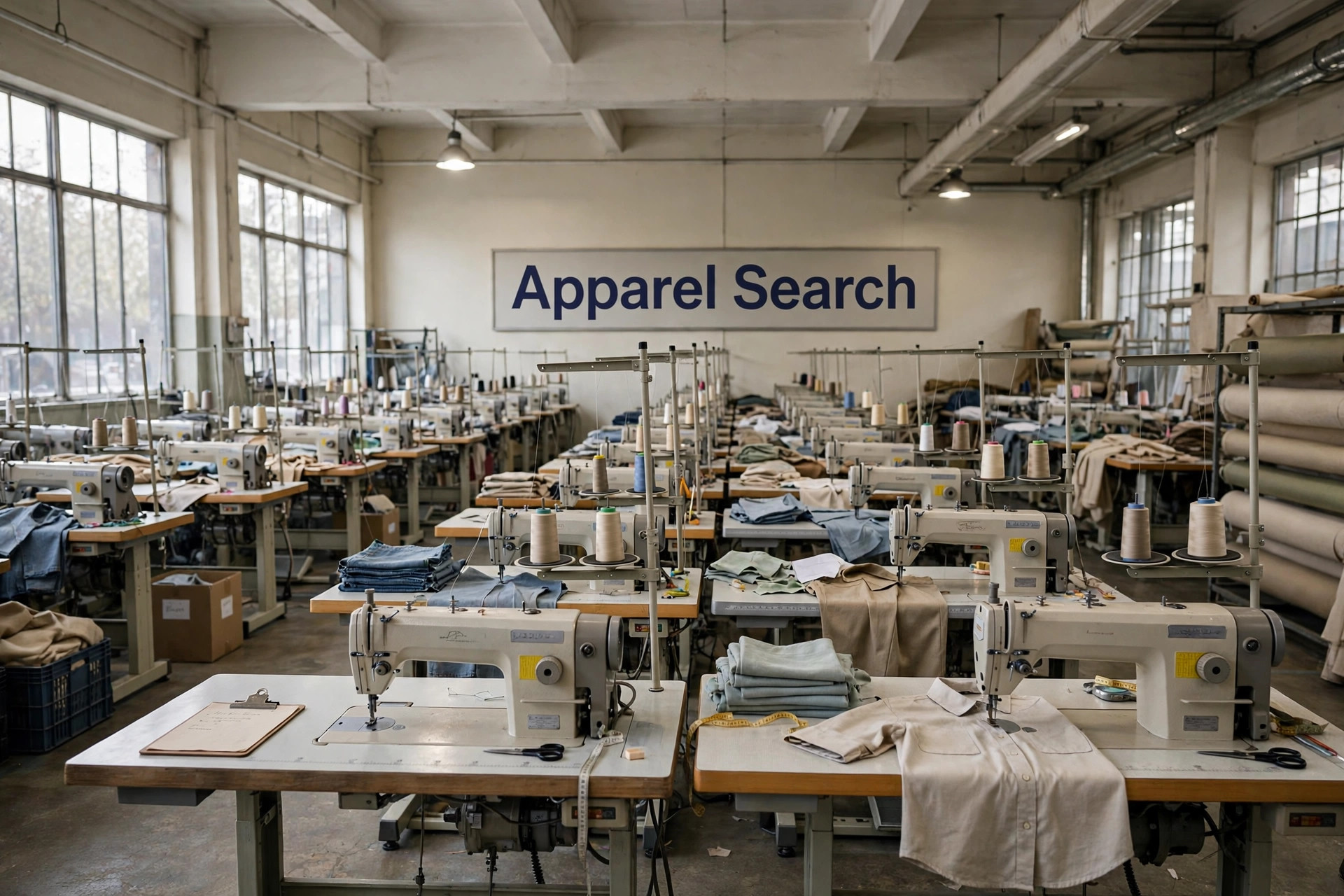
Factory verification is the set of checks that establishes three facts before you commit money: the factory exists, it is the business it claims to be, and the production capacity described in emails is physically there. It sits before sampling in the sourcing sequence because sampling with a phantom factory, a trading company posing as a factory, or a workshop with a quarter of the claimed capacity wastes the whole development budget. Verification is not distrust — legitimate factories pass these checks routinely and expect professional buyers to run them. The steps below move from free desk checks to remote verification, on-site visits, and third-party audits. Run in this order, the checks cost a few days and almost no money; skipped, the same discoveries arrive later in far more expensive forms — lost deposits, subcontracted production discovered at inspection, and seasons missed while a dispute is argued across time zones with a counterparty who may not legally exist.
Why Verification Comes Before Sampling
Verification prevents a specific, expensive set of failures. Phantom factories — a website, a rented office, no production at all — collect deposits and disappear or broker your order to an unknown workshop. Trading-company misrepresentation is subtler: an agent presents a partner factory’s photos and capacity as its own, so your quality agreements, prices, and delivery promises rest on a business you have never actually contracted with. Bait-and-switch capacity happens when a real factory shows its best line and full order book, then subcontracts your production to a cheaper unit you never saw. Each failure mode is cheap to detect before sampling and nearly impossible to fix after a deposit.
Sequence the work: desk checks first (hours, free), remote verification second (days, near-free), and a visit or audit before the first significant order. Verification also protects the factory’s side of the relationship — a buyer who verifies carefully is a buyer who pays carefully and specifies clearly, which good factories prefer. The companion guide to supplier verification covers the document-and-certificate side of due diligence for all supplier types; this guide concentrates on the physical factory: its existence, premises, machines, and production reality. Verification also scales: the depth of checking should rise with the size of the first order and the distance involved, but no first order, however small or urgent, should skip the desk checks entirely — they are the cheapest hour in the whole sourcing process.
Desk Checks: Documents and Registration
Start with paper, because inconsistencies in paper predict problems in production. Request: the business license or registration, showing the legal company name, registered address, legal representative, and scope of business; the export license if the factory will ship directly to you, or a clear statement of which export agent it uses; and bank details on company letterhead. Then cross-check the set for consistency. The company name on the license, the name on the bank account, the name on the quotation, and the name on the contract must be the same legal entity. The registered address should match the factory address you are given for visits and audits; a prestigious office-district address for a “factory” is a trading-company signal.
Run the free external checks as well. Search the company name with terms like “scam” and “complaint”; check the business on map and street-view services where coverage exists to confirm an industrial building at the stated address; verify the license number through the issuing country’s company registry where public lookup is available; and confirm the website domain age and contact details line up with the trading history claimed. None of these checks alone proves anything. Together they build a consistency picture, and fraud almost always cracks somewhere in the picture — a two-year-old company claiming fifteen years of exports, a license whose scope excludes garment manufacturing, a bank account in a different province or a personal name.
Remote Verification
When a visit is not yet justified, remote verification closes most of the remaining gap. The core tool is a live video walk-through, scheduled at short notice during working hours — short notice matters, because a staged tour needs preparation time. Direct the walk yourself rather than watching a prepared route: ask the camera to enter from the street sign and gate, pass through fabric storage, stop at the cutting tables, walk two sewing lines slowly, show finishing and packing, and pause on request at specific machines. Ask to see work in progress with current orders’ labels, the machine types your product needs (overlocks, coverstitch, buttonhole and bartack stations for most knit and woven programs), and a named machine counted aloud — “show me the third overlock on this line” is a request a borrowed video cannot satisfy.
Support the call with date-stamped photographs: request photos of specified areas holding a card with today’s date and your company name, a standard anti-recycling measure. Cross-check identity details: the person on the call should be the person on the business card and email signature; utility or premises documents, where a factory will share them, tie the legal entity to the physical site. Record what you saw in a short verification note with dates and screenshots. Remote verification cannot judge workmanship or atmosphere, but it reliably answers the existence and capacity questions, which are the questions this stage exists to answer. Keep the video appointment inside normal production hours and ask to see the shift actually working; a factory that can only show itself empty at midday has answered a question it was not asked.
The On-Site Visit
A visit converts verification from evidence to direct observation, and it follows a route. Fabric and trim warehouse: is stock organized, labeled, and shade-grouped, with current materials for current orders? Cutting: how many tables, manual or machine cutting, are markers and lay plans in use? Sewing lines: count the machines and operators actually working, note the machine mix against your product’s operations, and look at garments mid-production for the quality level the factory ships when nobody visits. Finishing: thread trimming, pressing, needle detection, folding and packing — the section where careless factories are most visible. Warehouse and dispatch: finished cartons labeled and staged by customer show an order book that is real.
Count things; impressions lie and counts do not. A factory claiming 200 machines that shows 60 working has a subcontracting habit you have now priced into your decision. Look at worker-conditions signals with the same directness: lighting and ventilation, machine guards and needle policies, fire exits unblocked, posted working hours, and whether the floor feels orderly at production pace rather than arranged for you. Ask to meet the production manager and the person who will run your order, and ask each the same question about current lead times; divergent answers locate the truth somewhere between. Write the visit report the same day, with counts and photographs, while discrepancies are still checkable.
Red Flags and Green Flags
Patterns repeat often enough to list. Treat the two columns as a scoring aid, not a verdict — any single flag has innocent explanations, but clusters demand answers before money moves.
- Red flag: refuses or endlessly postpones a live video walk-through.
- Red flag: prices 30–40 percent below every comparable quote with no cost explanation.
- Red flag: payment requested to a personal account, or an account name that does not match the license.
- Red flag: no current production visible; spotless lines and borrowed-looking showroom samples.
- Red flag: pressure for a large deposit before documents are supplied.
- Green flag: clean, consistent documents produced quickly and without argument.
- Green flag: real production on the floor, in your category, at the claimed scale.
- Green flag: direct answers on capacity limits, including what the factory does badly.
- Green flag: existing export customers, verifiable references, and accurate paperwork on a trial order.
Score a new factory against the wider criteria in the supplier evaluation checklist once verification is passed; verification establishes truth, evaluation establishes fit. Revisit the flag list after any trial order as well: a factory that argued over a documented red flag during verification usually argues again over a documented quality failure during production, and that pattern belongs in the supplier record where future buyers will see it.
Third-Party Audits and Re-Verification
When order value is significant, distance is great, or internal travel is impractical, commission a third-party factory audit from an inspection company. A standard audit verifies legal documents, walks and counts production areas, reviews quality systems and records, and reports with photographs. Typical pricing runs from a few hundred dollars per man-day depending on country and scope — small money against a first order, and routinely cheaper than one flight. Specify the audit scope in writing: existence and capacity verification, quality-system review, or social-compliance elements, since each is a different product. Read the report’s evidence, not just its summary grade, and follow up discrepancies directly with the factory.
Verification is not a one-time gate. Re-verify when: ownership or the legal entity changes; the factory moves premises or reports a major capacity expansion; bank details change (treat every bank-detail change as a fraud risk until independently confirmed by voice with a known contact); quality or delivery collapses without explanation; or two to three years have passed since the last check. The deeper capability assessment that follows verification — whether this factory can make your product to standard, scored systematically — is the subject of the supplier technical evaluation guide. Verification tells you the factory is real; evaluation tells you it is right. File every audit report and re-verification note with the original desk checks, so the factory’s record shows a continuous history rather than a single snapshot taken before the first order.
FAQs
- What is the difference between factory verification and an audit?
- Verification is the buyer’s own existence-and-identity check: documents, video walk-through, or a visit. An audit is a formal, often third-party assessment against a defined scope, which may include quality systems and compliance. Verification can be done by the buyer alone with documents and a video call; an audit produces a formal report that a third party stands behind.
- How do I verify a factory I cannot visit?
- Run desk checks on the license and bank details, then a live video walk-through you direct at short notice, plus date-stamped photos of named areas. Commission a third-party audit before the first large order. Each method answers the existence and capacity questions; none of them replaces sampling and trial orders for judging workmanship.
- What is the biggest single red flag?
- Payment details that do not match the legal entity on the business license — especially a request to pay a personal account. Legitimate factories invoice and receive payment as the licensed company. A close second is refusal of a live video walk-through, which removes the cheapest existence check a remote buyer has.
- Should the bank account name match the factory license?
- Yes. The account name, license name, quotation, and contract should all be the same legal entity. Any mismatch needs a documented explanation and independent confirmation before payment. Where an agent legitimately collects payment on a factory’s behalf, the agency agreement should be produced and filed with the verification records.
- How often should a factory be re-verified?
- Every two to three years at minimum, and immediately on triggers: ownership or address change, changed bank details, sudden capacity claims, or an unexplained collapse in quality or delivery. Keep every re-verification dated in the factory file, so the next check starts from evidence rather than from memory.
More Supply Chain & Manufacturing Guides
This guide belongs to the Apparel Search production series. Browse the companion guides below, or start from the manufacturing guides hub.
Sourcing & Suppliers
- Fabric Sourcing Guide
- Sourcing Fabric at Trade Shows
- Trade Show Follow-Up
- Low-MOQ Clothing Manufacturers
- Factory Verification (this guide)
- Supplier Verification
- Supplier Technical Evaluation
- The Global Apparel Supply Chain
Production & Factory Operations
- Production Management
- Sample Development Process
- Fabric Inventory Management
- Flexible Manufacturing Workforce
- Manufacturing From Synthetic Fabrics
- Garment Construction Techniques
- Textile Waste in Factories
Materials, Dyeing & Trims
- Fabric Dyeing Services
- Specialty Dyeing & Finishing
- Fabric Innovation
- Custom Trim Hardware
- Trim Development Management
- Smocking Techniques
Business & Retail
Search Apparel Search
Apparel Search: explore the manufacturing guides hub and production & sourcing resources for the fashion industry.