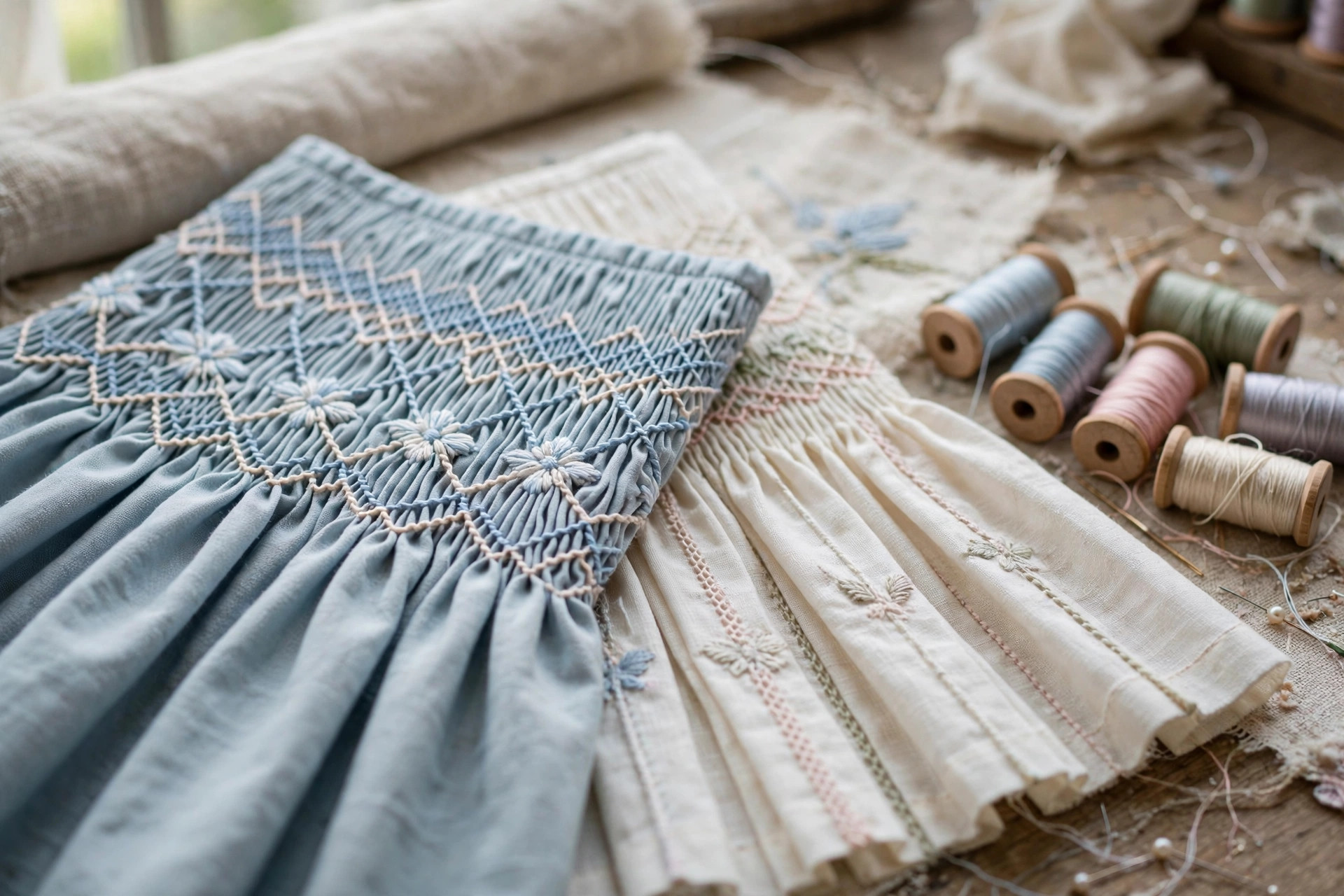
Smocking is the technique of gathering fabric into regular pleats and holding them with decorative stitching, so a flat width of cloth becomes an elastic, textured panel. In production, smocking is a manufacturing discipline with its own preparation machinery, stitch repertoire, quality points, and cost structure — concentrated in children’s wear, dresses, blouses, cuffs, and yokes, where it does two jobs at once: it decorates, and it builds controlled stretch into a woven garment with no elastane. A smocked panel fits a growing child, shapes a bodice without darts, and lets a cuff grip a wrist — all from thread tension and pleats. Brands sourcing smocked garments are buying hand skill organized at scale, and the buying goes better when the buyer understands how the panel is made, where it can go wrong, and why it costs what it costs.
What Smocking Does
Smocking works because pleats are stored width. A panel gathered into pleats and stitched at intervals can stretch sideways as the stitching flexes, then recover as the pleats close — elastic behavior from a fabric that has none. That function explains its classic placements. On children’s dresses, a smocked bodice fits across growth spurts and hand-me-down siblings, expanding through a season or two of wear. On dresses and blouses, smocking shapes the bust and waist without darts or elastic channels, and releases into fullness below the panel. On cuffs and yokes, it gathers wide fabric into a narrow band with the decoration built into the gathering itself.
The decorative half of the technique is the stitch pattern worked across the pleats: rows of embroidery that lock the pleats at chosen points, forming cables, waves, and diamonds on the surface while the pleats behind them supply the stretch. Function and decoration are the same stitches — a purely decorative version that stitches pleats rigid loses the elasticity that justifies the technique, and production smocking is always judged on both: does the panel look right, and does it still stretch and recover evenly across its full width? That dual test runs through every quality check in the sections that follow, and it distinguishes production smocking from surface embroidery applied to flat cloth, a different operation covered among the wider garment construction techniques. The panel’s width at rest, its width at full stretch, and its recovery are therefore style specifications, quoted on the order the way chest measurements are quoted for any other garment.
Preparing the Fabric
Smocking begins before any decorative stitch, with pleating: forming the even, parallel gathers the stitches will cross. Three preparation methods serve different volumes. Transfer dots — a printed or iron-on grid of dots on the fabric — guide hand gathering: running threads are sewn along each dot row and drawn up into pleats, the oldest method and still the route for fine hand work. Pleater machines feed fabric through geared rollers fitted with needles that pick up a thread row per pleat in one pass, pleating a panel in minutes; most commercial hand-smocking workshops pleat by machine and stitch by hand. Gathering by machine stitch — long-stitch rows pulled up, or shirring elastic — imitates the look for lower price points without true pleat structure.
The governing number is the gathering ratio: smocking consumes roughly 2.5 to 3 times the finished panel width in flat fabric, depending on fabric weight and pleat depth. A bodice finishing at 30 cm starts as 75 to 90 cm of pleated cloth. Patterns, fabric orders, and costings that use finished width understate consumption by nearly two-thirds — the single most common costing error in smocked styles. Fabric choice interacts with preparation: light to medium plain-weave cottons, lawns, and voiles pleat crisply and hold stitches; checks and stripes are traditional favorites because the pattern makes pleat evenness visible at a glance, which helps the smocker and the inspector alike. Panels are usually pleated in multiples and separated after stitching, which keeps pleating setup costs down on small children’s sizes.
The Core Stitches in Production
Four stitch families form the production repertoire, worked in rows across the pleats with embroidery thread. The cable stitch is the foundation: a horizontal stitch that alternates above and below each pleat, producing the rope-like rows that frame most designs and control the panel’s basic elasticity. The wave stitch travels diagonally up and down across pleats, creating zigzag bands that add vertical interest and firmer control. The diamond or trellis stitch combines diagonal journeys in both directions, crossing to form diamond lattices — the classic bodice pattern, often with small motifs worked inside the diamonds. Honeycomb stitch is worked largely from the back, joining pleats in pairs so the surface shows a textured, elastic honeycomb with minimal visible thread; it maximizes stretch and suits panels where function leads.
In production these stitches are specified as a pattern chart: the sequence of rows, the stitch type per row, the thread colors, and the number of pleats each motif spans. Smockers work to the chart the way knitters work to a pattern, counting pleats rather than measuring distances, which is why pleat count — not centimeters — is the unit of a smocking specification. A design is sampled, counted, and charted once; bulk panels then repeat the chart. Errors in the chart repeat identically on every panel, so chart approval on a finished, washed, stretched panel is the critical sign-off of the whole style. Thread is specified as firmly as stitch: stranded cotton embroidery floss is traditional, with the number of strands per stitch recorded on the chart because it changes the pattern’s weight and coverage.
Hand vs Machine Smocking
Three production routes deliver a smocked look, at three different points of cost and quality. Hand smocking — machine- or hand-pleated fabric stitched by a skilled worker following a chart — produces the genuine article: stitches with slight organic life, full elasticity, and pattern detail limited only by time. A single children’s bodice panel can take a skilled smocker several hours; hand smocking is priced accordingly and survives commercially in premium children’s wear, occasion dresses, and heritage brands. Machine smocking uses dedicated machines that stitch pleated fabric in repeated patterns at production speed: consistent, far cheaper, and limited to simpler, more geometric designs with a more mechanical regularity.
Embroidery-machine imitation is the third route: a multi-head embroidery machine stitches a smocking-style pattern onto fabric that has been gathered, or onto flat fabric treated to suggest pleats. At a distance the look is close; in the hand, the panel lacks true pleat elasticity, because the gathering is fixed or illusory. The honest comparison a buyer makes is cost per function: if the garment needs the stretch — a growing child’s bodice — only true smocking, hand or machine, delivers it. If the garment needs the look on a fixed panel, imitation serves at a fraction of the price. Trouble comes from buying one and selling it as the other; the stretch test exposes it in seconds, and customers perform it instinctively. Samples settle the route before costing does: stitch the same design by hand and by machine, stretch both, wash both, and let the product’s price point choose with the evidence in hand.
Smocking in Bulk Production
Smocked garments are built around the panel, and the first production decision is sequence: smock-then-cut or cut-then-smock. In smock-then-cut, a rectangular panel is pleated and stitched, then the garment piece is cut from the finished panel — efficient for simple shapes, with waste where the pattern curves. In cut-then-smock, the piece is cut oversize to the gathering ratio, pleated, smocked, and then trimmed or eased to final shape; bodices and yokes with shaped edges usually need this route. Either way, the panel is a semi-finished component with its own production line: pleating, stitching, pressing flat at the edges for seaming, and only then joining to the rest of the garment.
Quality control concentrates on four points. Pleat evenness: pleats of equal depth across the panel, checked against checks or stripes where the fabric shows them. Stitch consistency: rows level, tension even, chart followed — a drifting row is visible across a whole bodice. Elastic recovery: the panel stretched to a specified extension and released must return to its finished width within tolerance, evenly, with no dead zones where stitching has locked the pleats. Edge security: pleat threads and row ends locked so the first wash does not loosen the panel’s borders. Panels failing recovery or evenness are rejected before garment assembly — a smocked panel cannot be unpicked and redone economically, which makes in-process checking during stitching, not final inspection, the real quality gate. Panels are counted and bundled by size before they leave the smocking unit, because a panel stretched or shrunk out of its size band cannot be corrected at the sewing line.
Costing and Sourcing Smocked Garments
Smocking’s cost structure explains its geography. The dominant cost is skilled hand time, so hand smocking concentrates where that skill is both deep and economically priced: Madagascar, the Philippines, India, and Vietnam all carry long traditions of hand-smocked children’s wear production, often organized through workshops that pleat centrally and distribute stitching to trained home-based workers, collecting and checking panels at each stage. The tradition is generational — smockers trained by smockers — which is why new regions cannot be spun up in a season, and why established smocking suppliers hold their position for decades.
Price drivers, in order: stitching time (pattern density and panel size — a full honeycomb bodice costs multiples of a three-row cable design), fabric consumption at the 2.5 to 3 times gathering ratio, preparation route (machine pleating is standard; hand gathering adds time), and checking overhead, since every panel is individually inspected. Sampling timelines run longer than for plain garments: the pattern chart must be developed, counted, stitched, washed, and stretch-tested before a costing is real, so allow two to three sample rounds where a simple style needs one. Buyers new to smocking should cost from a finished approved panel, never from a photograph — two panels that photograph alike can differ by hours of stitching, and the difference is the price. Long relationships matter here more than in most categories: a workshop that knows a brand’s charts, threads, and standards removes a full sample round from every repeat style.
FAQs
- How much fabric does smocking take?
- Plan on 2.5 to 3 times the finished panel width in flat fabric, depending on fabric weight and pleat depth. A bodice finishing at 30 cm starts as 75–90 cm of cloth. Costings based on finished width understate fabric consumption by nearly two-thirds — the most common smocking costing error.
- What is the difference between hand and machine smocking?
- Hand smocking stitches pleated fabric by hand to a pattern chart: full elasticity, fine detail, hours per panel, premium prices. Machine smocking stitches repeated geometric patterns at production speed for a fraction of the cost. Embroidery-machine imitation copies the look without true pleat stretch.
- Which fabrics smock best?
- Light to medium plain-weave fabrics: cotton lawn, voile, batiste, and fine poplin pleat crisply and hold stitches well. Checks and stripes are traditional because the pattern exposes uneven pleats instantly. Heavy fabrics resist fine pleating; very slippery fabrics need careful preparation to hold pleat rows.
- Why do smocked garments cost more than plain ones?
- Skilled hand time dominates: a single bodice panel can take hours of stitching, on top of fabric consumption nearly triple the finished width and individual inspection of every panel. Pattern density is the biggest lever — a full honeycomb design costs multiples of a simple cable-row panel.
- How is smocking quality checked?
- On four points: pleat evenness across the panel, stitch consistency against the pattern chart, elastic recovery — the panel stretched to a set extension must return evenly to finished width — and edge security. Because a panel cannot be unpicked economically, checking happens during stitching, not only at final inspection.
More Supply Chain & Manufacturing Guides
This guide belongs to the Apparel Search production series. Browse the companion guides below, or start from the manufacturing guides hub.
Sourcing & Suppliers
- Fabric Sourcing Guide
- Sourcing Fabric at Trade Shows
- Trade Show Follow-Up
- Low-MOQ Clothing Manufacturers
- Factory Verification
- Supplier Verification
- Supplier Technical Evaluation
- The Global Apparel Supply Chain
Production & Factory Operations
- Production Management
- Sample Development Process
- Fabric Inventory Management
- Flexible Manufacturing Workforce
- Manufacturing From Synthetic Fabrics
- Garment Construction Techniques
- Textile Waste in Factories
Materials, Dyeing & Trims
- Fabric Dyeing Services
- Specialty Dyeing & Finishing
- Fabric Innovation
- Custom Trim Hardware
- Trim Development Management
- Smocking Techniques (this guide)
Business & Retail
Search Apparel Search
Apparel Search: explore the manufacturing guides hub and production & sourcing resources for the fashion industry.