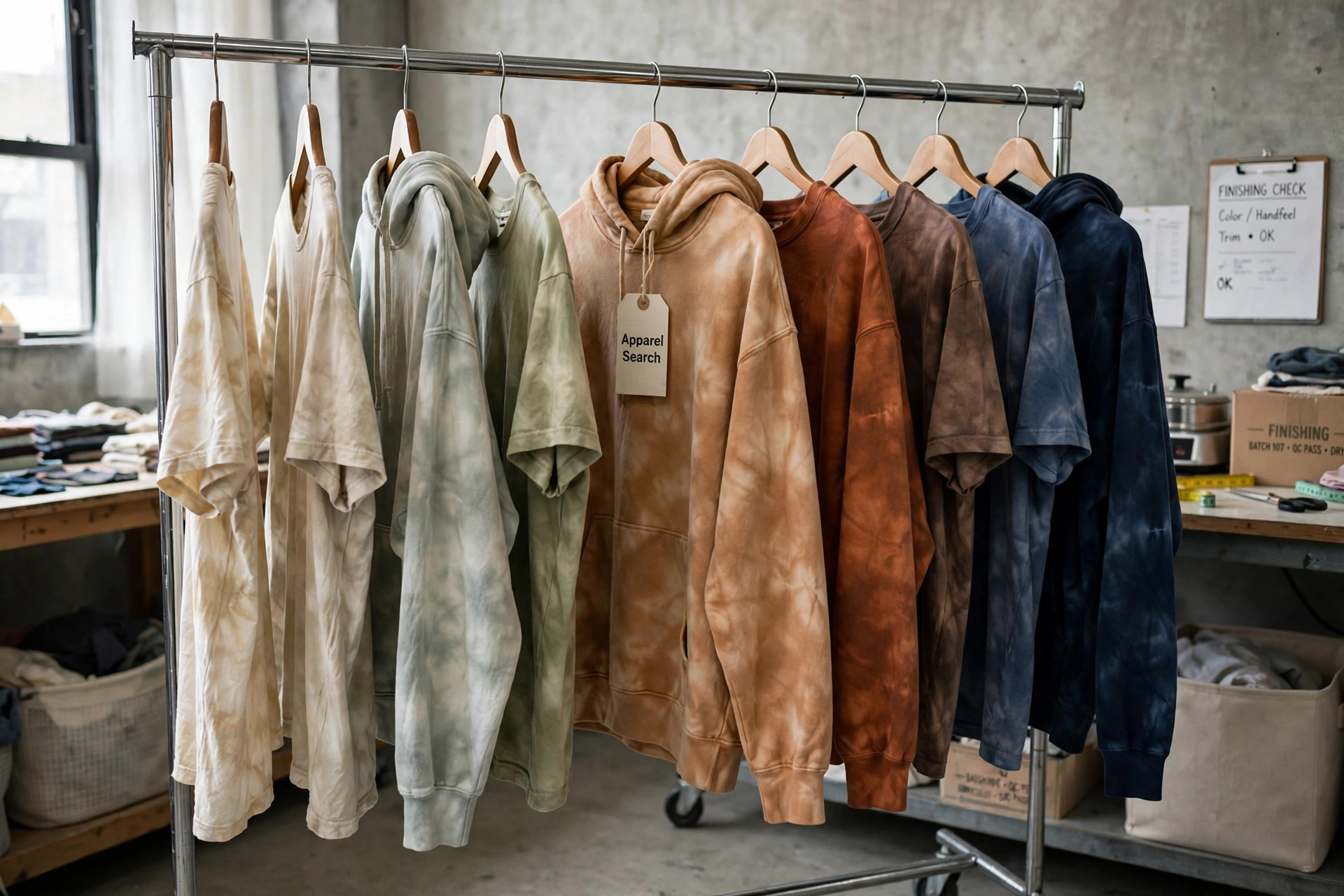
Specialty dyeing and finishing is where standard color becomes character: garments washed down to vintage softness, patterns that bleed from dark to light, finishes that repel water or resist odor. These effects sit on top of ordinary dyeing and finishing — a garment is first made and colored by conventional means, then given its effect — and they share one trait that defines how they must be bought: variation. A standard dye lot is judged on how little it varies; a specialty effect is judged on whether it varies in the right way, within limits a buyer approved in advance. Brands that treat effects like standard shades reject good production; brands that approve no limits accept anything. The repertoire — what the main effects are, how they behave, and how to sample them — is the working knowledge in between. None of these effects is exotic; all of them are routine production somewhere, bought well or badly.
Garment Dye Effects
Standard production dyes fabric, then cuts and sews it. Garment dyeing reverses the order: garments are sewn from undyed, prepared-for-dye fabric and dyed as finished pieces. The result reads differently in ways customers can see and feel. Dye takes unevenly across a garment’s components — seams, stitching, and thicker areas shade slightly deeper, cotton sewing thread may dye differently from the shell, and the whole garment carries the soft, lived-in tonal variation of a favorite old shirt rather than the flat uniformity of piece-dyed cloth. Sizing also moves: garments shrink in the dye bath, so patterns are cut oversize by a shrinkage allowance proven in trials, typically a few percent in each dimension.
Pigment garment dyeing pushes the effect further. Pigment sits on the fiber surface rather than bonding inside it, so the color is deliberately unstable: it fades at seams, edges, and abrasion points with every wash, producing the vintage, sun-worn tones of washed casualwear. The pigment dyeing guide covers that process in depth. The production consequences to plan for are common to all garment dyeing: components must be dye-compatible (a polyester zipper tape in a cotton garment stays white), elastane and trims must survive the bath, and every size shrinks from its own cut dimensions, so grading is proven on dyed size sets, not calculated once on paper. Because the whole garment is dyed at once, garment dyeing also forgives mixed fabric lots that would shade differently if piece-dyed — one reason converters use it to unify fabric bought from several mills.
Pattern Effects
Pattern effects put the design in the dye itself. Tie-dye binds, folds, or clamps fabric or garments so dye reaches some areas and not others; every piece is unique, and the production skill lies in making the uniqueness consistent — same fold geometry, same dye sequence, same proportions of color — across thousands of pieces. Dip dye immerses part of a garment to a measured depth, giving a hard color boundary or, with timed partial immersion, a gradient. Ombre is that gradient refined: a controlled fade from one shade to another, or dark to light, produced by gradually withdrawing the garment from the bath or by spraying.
Spray effects apply dye or pigment by gun, freehand or stenciled, for airbrushed fades and localized color. Discharge effects work in reverse: a printed agent removes dye from selected areas of a dyed garment, leaving the pattern in the fabric’s undyed tone — the process detailed in the discharge printing guide. The buying question for every pattern effect is repeatability: hand-executed effects vary piece to piece by nature, so approval is given on a range of pieces showing acceptable extremes, and the specification fixes what must not vary — color placement, boundary position, the colors themselves — while letting the organic parts of the pattern move. Production runs of hand effects are staffed accordingly: the same small team executes a design across the whole order, because changing hands mid-order changes the pattern as surely as changing dye.
Wash Effects
Wash effects are engineered in the laundry, after sewing, and they change hand feel as much as appearance. Enzyme wash uses cellulase enzymes to digest surface fiber on cotton, removing fuzz, softening the hand, and slightly muting color — a controlled, gentler alternative to abrasion that can be tuned from a light clean-up to a distinctly broken-in feel. Silicone softening applies a silicone emulsion in the final bath, coating fibers so the garment feels smooth and supple; the effect is real but partly temporary, diminishing over home washes. Stone washing tumbles garments with pumice, abrading surface dye and fiber for the faded, worn look of classic denim; synthetic abrasives and laser or ozone processes now achieve similar fades with less sludge and more control.
Wash engineering is dose engineering. Enzyme concentration, bath temperature, time, and garment load together decide the result, and overshooting costs fabric strength — an over-enzymed cotton can lose a measurable share of its tear strength while feeling wonderful in the hand. Every wash program therefore runs on a recorded recipe with a wash standard: an approved garment representing the target hand and shade, against which bulk loads are compared load by load. The laundry is a production partner with its own sampling and approval discipline, not a finishing afterthought, and its place in the sequence is set out in the garment finishing techniques guide. Denim programs record wash recipes against target shade codes, and a load that misses its standard is re-washed or re-sold into a lighter program rather than argued over.
Functional Specialty Finishes
A second family of specialty finishes adds performance rather than appearance. Water repellency (durable water repellent, or DWR) makes fabric shed droplets so they bead and roll off; modern formulations are increasingly fluorine-free, with some cost in oil repellency and durability. Antimicrobial finishes inhibit odor-causing bacteria on the fabric — silver-based, silane, and bio-based systems are the common families — and they answer a real problem in sportswear and socks, within regulatory limits on what may be claimed. Wrinkle-free finishes crosslink cotton fibers with resin so garments recover from creasing, at some cost to fabric strength and with formaldehyde limits governing the chemistry. Moisture-management finishes make hydrophobic fibers wick by altering their surface energy, spreading sweat so it evaporates.
The honesty these finishes demand is about durability. Nearly all are topical — applied to the fiber surface — and therefore decline with washing: a repellency rated when new may be largely gone after 20 to 30 home launderings unless re-proofed. Test reports state performance after a named number of washes, and specifications should too: ‘spray rating 80 after 10 washes’ is a claim a factory can be held to, while ‘water repellent’ alone is a wish. Brands that publish the wash-count basis of a finish rarely face returns over it; brands that imply permanence in a topical finish eventually do. Claims wording matters commercially as well: ‘odor control for the life of the garment’ and ‘odor control that lasts 20 washes’ describe the same finish with very different legal exposure.
Sampling Specialty Effects
Sampling specialty effects breaks the habits that work for standard shades. A lab dip approves a point; an effect must be approved as a range. The sampling unit is therefore a set: several garments or panels showing the lightest, darkest, strongest, and weakest versions of the effect the factory may produce, mounted or photographed as the acceptance standard. Bulk is then judged as inside or outside that set. Approving a single perfect sample guarantees disputes, because the second production load will not equal it and nobody agreed how far it may drift.
Trials run on the real garment, in the real laundry or dyehouse, at realistic load sizes — a hand-dipped single garment proves the idea, not the process, because bath ratios and mechanical action change with load. Wash standards deserve the same care: the approved standard garment is stored away from light, a duplicate works the factory floor, and both sides re-approve when a new season’s fabric changes the base the effect sits on. Record the recipe with the standard — enzyme dose, time, temperature, load weight — because the standard alone cannot reproduce itself. Where an effect is bought as a service on standard production, the commercial relationship follows the pattern of fabric dyeing services: specification first, evidence retained, remedies agreed in advance. Photograph the approved range under the same light at every re-approval; memory of an effect fades faster than the effect itself, and last season’s standard is next season’s dispute.
Risks and Failure Modes
Every specialty effect carries failure modes that standard production does not, and some styles should not carry them at all. Crocking — surface color rubbing off onto skin, furniture, or other garments — is endemic to pigment and heavy-surface effects; a garment that passes dry rub can fail wet rub badly, and white upholstery finds out first. Shade drift appears across a season as dye lots, water, and base fabric shift under an effect that amplifies small differences. Strength loss from aggressive washing is cumulative and invisible at delivery: the garment feels premium and fails early, the worst combination for returns and reviews.
The returns risk is the commercial form of all three. Effects that keep changing after purchase — pigment that fades noticeably in five washes, repellency that dies in ten — read to customers as defects unless the product story told them to expect exactly that. Decide against an effect when the garment’s use fights it: white-adjacent programs near crocking dyes, tailored clothing that cannot survive wash abrasion, children’s basics washed weekly at high temperatures. Used where the use supports them, with ranges approved and limits written down, specialty effects are among the few genuine differentiators left in apparel. Used as decoration on the wrong garment, they are a returns program with extra steps. The final test is the care label: if the effect cannot survive the washing instructions the garment must honestly carry, the effect and the garment do not belong together.
FAQs
- What is the difference between garment dyeing and piece dyeing?
- Piece dyeing colors the fabric before cutting; garment dyeing colors the finished, sewn garment. Garment dyeing shades seams and components unevenly for a soft, lived-in look and lets brands dye late to demand — but garments shrink in the bath, so patterns are cut with a proven allowance.
- Why do two garment-dyed items in the same color look different?
- Variation is inherent: dye uptake differs across seams, thicknesses, and components, and hand-executed effects differ piece to piece. Buyers approve a range of acceptable pieces rather than one sample, and bulk is judged as inside or outside that agreed range before cutting or sewing begins.
- Do specialty finishes wash out?
- Most are topical — applied to the fiber surface — so they decline with laundering. Water repellency and silicone softness fade fastest; enzyme softening is permanent because it changes the fiber itself. Specifications should state performance after a named number of washes, not just when new.
- Can specialty effects be combined on one garment?
- Often, yes: a garment might be pigment dyed, enzyme washed, and silicone softened in sequence. Each added process multiplies variation and strength loss, so combinations are trialed on the real garment at production load sizes, and the combined recipe — not each step alone — is what gets approved.
- Why does pigment-dyed clothing fade at the seams first?
- Pigment sits on the fiber surface instead of bonding inside it, and seams, edges, and creases take the most abrasion in wear and washing. The surface color wears away there first — the deliberate vintage behavior of pigment dyeing, and why it suits casual styles.
More Supply Chain & Manufacturing Guides
This guide belongs to the Apparel Search production series. Browse the companion guides below, or start from the manufacturing guides hub.
Sourcing & Suppliers
- Fabric Sourcing Guide
- Sourcing Fabric at Trade Shows
- Trade Show Follow-Up
- Low-MOQ Clothing Manufacturers
- Factory Verification
- Supplier Verification
- Supplier Technical Evaluation
- The Global Apparel Supply Chain
Production & Factory Operations
- Production Management
- Sample Development Process
- Fabric Inventory Management
- Flexible Manufacturing Workforce
- Manufacturing From Synthetic Fabrics
- Garment Construction Techniques
- Textile Waste in Factories
Materials, Dyeing & Trims
- Fabric Dyeing Services
- Specialty Dyeing & Finishing (this guide)
- Fabric Innovation
- Custom Trim Hardware
- Trim Development Management
- Smocking Techniques
Business & Retail
Search Apparel Search
Apparel Search: explore the manufacturing guides hub and production & sourcing resources for the fashion industry.