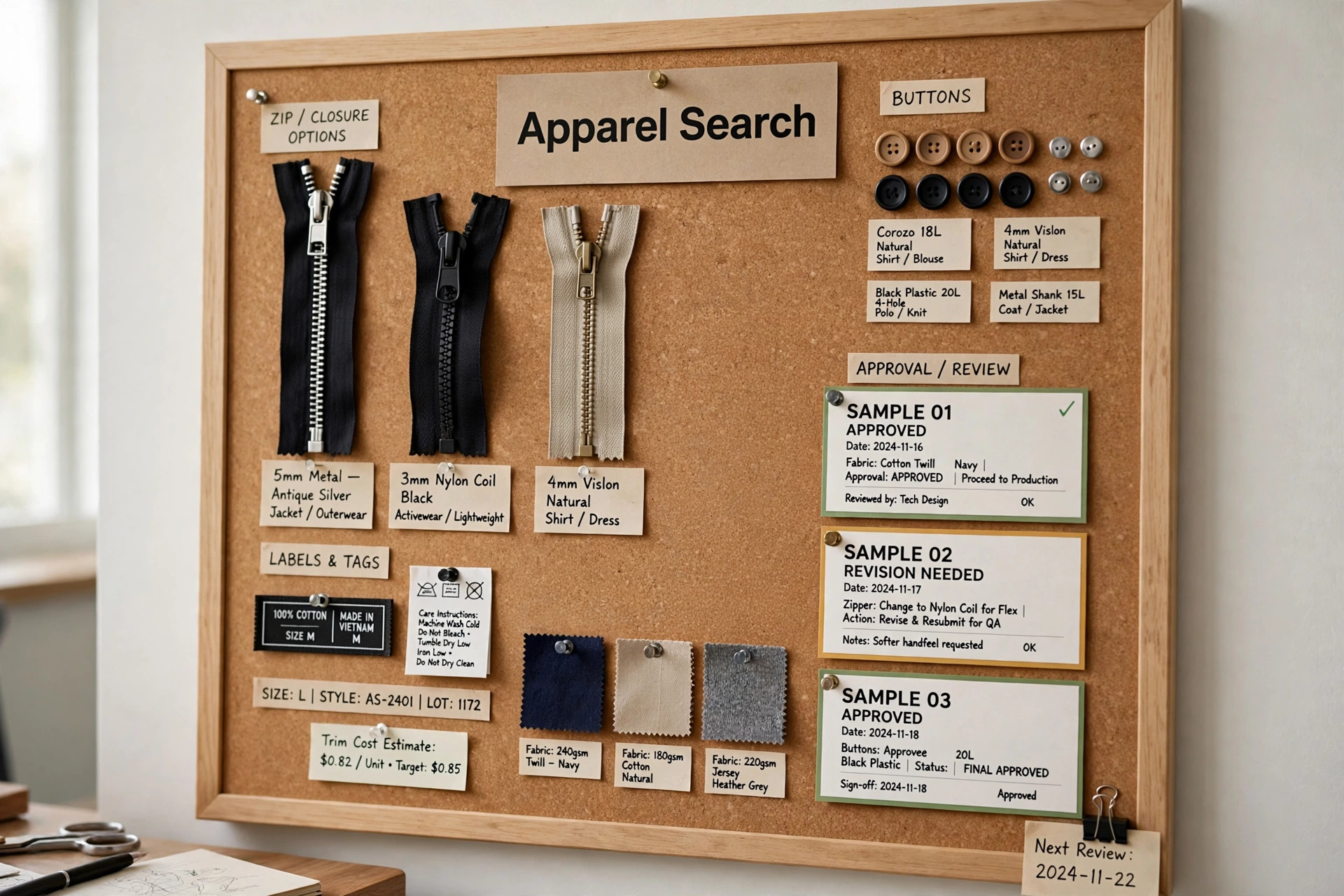
Trim development management is the discipline of getting every button, zip, label, thread and packaging item for a style specified, approved, produced and delivered before the sewing line needs it. A garment may carry 15 to 30 separate trim items, each with its own supplier, approval round and lead time, and the style cannot ship complete until the slowest one arrives. Experienced production teams treat trims — not fabric — as the most common cause of line stoppages and late deliveries. Managing trims well is therefore not purchasing administration; it is critical-path management, run backwards from the sewing date with the same seriousness as the garment calendar itself. Done well, the work is almost invisible: trims arrive, are checked, and are waiting when the line is ready, and nobody needs to discuss them at all.
The Trim Bill of Materials
The trim bill of materials (BOM) is the managed master list of every trim a style consumes, and it is a specification document, not a shopping list. Each line carries the item name, the supplier, the material and construction, size and color, the approved standard reference, the quantity per garment including wastage allowance, the unit cost, and the order and delivery status. A jacket BOM might list shell buttons, a main zip, lining tape, shoulder pads, interlining, threads by operation, woven and care labels, hang tags, polybags and cartons — 20 or more lines, each owned by a named person.
Three habits separate a managed BOM from a list. One owner: a single developer maintains the BOM; factories and suppliers work from it, never from side emails. Version control: every change is dated and numbered, and superseded versions are withdrawn, because a factory ordering from last week’s BOM is a defect waiting to happen. Completeness checks: the BOM is audited against a torn-down sample of the garment at pre-production stage — every component found on the garment must appear on the BOM, and every BOM line must be findable on the garment. The BOM lives inside the wider tech pack system, but trims earn their own tracking because their suppliers, timelines and failure modes differ from fabric’s. Review the BOM at every sample stage, not only at bulk: a trim dropped from the design at fit stage that stays on the BOM will be ordered, paid for and warehoused for no garment at all.
The Trim Critical Path
Build the trim calendar backwards from one fixed point: the date bulk sewing starts, which is the date every trim must be in the factory, checked and counted. Working backwards with typical ranges exposes how early trim work really begins. Custom hardware production and shipping can take 6 to 10 weeks after approval. Approval itself takes 2 to 4 weeks once strike-offs, shade checks and courier rounds are counted. Development and sourcing of the options before approval takes another 2 to 3 weeks. A custom button therefore starts its life 12 to 16 weeks before the sewing date — often before the fabric order is placed.
Stock trims shorten the chain but do not remove it: a stock zip still needs shade approval against bulk fabric, a lead time of 1 to 3 weeks, and delivery buffer. The critical path discipline is a dated milestone per BOM line — options presented, standard approved, order placed, production confirmed, shipped, received, checked — reviewed weekly, with any line slipping past its milestone escalated the same week, not at the delivery date. Add buffer where experience says it is spent: one extra week on any custom item, one extra courier round on any approval crossing a holiday period. Trims are the number one cause of line stoppages for a simple reason: a line can sew around a fabric problem, but it cannot sew a jacket with no zip.
Approvals and Standards
Every trim is approved against a physical standard before bulk is ordered, and the approved standard is kept, sealed and referenced by the BOM. Shade approvals are judged under a standard light source — a D65 daylight booth is the norm — against the actual bulk fabric, not against a lab dip or a screen image, because trim shades only matter in combination with the garment they sit on. Approvals cover more than shade: hand-feel and stiffness for tapes and interlinings, print quality for labels and tags, dimensions for buttons and buckles, and function for zips, snaps and cords.
Lab testing applies to trims as it does to fabric, scaled to risk. Colorfastness to washing and rubbing for dyed tapes, cords and embroidery threads; nickel release and restricted-substance checks for metal hardware in skin contact; flammability where regulations require it; and attachment strength for load-bearing items. Keep the test scope proportionate — a care label needs print durability, not a full chemical panel — but never let a regulated or skin-contact item into bulk untested because its value is small. Retain standards with discipline: one sealed set with the brand, one with the supplier or factory, each labeled with style, season, date and approver. When a dispute arises over bulk quality, the sealed standard is the argument-ender; without it, every discussion is opinion against opinion. Date and sign every approval, and photograph the approved item against its standard; photographs settle the small shade arguments that samples alone leave open.
Coordinating Trim Suppliers
Most styles draw trims from several sources at once, and the coordination question is who buys what. Under a nominated model, the brand selects and often negotiates the trim supplier, and the garment factory buys from that nominee at the agreed terms. Nomination protects consistency — the same zip, button and label quality across every factory making the brand’s product — and it concentrates volume for better pricing. Its cost is accountability splitting: when a nominated trim fails, the factory can fairly say the choice was not theirs, so nomination agreements must state who carries defect and delay risk.
Under factory-sourced trims, the garment factory buys against the brand’s specification and approved standard, and carries full accountability for what arrives. This suits commodity trims — threads, basic interlinings, packaging — where the factory’s local supply is faster and cheaper than any nomination. The management rule is to decide the model per BOM line, in writing, before orders are placed: nominated for brand-visible and custom items, factory-sourced for commodities, with no line left ambiguous. The product detail behind the most nominated category of all, custom metal and plastic hardware, is covered in the custom trim hardware guide; the management point here is that nominated items get the earliest milestones on the critical path, because their timelines are the least compressible.
Risk Management
Trim risk concentrates in predictable places, and each has a standard countermeasure. Single-source custom items — a logo button from one die at one maker — carry tooling, capacity and shipping risk in one package; mitigate by owning the die, holding a safety stock of one to two seasons’ core volume for continuity styles, and approving the item early enough that a remake is still possible. Late hardware is managed by the critical path itself: weekly milestone reviews catch a slip while air freight or a partial shipment can still save the sewing date.
Substitution control is the risk discipline brands most often skip. The rule is absolute: no supplier or factory substitutes any trim — a near-matching zip, a similar button, a different label stock — without written brand approval against the standard, however urgent the reason and however invisible the difference seems. Silent swaps destroy shade consistency across a delivery, break compliance evidence gathered for the original item, and surface at retail as mixed quality on one rail. Log every approved substitution on the BOM as a version change, with the reason recorded. Finally, hold a small contingency: a modest over-order, typically 2 to 5 percent on small hardware and labels, absorbs counting errors, attachment damage and inspection rejects without an emergency reorder at minimum-quantity prices. Finally, insure the calendar, not just the goods: for the single most critical custom item on a continuity style, an approved second source or a held buffer stock is cheaper than one missed delivery window.
Trims in the Tech Pack and Beyond
The trim BOM reaches the factory as part of the tech pack, and the trim slice of that package must be complete enough to order from without questions: item photographs or drawings, dimensions, materials, colors per colorway, placement and attachment method, supplier and standard reference for every line. Where a trim is colorway-specific — dyed zips, contrast buttons — the BOM maps each garment colorway to its trim set explicitly; “to match” is not a specification. The full package discipline behind this is covered in the tech pack management guide; the trim manager’s concern is that trim pages are updated with the same version control as measurement pages.
Readiness is staged. At pre-production sample stage, every trim should be the real item or a documented stand-in with an approval date — a PP sample sewn with substitute buttons proves fit and construction, but it proves nothing about the real button’s attachment or shade. By bulk, the standard is stricter: all trims delivered, counted against the BOM, shade-checked against bulk fabric and released to the line with the contingency quantity intact. Close the loop after delivery with a short trim review per style — what arrived late, what failed, what was over- or under-ordered — and carry those notes into the next season’s BOM. Labels and tags, the branding layer of the trim set, follow the development route set out in the custom branding guide.
FAQs
- Why do trims cause so many production delays?
- Because a style may need 15 to 30 trim items from different suppliers, each with its own approval and lead time, and the garment cannot ship until the slowest arrives. Custom items can need 12 to 16 weeks from development to factory delivery.
- What belongs on a trim bill of materials?
- Every trim line with supplier, material, size and color, approved standard reference, quantity per garment plus wastage, unit cost, and order and delivery status — version-controlled, owned by one developer, and audited against a torn-down garment sample. If an item cannot be found on either the garment or the list, one of the two documents is wrong.
- What is the difference between nominated and factory-sourced trims?
- Nominated trims come from a supplier the brand selects, protecting consistency across factories but splitting accountability. Factory-sourced trims are bought by the factory against the brand specification, with full factory accountability. Decide the model per BOM line, in writing. Ambiguity on any single line is exactly where disputes breed later.
- How much contingency trim should be ordered?
- Typically 2 to 5 percent extra on small hardware, labels and similar items. The overage absorbs counting errors, attachment damage and inspection rejects, and is far cheaper than an emergency reorder at minimum quantities and express freight. Labels and small hardware are cheap insurance at these percentages; long-lead zips are planned by milestone instead.
- Can a factory substitute a similar trim in an emergency?
- Never without written brand approval checked against the sealed standard. Silent swaps break shade consistency, invalidate compliance testing done on the original item, and mix quality within one delivery. Approved substitutions are logged as a BOM version change. That version record is the evidence trail if quality is questioned later.
More Supply Chain & Manufacturing Guides
This guide belongs to the Apparel Search production series. Browse the companion guides below, or start from the manufacturing guides hub.
Sourcing & Suppliers
- Fabric Sourcing Guide
- Sourcing Fabric at Trade Shows
- Trade Show Follow-Up
- Low-MOQ Clothing Manufacturers
- Factory Verification
- Supplier Verification
- Supplier Technical Evaluation
- The Global Apparel Supply Chain
Production & Factory Operations
- Production Management
- Sample Development Process
- Fabric Inventory Management
- Flexible Manufacturing Workforce
- Manufacturing From Synthetic Fabrics
- Garment Construction Techniques
- Textile Waste in Factories
Materials, Dyeing & Trims
- Fabric Dyeing Services
- Specialty Dyeing & Finishing
- Fabric Innovation
- Custom Trim Hardware
- Trim Development Management (this guide)
- Smocking Techniques
Business & Retail
Search Apparel Search
Apparel Search: explore the manufacturing guides hub and production & sourcing resources for the fashion industry.