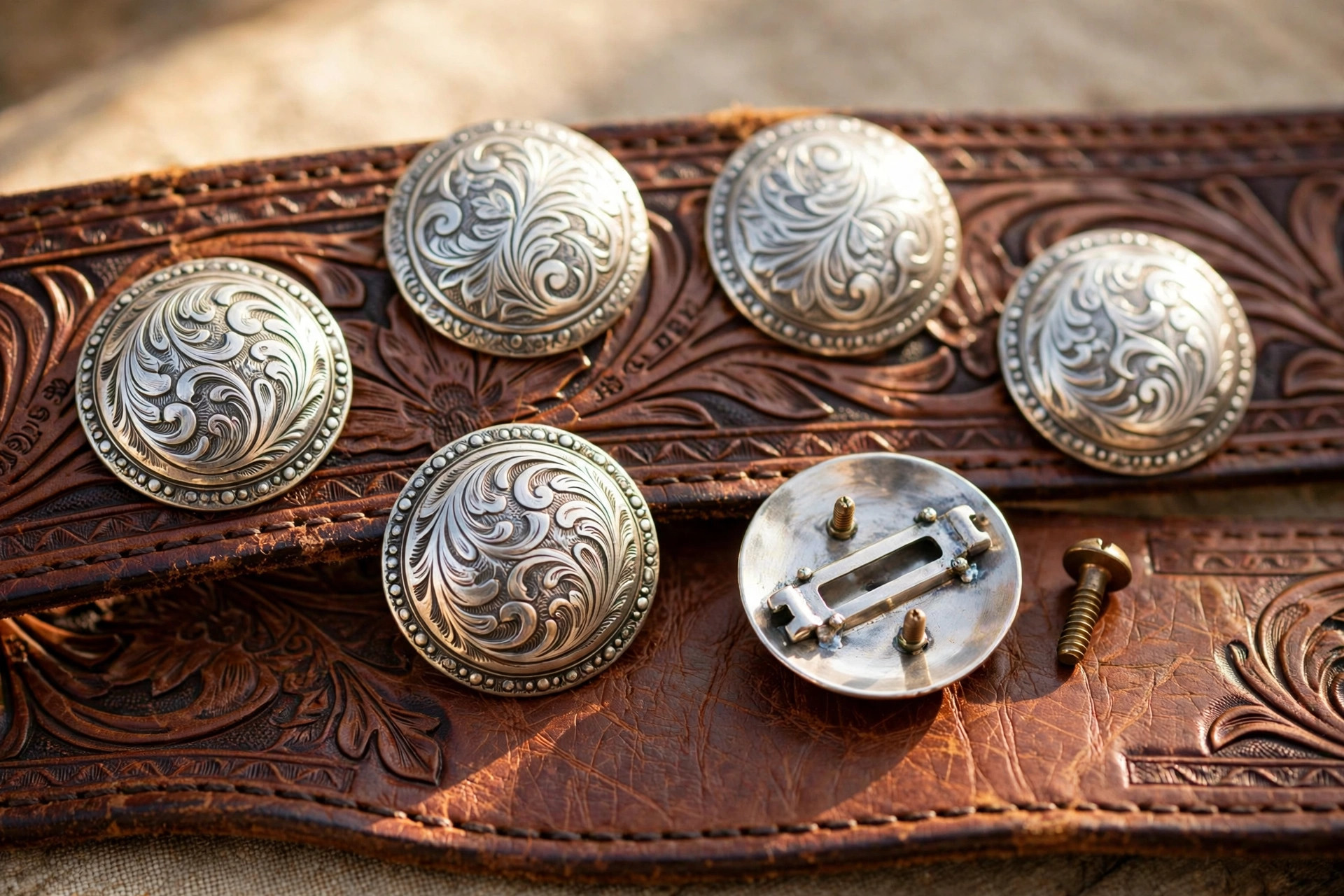
Conchos are decorative metal discs — traditionally silver — fitted to leather goods and clothing as ornament, and sometimes as a fastening. The name comes from the Spanish concha, meaning shell, for their round, often domed shape. They grew out of Spanish and Mexican leatherwork, passed into American Western saddlery, and from there onto belts, jackets, bags, and hats. Each concho fixes from the back, by a slot, a screw post, or a rivet.
How to Recognise a Concho
Look at the back, not the face. The engraved front — scrollwork, stars, rope edges, or a stamped motif — is decoration, but the fitting behind it tells you how the concho was made to be used.
- Slot back — a raised bar with a slot across the back, so a leather thong or strap can pass through and tie the concho on, saddle style.
- Screw back — a threaded post that fixes through a punched hole with a small screw, often called a Chicago screw, so the concho can be removed or swapped.
- Rivet back — a plain post peened over a backing piece for a permanent fixing on belts and tack.
Traditional conchos were sterling or coin silver, engraved by hand. Most made today are silver plate, nickel, stainless steel, brass, or cast alloy, in sizes from small jacket and shirt ornaments up to large belt and saddle pieces of two inches or more.
Where Conchos Are Used
The best-known use is the concho belt: a leather belt strung with a row of matching conchos, sometimes linked disc to disc without leather at all, worn as jewellery as much as a belt. On saddles and bridles, conchos cover the screws and joins of the leatherwork and add the flash that marks Western tack. The same discs decorate Western jackets and shirts, handbags and wallets, guitar straps, and the bands of cowboy hats.
Because screw-back conchos unscrew, they are easy to move between belts or replace when a strap wears out — one reason they have stayed a standard trim in Western wear for well over a century.
FAQs
- What is a concho belt?
- A concho belt is a leather belt strung with a row of matching conchos, often with a larger decorated buckle — or a belt linked from conchos alone, with no leather showing. It grew out of Southwestern and Western leatherwork and is worn as jewellery as much as a fastening.
- Are conchos always made of silver?
- No. Traditional conchos were sterling or coin silver, often hand-engraved, but most conchos sold today are silver-plated, nickel, stainless steel, brass, or cast alloy. Silver remains the classic look, not a requirement.
- How are conchos attached?
- Three ways, by the fitting on the back: a slot back takes a leather thong or strap, a screw back fixes through a punched hole with a small screw so it can be removed, and a rivet back is peened over for a permanent fixing.
Detailed Guides: see Conchos in the glossary A–Z listing of the Apparel Search fashion glossary for related terms.