Apparel Search Consumer Guides
Incontinence Underwear Buying Guide
Absorbent underwear explained as garments and product categories: washable versus disposable, absorbency labels, styles for men and women, and swim options.
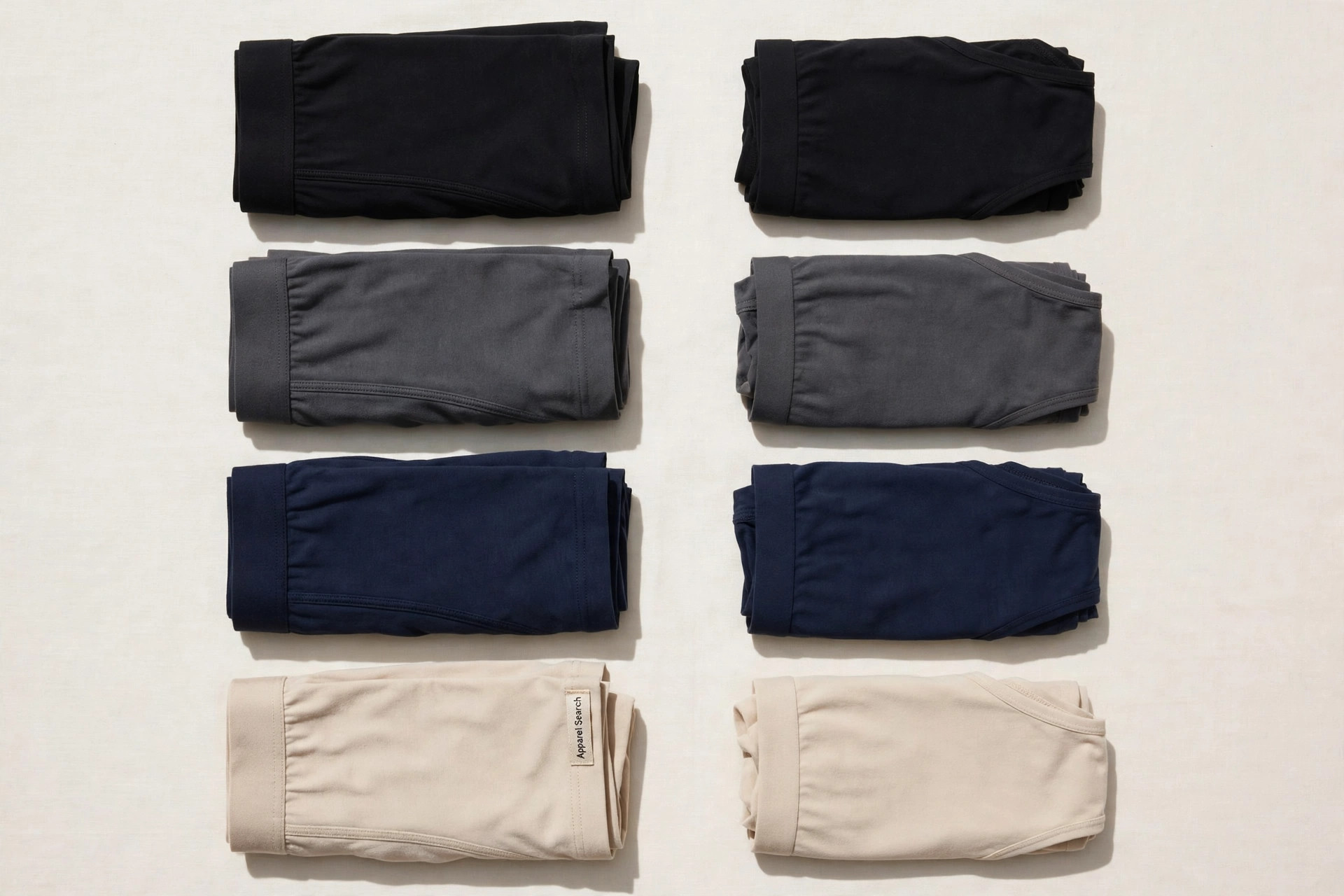
Absorbent underwear for bladder leaks is sold in two families that look alike in photographs and behave very differently in a laundry basket: washable underwear with an absorbent panel built in, and disposable products designed to be worn once. This guide explains both as what they are — garments and product categories — covering how absorbency is labeled, how the men’s and women’s styles are cut, how the washable kind fits under ordinary clothes, how many a rotation takes, and the swimwear end of the category. It belongs to the same garment-first family as our adaptive clothing guide and our adaptive clothing for seniors page, and its companion page covers the wardrobe worn around the underwear: incontinence clothing and travel tips.
Search Apparel Search
Two Product Categories: Washable and Disposable
Washable absorbent underwear is real underwear — briefs and boxer briefs in ordinary fabrics — with an absorbent panel built into the gusset or front: a wicking top layer, an absorbent core, and a leak-resistant backing, the same three-layer construction used across the absorbent-underwear category. It is worn, washed and worn again, so its cost is the purchase price spread across a rotation and a laundry routine. Because it is cloth, it looks, feels and folds exactly like the rest of the underwear drawer, which is the quality most buyers are actually shopping for.
Disposable products come in two shapes: pull-up disposable underwear, a complete garment worn once and discarded, and disposable pads or guards worn inside ordinary underwear. Their cost runs the other way — a low unit price paid per piece, per day, indefinitely — balanced against zero laundry and easy travel. Many households run both systems: washable pairs for home days, disposables for travel or as spares kept in a bag. Neither family is a medical device in the way this guide uses the words; they are clothing categories, chosen the way any clothing is chosen, by fit, fabric and routine.
Absorbency Levels and Their Labels
Absorbency is sorted into levels with names like light, moderate, heavy and overnight, sometimes with a stated capacity in ounces or drops on a house scale. As with the rest of the absorbent-underwear category, there is no cross-brand standard behind the words: each maker tests and labels its own range, and one brand’s moderate is not a promise about another’s. Read the level together with the panel — its size and placement decide real coverage as much as the headline number does. A bigger panel in a moderate absorbency covers more of the garment than a small panel in a heavy.
Level choice is a routine judgment: light levels are cut for occasional small leaks and wear thinnest under clothes; heavy and overnight levels carry the largest panels and the most padding, and are the styles stocked for night use and long stretches away from a change. Buying one pair at the level above your estimate is the standard way to calibrate a new brand, because fit and panel placement vary enough that the first pair is partly a fitting exercise.
Styles for Women, Styles for Men
The two ranges are cut differently because the panel has a different job in each. Women’s styles mirror the ordinary drawer — briefs, bikinis, hipsters and boyshorts — with the absorbent panel centered in the gusset, rising higher at front and back as the absorbency level climbs. Waistbands sit at the rises of normal underwear, and the fabrics are the smooth knits of ordinary underwear so the pair reads as underwear, full stop.
Men’s styles are briefs and boxer briefs in which the absorbent zone is placed higher and further forward, following men’s anatomy, and many designs keep a working fly front so the garment functions like the brief it resembles. Boxer briefs are the most common men’s shape in the category: the leg length keeps the panel registered against the body through a day of sitting, standing and walking. In both ranges, dark colors — black, charcoal, navy — are the best sellers, for the camouflage reasons the companion clothing and travel tips page sets out.
Fit Under Everyday Clothes
The design brief for the whole category is invisibility in wear: no outline under trousers, no rustle, no waistband that announces itself. The washable styles meet it most easily — a smooth knit brief with a built-in panel is, from the outside, a brief. Fit decisions are the ordinary ones, with two additions: the garment must sit snug enough that the panel stays where the body needs it (a waistband that migrates takes the panel with it), and the rise should match the trousers it will live under, so waistbands stack rather than compete. Sizing runs by waist or hip measurement on each brand’s own chart, and charts differ — measure, do not assume.
How Many to Own
Rotation math again decides the drawer. Multiply the changes you plan in a day by the days between laundry loads, then add the drying turnaround, because washable absorbent underwear air-dries to protect its panel — the wash routine is the one in our laundry guide, a cold rinse where needed, a normal wash without fabric softener (softener coats absorbent fibers), and air to dry. A two-changes-a-day rhythm on a twice-weekly wash lands around eight to ten pairs; a one-change rhythm needs about five. Disposables skip the arithmetic and replace it with a stocking habit: a week’s supply in the drawer and a spare set outside the house, which the travel tips page turns into a kit.
Swim Options
Swimming has its own corner of the category: incontinence swimwear. The standard design is a containment swim brief or short — an inner absorbent-and-containment layer inside a garment that reads as swimwear — worn alone as the swimsuit or under an ordinary swimsuit as its base layer. Styles exist for men and women, in brief, short and one-piece forms; fuller-coverage versions sit naturally alongside the sets in our modest swimwear guide, and the general swimwear landscape is mapped in our women’s swimsuits guide. Swim styles are sized and leveled like the underwear: buy by measurement, and read the stated absorbency as the maker’s own scale.
A Garment Guide, Not Medical Advice
This page covers clothing: how the garments are designed, organized, fitted and worn. It describes what products are made of and how they are put together — nothing here is a claim about what any garment does for a medical condition, and questions about your own situation belong to your own doctor or care team, whose guidance outranks any product description — including the ones described here.
Shop Incontinence Underwear on Amazon
Ready to shop? Product links are kept in one place on the Apparel Search shopping guide:
Shop Clothing on AmazonThis link opens the Apparel Search shopping guide for Amazon, where the product links are kept in one place.
Common Questions
What is washable incontinence underwear?
Ordinary-looking underwear — briefs and boxer briefs for men and women — with an absorbent panel built into the garment: a wicking top layer, an absorbent core and a leak-resistant backing. It is worn like regular underwear, machine washed without fabric softener, air dried, and worn again. From the outside it reads as underwear, which is the point of the design.
How do absorbency levels work?
Brands sort their ranges into light, moderate, heavy and overnight levels, but the words are each maker’s own — there is no cross-brand standard or shared test. Read the level together with the panel’s size and placement and any stated capacity, and expect to calibrate with a first pair: fit and panel position vary enough between brands that one test purchase teaches more than any chart.
How many pairs do you need?
Multiply your planned changes per day by the days between laundry loads, then add a day for air drying. One change a day on a twice-weekly wash comes to about five pairs; two changes a day comes to eight or ten. Disposable users replace the rotation with a stocking rhythm — a week’s supply at home and spares kept where the day happens.
Is there swimwear made for incontinence?
Yes — it is its own product category. Incontinence swimwear is a swim brief, short or one-piece with a containment layer built in, worn alone as the swimsuit or under an ordinary swimsuit as a base layer. Men’s and women’s styles both exist, sized by measurement like the underwear, with absorbency stated on each maker’s own scale.
Please note: Apparel Search is a fashion and clothing guide, not a medical authority. Pages in this section describe clothing features and dressing ideas only. We make no claim that any garment or special product will improve, treat, or help with any medical condition, and descriptions of product features reflect how those products are designed and marketed, not a medical endorsement. Please check with your own doctor or care team about what is right for you.