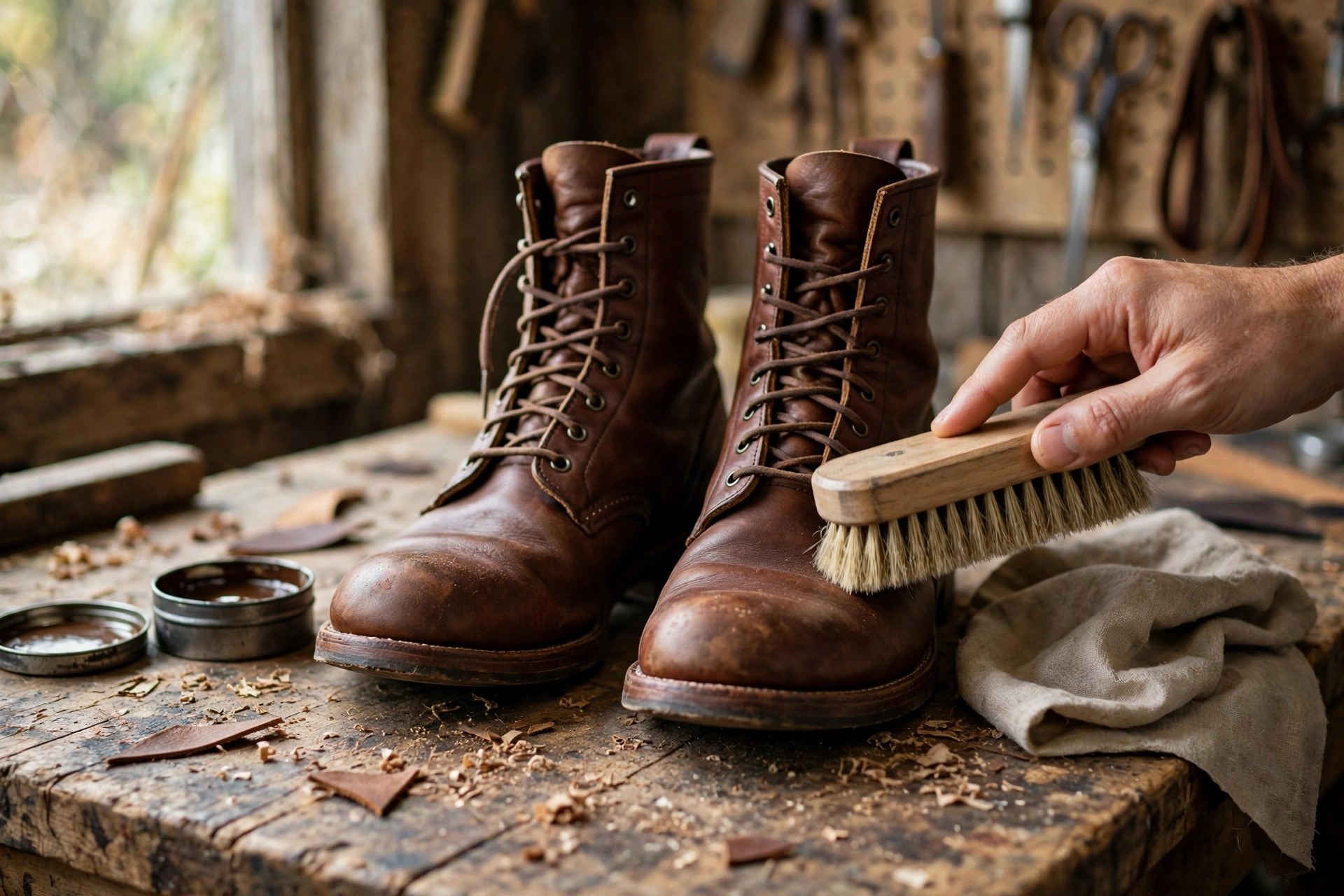
Leather boot care is a short routine repeated through the season: brush or wipe off dirt and road salt promptly, let boots dry slowly at room temperature, condition the leather when it looks dry, and keep a suitable waterproofer renewed. Winter is hard on boots because salt draws moisture out of leather and leaves it stiff and cracked, while slush soaks it from outside. None of the steps is difficult — what damages boots is neglect between wearings and fast drying on a radiator. Boots that get this routine keep their shape, resist water, and can be resoled and worn for many years.
Cleaning and the Salt Problem
After wearing, knock off dried mud and brush boots down with a soft brush. Wipe the leather with a slightly damp cloth to remove salt residue — the white tide lines salt leaves behind will dry the leather and can stain it permanently if left. For set salt marks, wipe with a cloth dampened with a mild solution (a little white vinegar in water is the traditional remedy), then wipe again with plain water and let the boots dry. Stuff boots loosely with newspaper or insert boot trees while they dry: it holds the shape and draws moisture from inside. Always dry at room temperature away from radiators, fires, and hair dryers — forced heat cracks leather.
Once clean and dry, condition. Leather loses its natural oils with wear and wetting; a quality leather conditioner rubbed in thinly and buffed restores flexibility and some water resistance. Condition when the leather looks pale, feels stiff, or after several wet wearings — over-conditioning soft boots can oversoften them, so thin coats, repeated as needed, beat one heavy coat. If your boots are suede or nubuck rather than smooth leather, skip conditioner entirely and follow suede care instead.
Waterproofing and Rotation
Waterproofing tops up what conditioning starts. Wax- and oil-based treatments give the strongest protection for work and hiking boots but can darken leather and change its finish; silicone or fluoropolymer sprays suit fashion boots and alter the look less. Either way, test in a hidden spot first, apply to clean dry boots, and renew through the season — protection wears off exactly where slush hits hardest. Finally, rotate: leather boots worn every day stay damp inside and break down faster. Alternating pairs, and storing off-season boots clean with trees in a dry place, doubles their working life. For choosing boots in the first place, see our guides to men's leather boots and women's leather boots.
Common Questions
- How do I get white salt stains off leather boots?
- Wipe them off as soon as you can with a cloth dampened with water; for set marks, use a cloth dampened with a little white vinegar diluted in water, then wipe with plain water. Let the boots dry slowly, then condition — salt dries leather out.
- Can I dry wet leather boots on a radiator?
- No — direct heat dries leather too fast and cracks it. Stuff the boots with newspaper or boot trees and let them dry at room temperature, away from heat sources. It takes longer, and it is the difference between boots that recover and boots that stiffen.
- How often should leather boots be conditioned?
- When the leather looks dry, pale, or stiff — typically a few times a season for boots worn in wet winter weather, less for occasional wear. Apply thin coats; you can always add more, and over-conditioned leather goes limp.
- What is the best waterproofing for leather boots?
- For hard-worn work and hiking boots, wax- or oil-based treatments protect most but may darken the leather. For dressier boots, a spray waterproofer preserves the finish with lighter protection. Test any product in a hidden spot first and reapply through the season.
Garment Care & Clothing Storage Guides
This page is part of the Apparel Search garment care series — practical guides to washing, finishing, and storing the clothes you own. Browse the full series below.