Slim Retro Sneakers
The low-profile suede, nylon and gum-soled trainers that quietly replaced the chunky sneaker
A slim retro sneaker is a trainer built on the proportions sport used before soles got thick: a low, narrow silhouette that sits close to the ground, an upper of suede, soft leather or nylon with almost no padding, and a thin, flat sole — very often in natural gum rubber. Nearly every example in the current wave is a reissue or close descendant of a shoe designed between the 1960s and the 1980s for indoor sport: football training, handball, racquet sports and, in one famous case, motor racing. They were tools for turning quickly on a polished floor, and the leanness that made them good at that job is exactly what makes them look right now — under wide trousers, tailoring and dresses — after a decade in which sneakers kept getting bigger. This guide defines the style, walks through the families that define it — with the honest history of each — and covers choosing, styling and care.
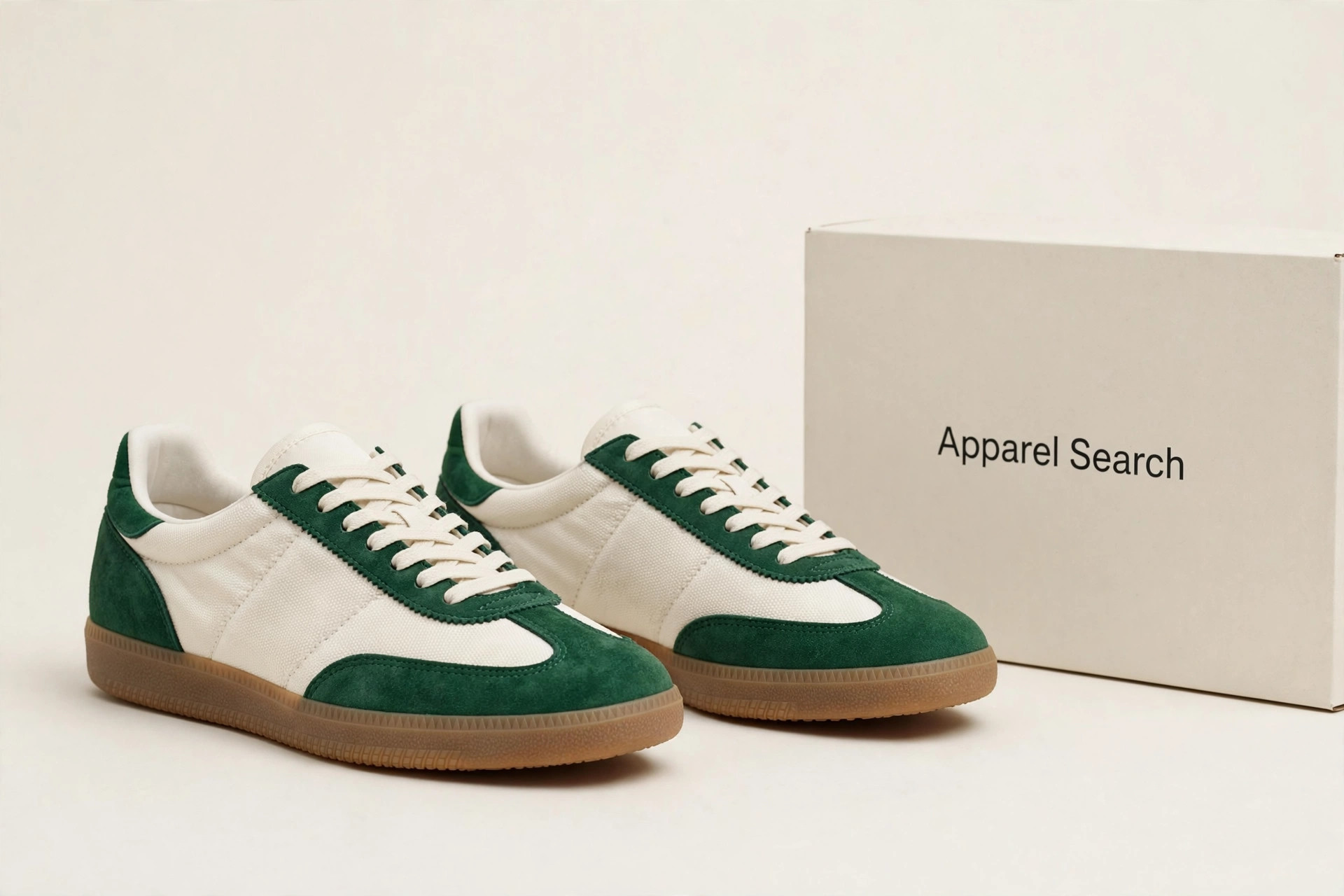
What Defines the Slim Retro Silhouette
Four features separate this category from the chunky sneaker and the modern cushioned runner. The first is height, or the lack of it: the sole is a thin slab, so the foot sits low and the ankle shows. The second is width: the last — the form the shoe is built around — is narrow, so the shoe follows the foot instead of surrounding it with foam. The third is material: suede is the signature upper, usually paired with nylon or mesh panels and a suede toe overlay, because that is what 1960s and 1970s training shoes were made from. The fourth is the gum sole, the translucent honey-brown rubber indoor sports adopted because it grips courts without marking them — now the quickest visual signal that a sneaker belongs to this family. Our sneaker definition covers the wider footwear vocabulary this guide builds on.
The roots are specifically indoor. Outdoor running shoes of the same decades already had wedges and cushioning; it was the court sports — five-a-side football, handball, squash, racquetball — that demanded a shoe which stayed flat, gripped hard floors and let a player feel the surface. Racing drivers wanted the same ground feel through a pedal, which is why the motorsport branch of the family looks like a cousin of the handball branch. When fashion went looking for an alternative to bulk, it did not invent a new shoe. It reopened the indoor-sport archive.
The Key Families, With Their Real Histories
Model names below are given as editorial fact: these are the shoes the category is built from. Each history is brief and documented — several of these shoes carry folklore the brands themselves have corrected.
adidas Samba — the icy-pitch original
The Samba is the family's founding shoe. adidas founder Adolf (Adi) Dassler designed it in 1949, and the first version appeared in 1950, as a football shoe for a specific problem: training on frozen, rock-hard winter pitches, where ordinary studded boots skidded. The answer was a kangaroo-leather upper on a gum sole cut with suction-cup-like lugs for grip on ice. Popular retellings say the name came from the 1950 World Cup in Brazil, but adidas's own published history says the shoe earned the nickname at matches in Germany, and the company has corrected the World Cup story directly. The low version familiar today, launched in 1972 in adidas's account, became the standard shoe for indoor football and futsal, its flat gum sole and suede T-toe built for hard courts. From there it passed through British terrace culture into the general wardrobe, and its 2020s revival turned a niche classic into the defining sneaker of the slim wave. The adidas company profile gives the brand context behind this and the two adidas families below.
adidas Gazelle — the first suede trainer
The Gazelle launched in 1966, developed from adidas's earlier Olympiade running shoe, and holds a genuine first: the brand's first trainer with a suede upper, when training shoes were leather or canvas. Dyed suede took colour far more vividly than leather, and the original came in two versions — blue for training, red with a transparent non-slip sole for indoor sport. By 1968 the design had settled into the form still sold today. It later became associated with handball courts, then with terrace and 1990s British pop culture. Next to the Samba it reads softer and simpler — all suede, less leather structure — which is why many stylists treat it as the dressier of the two.
adidas Handball Spezial — the connoisseur's pick
The Handball Spezial made its debut in 1979, in adidas's own words as a top-performance shoe for elite handball players on the indoor courts of Europe. Its specification is the category in miniature: a premium suede upper for smooth movement, a gum rubber outsole for grip and stability through quick stops and sharp turns, and a low profile that kept the player close to the floor. Like the Samba, it escaped its sport through 1980s and 1990s terrace culture, and returned to prominence in the 2020s — often chosen for its richer suede colourways and slightly more padded feel than the Gazelle.
Onitsuka Tiger Mexico 66 — the first striped trainer
The Mexico 66's design was developed in 1966 by Japan's Onitsuka Tiger, ahead of the 1968 Mexico City Olympics. Its ancestor was the Limber of that year — one of the first shoes to carry the brand's crossed stripes, originally called the Mexico Line — and the modern shoe combines that design with the slim shape of the earlier Limber Up trainer. The name, formalised at the brand's early-2000s relaunch, records the formula: Mexico for the Games, 66 for the year. Uma Thurman's yellow pair in Kill Bill: Volume 1 (2003) is a confirmed Mexico 66, an homage to Bruce Lee's yellow outfit in Game of Death — although the shoe Lee himself wore is debated and may not have been this model. It is the lightest member of the family.
Puma Speedcat — the racing shoe that left the pit lane
The Speedcat is the family's youngest original and its only motorsport branch. Puma had made racing shoes for Formula 1 drivers since the 1980s, and the Speedcat, released in 1999, was developed from the shoe made for driver Stefan Bellof in 1984–85. The original was genuine safety equipment: premium leather with a fireproof lining, built with racing-equipment company Sparco, and shaped for pedal feel — a very thin sole and a rounded heel that lets a driver's foot roll smoothly. In 2000 Puma launched the lifestyle version, in ordinary leather and suede without the fireproof lining. A European street staple in the 2000s, it went quiet for years and was re-released in July 2024, straight into the slim-sneaker moment. It is the narrowest fit in this guide.
Puma Palermo — the city-series terrace shoe
The Palermo is Puma's terrace classic. In Puma's own account it debuted in 1980s football stadiums as a terrace staple, part of a special series honouring famous European cities — London and Oslo among them — this one named for Palermo, the capital of Sicily. It carries the family markers: low-top silhouette, retro T-toe, gum sole, and a small side tag with the Puma name in gold. After decades in the archive, Puma brought the Palermo OG back in July 2023 in its original blue-and-white colourway. For buyers it is the Samba alternative from the other Herzogenaurach brand — same terrace DNA, usually easier to find in stock.
Nike Killshot — the American court shoe
The Killshot proves the slim formula was not only European. Nike introduced the original in 1979 as a court shoe for racquetball and squash, with a mesh upper and suede overlays — the American answer to the same brief the handball shoes answered. Its fame comes from its second life: in 2009 Nike and J.Crew released the Killshot 2, a leather update that kept the suede detailing and gum sole, sold exclusively through J.Crew for a decade of sell-out drops before Nike made it a general release in August 2019. It became the default slim sneaker of American smart-casual menswear years before the current wave, and remains the easiest entry point for anyone who wants the silhouette without a football reference.
Beyond the headline names, the same archive logic keeps producing relatives: ballet-flat hybrids take the thin sole in a more delicate direction, covered in our sneakerinas styling guide, and the women's sneakers guide places this family inside the full women's sneaker landscape.
Why Slim Replaced Chunky
The chunky sneaker — the oversized “dad shoe” that dominated the late 2010s — did not disappear, but it lost its position as the default fashion sneaker, for practical as much as aesthetic reasons. First, proportion: the trouser silhouette of the 2020s is wide — wide-leg, barrel and pleated cuts — and stylists consistently note that a slim shoe streamlines those volumes instead of adding a second block of weight at the hem. Second, range: a low suede trainer crosses categories a maximal runner cannot — tailoring, dresses and skirts, and offices where a sculpted sole still reads as gym kit. Fashion coverage has described them as a kind of quiet luxury, and as a candidate for the universal reference sneaker the market had been missing. Third, nostalgia with receipts: every leading model is a real archive design with a documented sporting past, a story a newly designed “retro-style” shoe cannot fake. Finally, there is simple fatigue: after years of maximalism, a shoe that asks for no attention is itself the statement.
None of this makes the chunky sneaker wrong — cushioned shoes keep their honest jobs: long walks, standing shifts and running. It makes the slim shoe the better default for most wardrobes now: the pair that goes with the most clothes, in the most settings, with the least thinking.
How to Style Slim Retro Sneakers
With tailoring
This is the pairing that carried the trend. A slim suede trainer under pleated wool trousers or a relaxed suit keeps the line of the leg unbroken, where a chunky sole would chop it. The trouser should break cleanly or crop just above the shoe, never pool over it; smooth leather or dark suede suits suiting best, nylon mixes casual tailoring; and keep the pair clean — a scuffed trainer under a suit reads as an accident, not an attitude. A dedicated clean pair for smarter outfits, as our fuller how to style sneakers guide recommends, is the simplest system.
With denim
Denim is the home fixture. Straight and wide-leg jeans want the slim shoe for the proportion reason above; the hem should sit on or just above the shoe so the gum sole shows. With double denim, a suede retro trainer in a third colour — deep green, burgundy, tan — separates the two denim pieces better than a white shoe does. Cuff once, keep socks low, and let the shoe be the vintage note.
With dresses and skirts
A low trainer grounds a dress the way a ballet flat does, but with more ease: midi and maxi dresses gain a deliberate casual edge. Suede in a tonal colour — sand with a cream dress, chocolate with a floral — looks most intentional; a bright nylon colourway makes the shoe the outfit's single sporty accent. Mini lengths suit the slimmest profiles of all. Skip thick athletic socks: a low or no-show sock keeps the ankle line the style depends on.
Choosing a Pair: Fit, Materials and Suede Care
Fit — expect narrow, plan accordingly
Almost every shoe here was lasted for a sport that wanted the foot held closely, so the category runs narrow. Wide feet should expect to go up a half size; anyone between sizes should take the larger one. The thin sole is the other trade-off: very little cushioning or arch support, because court shoes traded padding for court feel. That is fine for ordinary days, but not for a standing job, and rotating pairs is better for your feet. Leather needs a few wears to soften; suede gives sooner; racing-derived models are the least forgiving.
Materials — suede, leather, nylon
Suede is the classic upper: soft from the first wear, rich in colour, and the most vulnerable to rain and stains. Smooth leather versions wipe clean and dress up further. Nylon or mesh with suede overlays is the lightest, most breathable build, closest to the 1970s running originals, and the most casual. The gum sole is common to all: it grips well on dry pavement and polished floors, and yellows very slightly with age — patina, to most wearers, rather than damage.
Suede care — the routine that keeps them alive
Suede is not fragile, but it is procedural. Spray a new pair with water-and-stain protector before the first outing. Brush after wear — it lifts dust and restores the nap in thirty seconds. Treat scuffs with a suede eraser, then brush again. If a pair gets wet, stuff it with paper and dry it slowly away from heat and direct sun; never machine-wash or soak suede, because water stiffens the fibres and leaves tide marks. Store pairs out of direct sunlight, which fades dyed suede. Pale colours need the brush routine most; deep colours forgive almost everything except a soaking.
What to Avoid
Do not run in them. These are reissues of court shoes from before modern cushioning; running in them invites sore feet and ruined shoes. Do not treat a rainy day casually — unprotected suede plus a downpour is the one genuinely damaging combination, so check the forecast or choose the leather pair. Do not buy a size down for the sleek look: a slim shoe worn too small looks strained, not sleek, and will punish you by noon. Do not let one pair do everything — two pairs in rotation (one suede, one leather or nylon) stay presentable for years. And be careful where you buy hyped colourways: slim retro models are heavily imitated, so buy from the brand or an authorised retailer, and distrust prices far below every other seller.
Common Questions
What makes a sneaker a slim retro sneaker?
A slim retro sneaker is a present-day issue or reissue of a low-profile trainer designed before the era of thick, sculpted soles: a narrow last, a thin flat sole — very often gum rubber — and an upper of suede, leather or nylon with little padding. The shape comes from indoor sports of the 1960s to 1980s, where a low shoe gave players court feel and quick changes of direction.
Are slim retro sneakers comfortable for all-day wear?
They are comfortable for ordinary city wear once broken in, but they are not cushioned walking shoes. The thin soles offer little shock absorption or arch support, because the originals were built for short, sharp court sports, not standing all day. If you walk long distances daily, alternate pairs and keep a more cushioned shoe in rotation.
Do slim retro sneakers run small or narrow?
Most run narrow, because the lasts come from racing, handball and court shoes built to hold the foot closely. Wide feet often need a half size up, and suede versions give more across the toes than stiff leather ones. If you are between sizes, the larger size is usually the safer choice in this category.
How do you keep suede retro sneakers clean?
Brush them dry with a suede brush after wear to lift dust and restore the nap, treat marks with a suede eraser, and apply a water-and-stain protector spray before the first outing and after cleaning. Never soak suede or put it in a washing machine: water stiffens and stains it. Stuff damp pairs with paper and dry them away from direct heat.