
A teddy coat is a coat made from deep-pile borg fleece — a dense, curly fabric that looks and feels like the plush of a teddy bear. The same coat is also sold as a borg coat, after the fabric itself. It is warm, soft, deliberately casual, and usually cut roomy, with big lapels or a simple collar and a relaxed, wrap-up shape.
What a Teddy Coat Is Made Of
Most teddy coats are polyester pile: synthetic fibres looped and sheared into that short, springy curl. Polyester borg is light for its bulk, holds its loft well, dries faster than natural pile, and keeps prices down. At the other end of the market are wool and wool-blend versions, where wool fibres give a denser, heavier, slightly less uniform pile, better breathability, and a higher price. Recycled-fibre versions, usually recycled polyester, are now common and perform much like standard polyester.
What is underneath matters as much as the pile. A smooth satin or viscose lining helps the coat slide over knitwear, stops sleeves catching, and adds a wind-resistant layer. Unlined or half-lined coats feel lighter and cost less, but they are noticeably draughtier and harder to pull on over a jumper. Check the lining before judging warmth from the thickness of the pile alone.
How Warm Is a Teddy Coat, Honestly?
The pile traps a lot of still air, and trapped air is what insulation is, so a teddy coat is genuinely warm for dry cold and everyday wear: school runs, commutes, dog walks, and evenings out. A lined, knee-length coat over a proper jumper handles a typical winter day comfortably.
Its weakness is wind. Air moves through unlined pile, so on an exposed, gusty day the warmth drains faster than the thickness suggests, and the fabric has no answer to sleet or wet snow. It is not a ski coat or a storm coat, and it should not be bought as one. For the slopes, see what to wear skiing — a waterproof shell and proper layers do a job a teddy coat cannot. Think of the teddy as a very cosy town coat, and it will not disappoint you.
Styles: Longline, Cropped, Zipped, and Buttoned
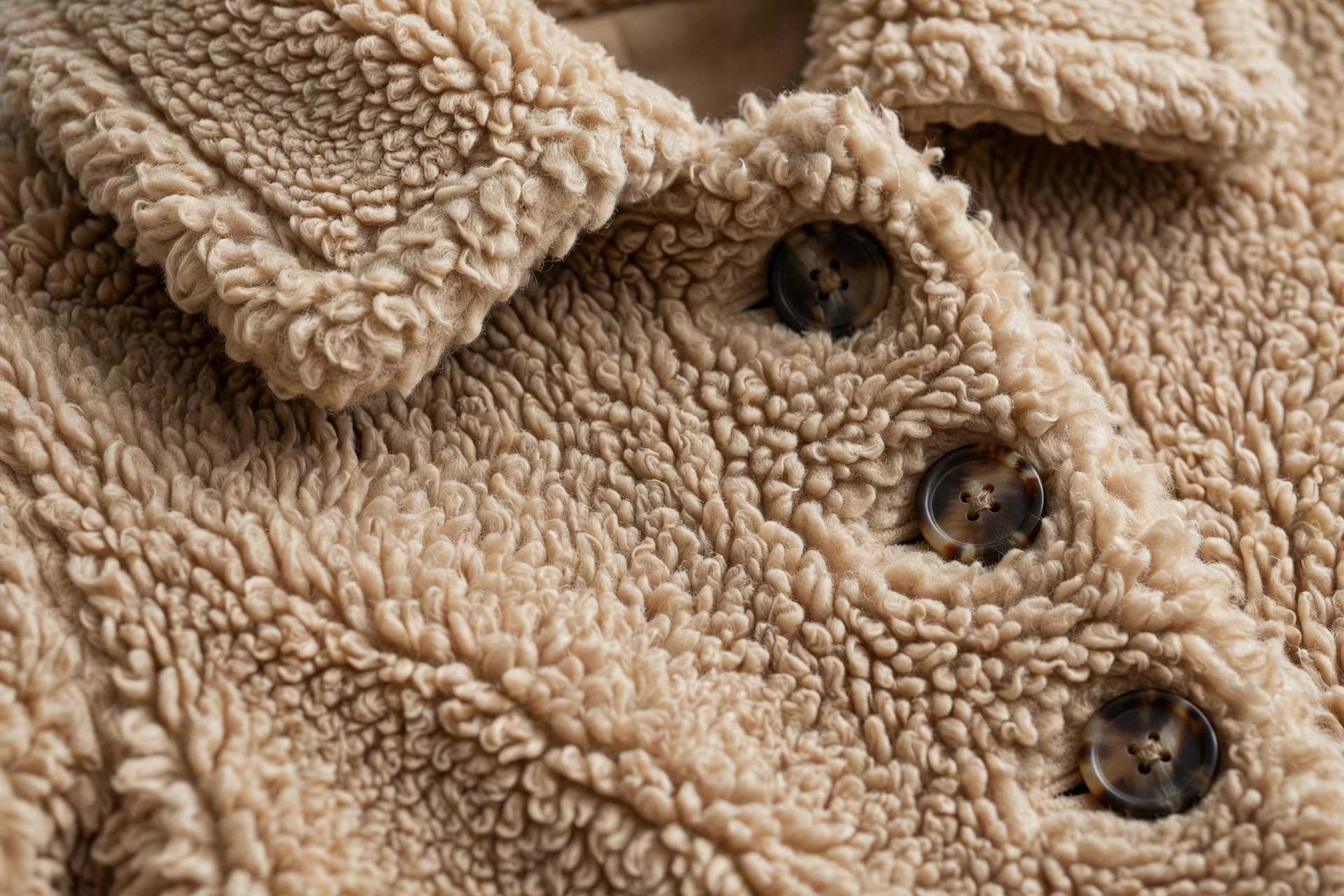
The classic is the longline coat: below the knee, wide lapels, one or two buttons, in camel, cream, or chocolate. It is the warmest and most versatile cut, and the one that works over tailoring. The cropped teddy jacket ends at the hip or waist, often with a zip or poppers, and behaves more like a fleece jacket — good with high-waisted jeans and boots, less good in serious cold because it leaves legs bare.
Between those poles sit zip-front styles, which read sportier and seal draughts better than buttons, and button-front styles, which read smarter. Colour has moved well beyond camel: black, ivory, burgundy, forest green, and soft pastels all work in this pile, and darker shades hide city grime and pile wear far better than cream does.
How to Style a Teddy Coat
The coat brings the volume, so the rest of the outfit should stay comparatively slim. Casually, wear it over straight or skinny jeans, a fine-knit top, and ankle boots or clean trainers; the contrast between the bulky coat and a neat leg keeps the shape intentional rather than swamped. Over tailoring — a trouser suit, a midi dress, smart boots — a longline teddy works surprisingly well, softening formal clothes without looking sloppy, which is why it became a winter work staple.
Accessories should be simple and warm. An oversized scarf tucked into the open neck adds the layer the open front lacks, but choose one statement texture at a time: pile plus a huge scarf is plenty. Leather gloves and a structured bag sharpen the softness; a beanie keeps the look relaxed.
Teddy Coat vs Faux Fur Coat — and Caring for the Pile
The difference is the pile. Teddy borg is short, dense, and curly, with a matte, fleecy finish. A faux fur coat imitates animal fur with longer, straighter, often glossier fibres. That changes the mood — teddy is casual and cosy, faux fur is dressier and more dramatic — and usually the price, since longer faux fur costs more to make well. Teddy is also easier to wear daily; faux fur tends to be saved for going out.
Care
Shake the coat outdoors and brush the pile gently with a soft clothes brush to lift dirt and restore the curl; spot clean marks with a damp cloth rather than washing the whole garment. Wash only if the care label explicitly allows it, on a gentle cold cycle, and dry flat away from radiators, which can scorch synthetic pile. Store it hanging on a wide hanger with room around it, never vacuum-packed or crushed under heavier coats, or the pile will flatten in patches that brushing cannot revive.
Common Questions
- Is a teddy coat warm enough for winter?
- For dry, everyday winter cold, usually yes, especially a lined longline style worn over knitwear. In biting wind, wet snow, or hours outdoors, the pile alone is not enough, because wind passes through unlined borg. Add layers, or choose a technical coat for those conditions.
- What is the difference between a teddy coat and a borg coat?
- Nothing, in most shops. Borg is the name of the deep, curly pile fabric itself, and teddy describes the finished coat made from it. The two labels are used interchangeably for the same plush, teddy-bear style of coat.
- Can you wash a teddy coat?
- Only if the care label allows it. Many teddy coats are dry-clean or spot-clean only, and machine washing can mat the pile permanently. If washing is permitted, use a gentle cold cycle, dry flat away from heat, and brush the pile once dry.
- Is a teddy coat the same as a faux fur coat?
- No. A teddy coat uses short, dense, curly borg pile that looks like a teddy bear, while faux fur imitates animal fur with longer, straighter fibres. Teddy reads casual and cosy; faux fur reads dressier and usually costs more.
- How do you stop a teddy coat looking bulky?
- Keep what goes underneath slim: a fine knit, straight or skinny trousers, and a defined shoe. Leave the coat open when you can, choose a length that ends at a narrow point of the leg, and avoid adding a second bulky layer on top.
Winter Warmth and Style Series
This guide is part of the Apparel Search winter warmth and style series: the coats, scarves, and cold-weather pieces that make winter dressing both warm and good-looking. Browse the full series below.