Traditional Dress by Country · Mali
The Boubou and Bogolan of Mali
Mali dresses in earth and ceremony. The earth is bogolan — cotton cloth painted with river mud in black, ochre and white geometry, one of Africa's most recognisable textiles. The ceremony is the grand boubou, the great embroidered robe that Bamako wears for festivals and Fridays. Together they tell Mali's story: Bamana farmers' mudcloth, Dogon weavers on their cliffs, desert trade and river cities, and a capital whose tailors and dyers keep both crafts alive. This guide explains the robe, the cloth and their meanings.
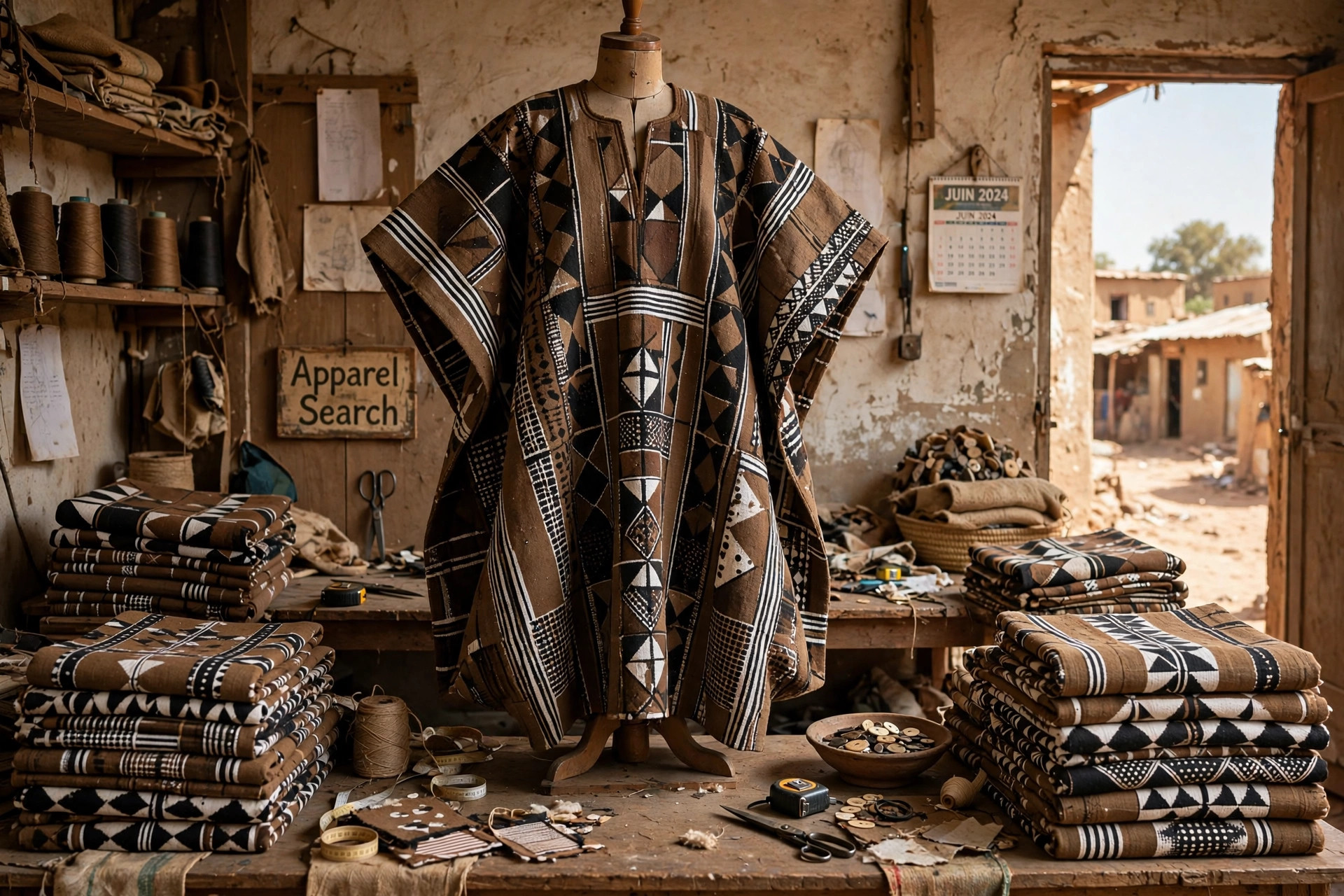
The Garment
The Grand Boubou of Mali
Mali's grand boubou shares its family with Senegal's robe — the same great width, the same embroidered neck, the same layered outfit of tunic and trousers beneath — but it carries a Malian accent shaped by the country's position at the meeting of Sahel, savanna and desert. Bamako, the capital on the Niger River, is a city of tailors and dyers where the boubou is everyday formal dress as much as festival wear, and where a man's robe wardrobe, like a library, is built over a lifetime.
The cloths differ from Dakar's. Fine Malian boubous use damask like their Senegalese cousins, but Mali adds its own great textiles to the robe: panels and whole robes of bogolan mudcloth, indigo-dyed cottons from a dyeing tradition of real depth, and the narrow-strip woven cottons that West African looms have produced for centuries. A Bamako celebration shows all of them at once — gleaming damask beside earth-toned mudcloth, indigo beside white — a textile census of the whole country.
Mali's dress history runs deep. The medieval empires of Ghana, Mali and Songhai made cities like Timbuktu and Djenné wealthy on trade that included cloth, and weaving and dyeing are documented in the region for many centuries. The Friday mosque at Djenné, the great mud-brick city, still gathers a congregation dressed in boubous and robes whose silhouettes would be recognisable in accounts centuries old. Traditional dress in Mali is not a revival; it is a continuity.
Women's dress shares the stage: tailored boubous and grand robes in dyed damask and prints, headwraps of sculptural ambition, and — for everyday and ceremony alike — wrappers and outfits in bogolan and indigo. Bamako's women dyers, working in cooperatives and family workshops, are among the masters of the mudcloth and indigo arts described below.
Anatomy
The Parts of the Outfit
The Malian outfit, layer by layer:
- Grand boubou
- The wide outer robe with embroidered neckline, worn over tunic and trousers. Malian examples range from white damask formality to robes incorporating bogolan panels — the combination shown in this guide's photograph.
- Tunic and trousers
- The under-layer set, often matching, visible at neck and hem. For daily wear the tunic alone, without the grand robe, is standard dress across Mali.
- Bogolan garments
- Shirts, robes, wrappers and jackets cut from mudcloth, worn by men and women. A bogolan shirt with jeans is Bamako street style; a full bogolan robe is a statement of cultural pride.
- Indigo dress
- Deep blue indigo-dyed cloth, in robes, wrappers and headwraps — the colour of an old and skilled Malian dyeing tradition, worn across the country.
- Head coverings
- Women's headwraps (moussor) in matching or contrasting cloth; men's caps and, in the north, the wrapped turbans of the desert peoples, worn against sun and sand.
- Dogon and Bamana cloth
- Regional woven cottons — Bamana strip-weaving and the indigo-and-white cloths associated with Dogon country — worn locally and traded nationally.
Variations
Dress Across Mali's Regions
Mali is one of Africa's largest countries, and its dress maps its geography:
| Region / people | Signature dress | Notes |
|---|---|---|
| Bamana (Bambara) heartland | Bogolan mudcloth, strip-woven cotton, boubous | The mudcloth tradition's home, around Bamako, Ségou and Bougouni |
| Bamako | Grand boubous in damask and bogolan, tailored fashion | The capital's tailors and women dyers set national style |
| Dogon country | Indigo and white woven cloth, distinctive caps | Cliff villages of the Bandiagara escarpment; cloth tied to local ritual life |
| The north — Timbuktu and the desert | Flowing robes and turbans in indigo and white | Desert dress shaped by sun, sand and Tuareg and Songhai traditions |
| Djenné and the river cities | Boubous and robes of the old trading cities | Centuries of Niger River trade in cloth and dress |
As everywhere in this series, the table simplifies: Malian families mix regional dress freely, a Bamako wardrobe holds cloth from every region, and festival dress is chosen for beauty and meaning rather than by rule. What unifies the country is the robe silhouette and the respect for cloth itself — its making, its symbols and its makers.
Cloth and Pattern
Bogolan: The Mudcloth Story
Bogolan — bogolanfini, 'mud cloth' — is made by a process unlike any other in this series. Cotton is first woven, traditionally in narrow strips sewn together, then soaked in a dye of pounded leaves that prepares it to receive the design. The artist then paints the pattern with fermented river mud, rich in iron, which reacts with the treated cloth to give a deep black; the unpainted areas are bleached in the sun to white, and ochre and other earth tones complete the classic palette. The work is slow, seasonal and skilled, and traditionally — in Bamana country — it is women's art, passed from mother to daughter.
Our World Textiles guide to mudcloth and bogolan follows the process stage by stage — the leaf bath, the mud painting, the sun bleaching — and explains how to tell hand-painted cloth from the printed imitations that now flood tourist markets. Read it alongside this guide: the robe above makes full sense only when the cloth's making is understood.
The patterns are a language, though one that requires humility from outsiders. Bogolan motifs include geometric signs and figures that makers associate with proverbs, histories, animals and protective meanings; particular cloths were traditionally made for hunters, for young women at life transitions, and for protection in childbirth. Modern Bamako artists — Mali has produced internationally exhibited bogolan painters — work the tradition into contemporary art and fashion, while village makers continue the older repertoire. A buyer should know two things: that printed 'mudcloth pattern' fabric is a different, cheaper thing, honestly enjoyable as print; and that real bogolan, smelling faintly of earth and iron, with the design's slight hand-drawn life in every line, is unmistakable once handled.
Living Dress
Boubou and Bogolan Today
In Bamako the boubou never left: Fridays, weddings, naming ceremonies and official life all dress in robes, and the capital's tailors — like Dakar's — work to festival deadlines, above all Tabaski and Ramadan's end. Bogolan has had a second, wider life: from the 1980s onward Malian designers carried it into international fashion, and mudcloth shirts, jackets and robes became a global signifier of African style, worn from Bamako to Brooklyn. That fame is double-edged — it sustains makers and floods markets with imitations at once — and Malians distinguish sharply between the real cloth and its printed shadow.
The crafts behind the dress — weaving cooperatives, women's dyeing groups, embroidery and tailoring workshops — are part of the industry picture on our Africa clothing industry page. For the robe as wearable fashion beyond Mali, our men's boubou and agbada guide, linked below, sets the Malian grand boubou beside its Senegalese and Nigerian cousins.
Wearing
Wearing Basics
The grand boubou is worn as in Senegal: sleeves hitched over the shoulders, hem sweeping, underlayers neat. Bogolan garments wear like any honest cotton — a mudcloth shirt or jacket is straightforward clothing — with one consideration: the cloth is relatively heavy and its surface pattern is the garment's whole value, so it is worn as the outfit's statement piece, over plain companions. Headwraps complete women's outfits in matching bogolan or contrasting dyed damask.
Fit for robes follows the family rule — volume and length over tailoring — while tailored bogolan follows ordinary fit. When commissioning in Bamako, agree whether panels will be genuine hand-painted cloth; a robe 'with bogolan' may mean anything from the real art to a printed panel, and the price difference is the difference between the two.
Keeping
Care and Storage
Genuine bogolan should be washed sparingly and gently: cool water, mild soap, no soaking for long periods and no bleach, dried in shade. The mud-based black is durable — the cloth was made for wear — but harsh washing dulls the contrast that is its beauty, and the leaf-treated ground can fade unevenly. Many owners dry-clean good bogolan or wash it rarely and air it often. Damask boubous follow the Senegalese rule: gentle cleaning, professional re-starching for festival shine.
Store mudcloth flat or rolled rather than folded sharply, since the painted surface can crack along a hard crease over years; keep it dry and aired against mildew in the rainy season. Indigo cloth improves with age and washing, softening like denim — one of the pleasures of owning it.
Acquiring
Buying and Collecting
Bamako's artisan markets and the cooperatives of Ségou and other mudcloth towns are the places to buy bogolan, ideally from the makers, who will explain a cloth's motifs and making. Handle it: real bogolan is hand-painted, its lines alive with small irregularities, its reverse showing the design's work, its weight honest cotton. Printed imitations are smoother, perfectly regular and much cheaper — buy them as prints if you like them, never at mudcloth prices. For robes, Bamako's tailors commission as Dakar's do; bring time, agree the cloth precisely, and order ahead of festivals.
Collectors value older Bamana cloths, hunters' shirts and documented pieces by known artists; the contemporary art end of bogolan — large painted cloths by Malian artists — is a recognised field. As with all ceremonial textiles in this series, some traditional cloths carry meanings their makers may not wish to sell as decoration; buying from makers, and listening to them, is both the ethics and the pleasure of the field.
Common Questions
Common Questions
What is bogolan?
Bogolan, or bogolanfini, is Mali's mudcloth: handwoven cotton treated with a leaf dye, painted with fermented river mud to give black designs, and sun-bleached to leave white and ochre patterns. Traditionally made by Bamana women, its motifs carry proverbial and protective meanings.
How is bogolan different from printed mudcloth fabric?
Genuine bogolan is painted by hand, strip by strip: its lines have small irregularities, the design's work shows on the cloth, and it carries a faint earthy smell. Printed imitations are perfectly regular, smooth and much cheaper. Both are sold in Mali's markets — the skill is knowing which you are paying for.
What do Malian men wear for festivals?
The grand boubou: a wide, embroidered robe over a tunic and trousers, in damask, indigo or robes incorporating bogolan panels. Fridays, weddings, naming ceremonies and the Eid festivals all call for the robe, and Bamako's tailors work to festival deadlines year-round.
What is Dogon cloth?
The woven cottons of Dogon country, around the Bandiagara escarpment — classically indigo and white cloths and distinctive local dress tied to the region's villages and ritual life. Dogon weaving is one of several regional Malian traditions alongside Bamana mudcloth and strip-weaving.
How should bogolan be washed?
Sparingly and gently: cool water, mild soap, no bleach and no long soaking, dried in shade. Harsh washing dulls the black-and-white contrast. Many owners air bogolan often and wash it rarely, or dry-clean their best pieces.
Keep Exploring
More to Explore
In This Series
Traditional Dress by Country
The series hub — every country guide, from the hanbok of Korea to the kilt of Scotland, as each is published.
Visit the hub ↑Africa Clothing Industry
Apparel Search’s Africa clothing industry page — the wider apparel and textile sector across the continent that these traditional crafts sit within.
Explore ↑Go Deeper
Search Apparel Search