Traditional Dress by Country · Senegal
The Boubou of Senegal
Few garments make an entrance like a Senegalese boubou. Yards of gleaming damask, embroidered at the neck with patient geometry, falling in great sleeves from the shoulders — the grand boubou, or grand mbouba, turns walking into ceremony. Dakar is famous across West Africa for elegance, and the boubou is its masterpiece: worn by men and women, cut by master tailors, and reinvented every season. This guide explains the robe's forms, its cloths and embroidery, when it is worn, and how Dakar keeps it at the cutting edge.
The Garment
What a Boubou Is
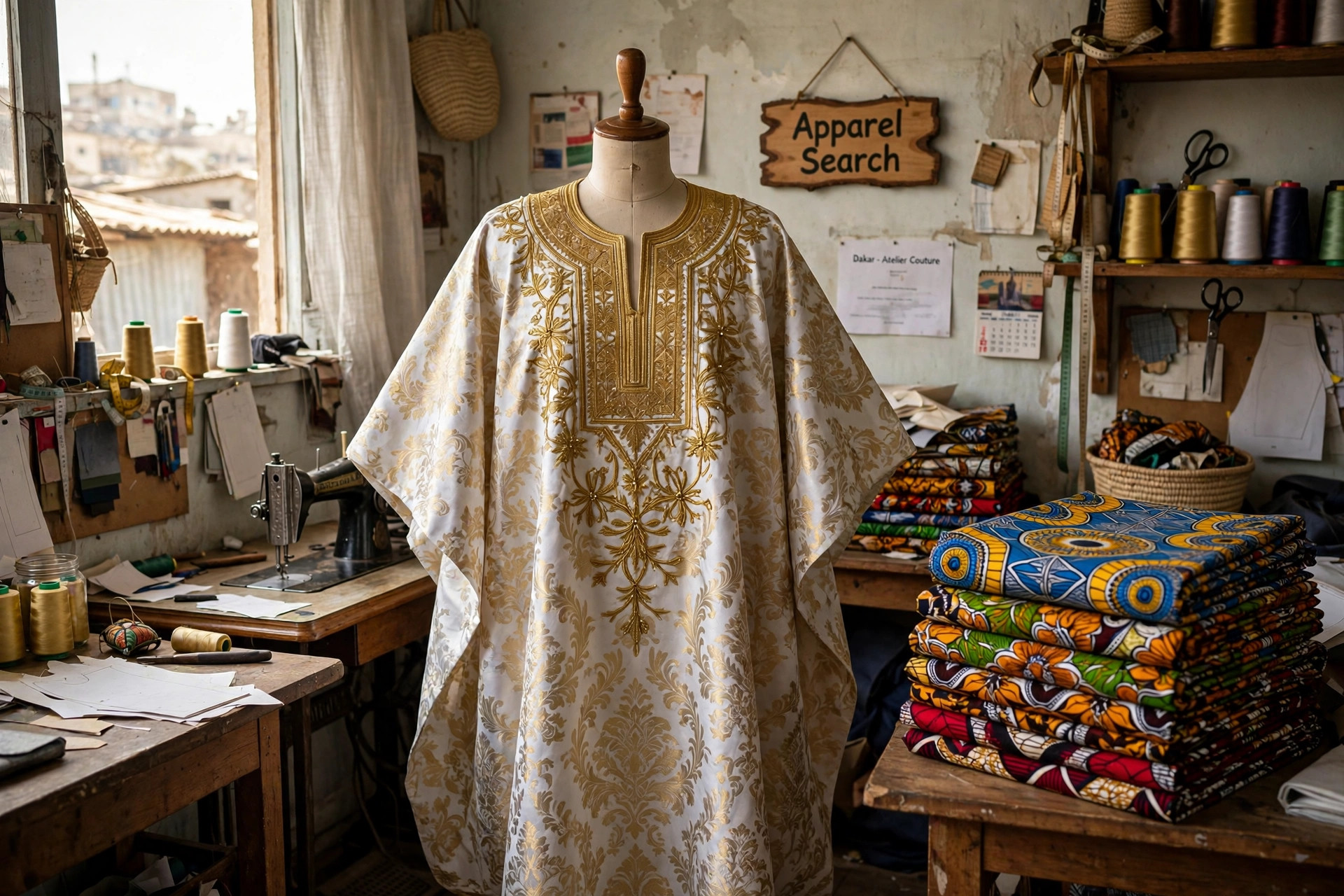
The boubou — grand mbouba in Wolof for the grand form — is a wide, flowing robe worn across West Africa, and in Senegal it reaches a particular refinement. The grand boubou is cut enormously wide, with great sleeves formed by the cloth's full width falling from the shoulder, a round or V neckline finished with embroidery, and a length that sweeps the ground. Under it men wear a shorter tunic and trousers; the robe is the public layer, the one that carries the embroidery, the shine and the statement. Women's boubous follow the same generous logic in brighter cloth and bolder pattern.
The robe belongs to a family that spans the Sahel and the coast — the agbada of Nigeria, the boubous of Mali and Mauritania, the gowns of the Hausa world — shaped by centuries of trade, Islam and court culture moving along the Niger and across the desert. Senegal's version is distinguished by the confidence of its capital: Dakar, long a fashion city, treats the boubou not as folklore but as current fashion, with tailors' ateliers producing seasonal variations and clients who commission robes the way other capitals commission suits.
Cloth is the boubou's first luxury. The prestige fabric is damask — bazin, especially the richly finished bazin riche — a cotton damask with a woven pattern and a polished sheen, beaten and starched to a crisp lustre that catches light as the wearer moves. White and cream damask with tonal embroidery is the classic of classics for men; women command the full colour range, in damask, in lace, and in the wax prints and modern fabrics that Dakar's markets stack to the ceiling.
Embroidery is the second luxury, concentrated where the eye lands: around the neckline, down the chest, at the cuffs and sometimes in a great panel on the back. Machine embroidery now does most of this work, in workshops whose skill is a Dakar specialty, while hand embroidery crowns the most expensive commissions. The finished robe can contain many metres of cloth — which is the point. In boubou culture, abundance of cloth is itself the elegance.
Anatomy
The Parts of the Outfit
A formal Senegalese outfit is layered, and each layer has its role:
- Grand boubou / grand mbouba
- The great outer robe: full-width sleeves, floor length, embroidered neck and chest. Worn for Fridays, festivals, weddings and formal life; the sleeves are gathered up over the shoulders or arms in practised gestures as the wearer moves and greets.
- Under-tunic and trousers
- Men wear a knee-length or shorter tunic and drawstring trousers beneath the robe, often in the same cloth for formal sets. The layers show at the neck and below the robe's hem.
- Women's boubou
- Cut wide like the men's but styled with women's tailoring — shaped waists in modern versions, dramatic headwraps (moussor) in matching or contrasting cloth, and jewellery to complete the picture.
- Embroidery
- The robe's signature: geometric and scrolling patterns at neck, chest and cuffs, worked by machine or hand in matching or metallic thread.
- Damask (bazin)
- The prestige cloth, polished and starched to shine. The quality grades of bazin are a Dakar market science in themselves.
- Accessories
- Leather slippers or fine shoes, a watch and, for women, gold jewellery and the headwrap. Nothing about a formal boubou outfit is accidental.
Variations
Forms of the Boubou
From the ceremonial maximum to daily dress, the family in descending order of grandeur:
| Form | Character | Worn for |
|---|---|---|
| Grand mbouba | Maximum width and length, finest damask, full embroidery | Eid festivals, weddings, Friday prayer, state and family occasions |
| Everyday boubou | Simpler cloth, less embroidery, sometimes shorter | Daily wear, work, neighbourhood life |
| Women's celebration boubou | Bright damask, lace or wax print, dramatic headwrap | Weddings, naming ceremonies (nguent), baptisms, parties |
| Modern tailored boubou | Slimmer cuts, contemporary fabrics, fashion detailing | Young Dakar fashion, offices, events |
Senegalese social life gives the robe constant work. Naming ceremonies, weddings that run for days, religious festivals — Tabaski (Eid al-Adha) above all, when new boubous are commissioned across the country and tailors work around the clock — and the weekly rhythm of Friday prayer all call for the robe at its best. A man's wardrobe is judged by his boubous the way another culture judges suits, and a family's standing is quietly displayed in the cloth it commissions for a festival.
Cloth and Pattern
Damask, Wax Print and the Embroiderer's Art
Bazin damask arrives in Senegal as imported cloth and is transformed locally: dyed in a glorious range of colours — Dakar's dyers are famous, and the city's tie-dyed and hand-dyed damasks in indigo, magenta and emerald are artworks in themselves — then finished, polished and tailored. The sheen of a great bazin robe is not in the cloth as bought; it is beaten and starched into it, and it fades a little with each wash, which is why festive robes are worn, aired and refreshed with the care other cultures give to silk.
Alongside damask runs the whole printed-cotton world. Our World Textiles guide to African wax prints explains the cloth that fills Dakar's markets and women's boubous alike — its manufacture, its named designs, and how to judge the genuine article. Senegalese women are among West Africa's most inventive wax-print dressers, mixing prints, lace and damask in single outfits with a confidence that fashion capitals study.
Embroidery workshops complete the chain. The patterns — interlacing geometry with roots in the region's Islamic art, scrolling florals, and modern motifs — are drawn, transferred and stitched at speed by specialists whose work decides a robe's price as much as its cloth. When you commission a boubou in Dakar, you are really commissioning three crafts at once: the dyer, the embroiderer and the tailor.
Living Dress
The Boubou Today, and Dakar Style
Senegal's reputation for elegance — the national art of sañse, dressing beautifully — is carried daily by the boubou and its women's counterparts. Dakar's tailoring culture is the engine: ateliers large and small take commissions, copy and improve designs at remarkable speed, and turn festival deadlines that would defeat other industries. Clients bring cloth, a photograph or a sketch, and return for fittings; a good tailor-client relationship lasts decades and dresses whole families.
For men arriving at this guide from the fashion side, our men's boubou and agbada guide, linked below, compares the Senegalese robe with its Nigerian and Malian cousins as clothing to wear today. The wider trade — cloth importing, dyeing, embroidery workshops and tailoring — sits within the continental industry surveyed on our Africa clothing industry page. And the diaspora carries Dakar style worldwide: Senegalese tailors work in Paris, New York and beyond, and a grand boubou at a Harlem or Brussels celebration is a flag planted by cloth.
Wearing
Wearing Basics
The grand boubou's width is managed, not merely worn. The great sleeves are hitched up over the shoulders or gathered onto the forearms, the robe's front is lifted slightly for stairs and thresholds, and the whole garment is in constant small motion — adjusting it gracefully is part of the wearer's poise. Underlayers should be neat, since they show at neck and hem, and shoes are polished: the robe forgives nothing below its hem. Women's boubous are completed by the headwrap, tied high and sculptural for celebrations, and by jewellery chosen against the cloth's colour.
Fit, in boubou terms, means volume and length: the robe should fall from the shoulders in an unbroken sweep, its hem just clearing the ground, its embroidery centred. A robe that is too short or too narrow has missed the garment's whole idea. When commissioning, bring your under-tunic measurements but let the tailor judge the robe's width — that judgement is what you are paying for.
Keeping
Care and Storage
Damask boubous are best dry-cleaned or washed very gently by hand, since the polished finish that gives bazin its shine diminishes with washing; many owners have festive robes professionally cleaned and re-starched, restoring the lustre for the next festival. Embroidery should be washed inside out and never wrung. Wax-print boubous wash more robustly — cool water, mild soap, shade drying to hold the colours.
Store robes folded with tissue at the folds or hung on padded hangers in a garment bag, away from light. The great enemy is a crease worn into the same fold through the embroidery, and mildew in humid months; air the wardrobe in the dry season. A well-kept damask robe serves for many festivals, and embroidered family robes are kept and re-worn across years with pride.
Acquiring
Buying and Commissioning
Dakar is the place: its markets — Sandaga and HLM among the famous names — stack damask, lace and prints in overwhelming choice, and tailors' ateliers cluster around them. The classic route is to buy cloth with advice (sellers grade bazin expertly and will say so), choose an embroiderer or a tailor who coordinates one, agree the design from the tailor's sample books and photographs, and allow real time — festival seasons, above all the run-up to Tabaski, fill every order book in the city. Ready-made boubous exist at every price, but a commissioned robe fitted to its wearer is the tradition's heart.
Judge a finished robe by its embroidery's evenness, the centring of the neck design, the sweep and level of the hem, and the cloth's hand and sheen. Abroad, Senegalese and West African tailors in diaspora cities offer the same commission culture. Buy the best cloth you can: in a boubou, the cloth is most of the garment, and a great bazin in a simple cut will outshine a poor cloth under heavy embroidery every time.
Common Questions
Common Questions
What is a boubou?
A boubou is West Africa's grand flowing robe — in Senegal, the grand mbouba — cut very wide with great sleeves, worn over a tunic and trousers by men and in bright tailored forms by women. Prestige versions use polished damask (bazin) with embroidery at the neck and chest.
What is bazin?
Bazin is the damask cotton cloth favoured for fine boubous. It is dyed — Dakar's dyers are famous — and finished with starch and polishing until it shines. That sheen is the mark of a festive robe, and it softens with washing, which is why good boubous are carefully cleaned and re-starched.
What is the difference between a boubou and an agbada?
They are cousins in the same West African grand-robe family. Agbada is the name most used in Nigeria, boubou (grand mbouba) in Senegal and the Francophone Sahel. Cuts, embroidery styles and cloth preferences differ by country and tailor, but the generous, ceremonial idea is shared.
When are grand boubous worn in Senegal?
For the high points of the calendar and of life: Tabaski and Korité (the Eid festivals), Friday prayer, weddings, naming ceremonies and formal visits. Tailors work at full stretch before Tabaski, when families across Senegal commission new robes.
Why is the boubou cut so wide?
The width is the elegance. Yards of cloth falling in great sleeves display the fabric's quality, move ceremonially, and keep the wearer cool in Sahelian heat. Managing the sleeves gracefully — hitching them over the shoulders as you greet and move — is part of wearing the robe well.
Keep Exploring
More to Explore
In This Series
Traditional Dress by Country
The series hub — every country guide, from the hanbok of Korea to the kilt of Scotland, as each is published.
Visit the hub ↑Africa Clothing Industry
Apparel Search’s Africa clothing industry page — the wider apparel and textile sector across the continent that these traditional crafts sit within.
Explore ↑Go Deeper
Search Apparel Search