Palletizers for Clothing Warehouses
Machines that build pallet loads of garment cartons — layer by layer, at a steady rate, in a stable pattern.
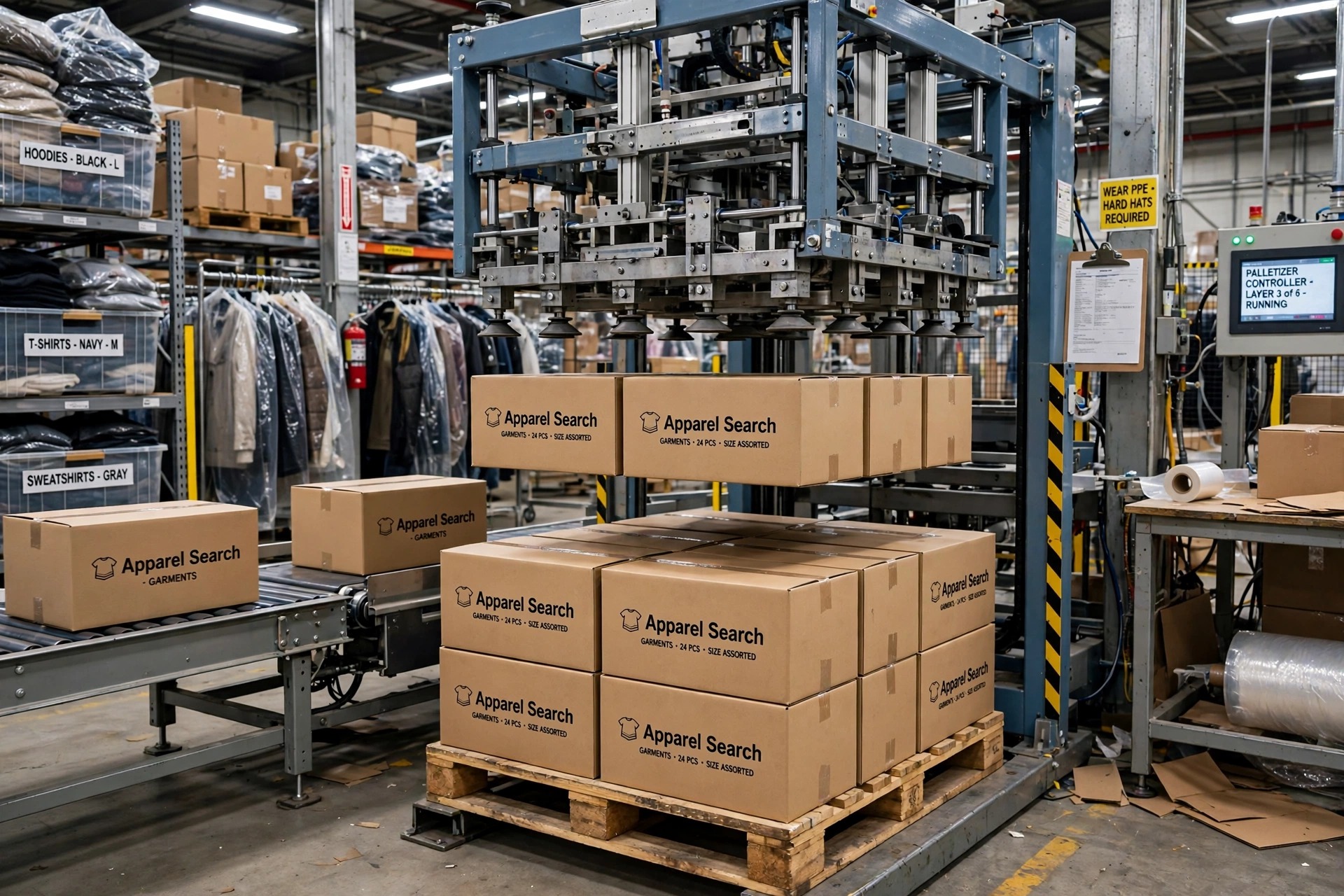
A palletizer builds the pallet for you: it takes a stream of cartons arriving on a conveyor and arranges them, layer by layer, into a stable, square, shippable pallet load. Hand stacking is slow, inconsistent and hard on backs; a palletizing machine does the same work at a steady rate, with the same interlocked pattern on every layer, and hands the finished pallet to strapping or stretch wrapping in exactly the condition those machines want. For a clothing warehouse shipping palletized cartons of garments every day, the palletizer is the machine that turns packing output into transport-ready freight.
Warehouse Machinery Types
How Palletizing Machines Work
Conventional palletizers divide by infeed height. In a high-level (high infeed) machine, cartons arrive on an elevated conveyor, are turned and pushed into rows, and each completed layer is formed on an apron and lowered gently onto the pallet, which stays in one place while the load grows. In a low-level (floor infeed) machine, cartons arrive at floor height and the formed layer is lifted to the pallet, or the row-building conveyor rises and lowers to meet the layer position. Low-level machines are easier to watch, clear and maintain because everything happens near the floor; high-level machines typically run faster and take less floor space for the same rate.
The layer pattern is the heart of the process. Cartons are turned — some along the layer, some across it — so each layer interlocks like brickwork, which is what keeps a tall load of light, slightly springy garment cartons from leaning or shedding boxes in transit. Pattern forming, soft case turning and low-pressure layer placement matter doubly with apparel cartons, which are lighter and more crushable than most palletized goods: the machine must be positive enough to square every carton and gentle enough not to damage the garments inside.
Robotic palletizers use an articulated arm to place cartons or whole rows one pick at a time. They are flexible — one robot can build several patterns on several pallet positions — and suit mixed-case work. Conventional machines are generally faster on one repeating case size and simpler in operation. Between the two sit hybrid layer-forming robots that pick a complete formed row or layer at a time. Rates across the families run from roughly 15 cases per minute for modest machines to 50 or more for high-speed conventional lines, and beyond that for specialised high-throughput systems.
Palletizing Clothing and Textile Cartons
Apparel freight has its own demands. Cartons vary constantly — a warehouse may palletize dozens of carton sizes in a week as styles and orders change — so quick pattern changeover from a stored recipe, selected on a touch screen, is worth more than a small advantage in top speed. Cartons are also frequently underfilled and flexible, which defeats case handling designed for rigid, fully packed boxes; soft turning systems and layer support during placement keep the load square. Unsupported shrink-wrapped cases, common for bundled garments, can also be palletized by machines designed to handle them without a carton at all.
The palletizer does not stand alone. Upstream it needs a metered, correctly spaced carton feed from the case conveyor; downstream it needs an empty-pallet dispenser feeding pallets one at a time, a pallet conveyor to carry finished loads away, and strapping or stretch wrapping to secure them — concurrent stretch wrapping is offered as an option on some machines, combining two steps of the line in one footprint. Slip sheets or layer sheets between layers can be placed automatically where loads need extra stability or where cartons must not scuff.
Safety and supervision complete the picture. Palletizing cells are fenced or light-guarded because layers and pallets move with real force; operators supervise from outside the guarding, clear faults through access gates, and keep the area free of the strap offcuts and broken pallet wood that cause most stoppages. A well-run cell needs one attentive operator where hand stacking the same volume would need a team.
Palletizer Manufacturers
Production Automation Inc.
Production Automation, Inc. is a manufacturer of economical, high-speed, continuous-motion, in-line palletizers, presenting the Series 2500. The Series 2500 Palletizer can handle a wide range of case sizes, including unsupported shrink-wrap cases, at a speed range of 25 cases per minute, with electric or hydraulic drive, heavy-duty tubular construction, a soft case turning system, a pattern forming area, low-pressure layer placement, a scissor-lift type pallet dispenser and an easy-to-use touch screen display.
Supplies: Series 2500 in-line palletizers, 25 cases per minute
Pasco Systems
Since 1976, PASCO has been designing and manufacturing rugged, reliable automatic palletizers for all types of industry. The company is headquartered in St. Louis, Missouri — large enough to solve complex material handling needs, yet small enough to offer personal attention, with callers able to talk directly to a design engineer, a field technician or the owner. PASCO designs, manufactures, integrates and installs each system around the customer's particular needs, with a team dedicated to the project.
Supplies: Automatic palletizers, designed, integrated and installed
Top Tier (TopTier)
TopTier manufactures palletizers exclusively, using patented technology and simplified modular designs for reliability and flexibility. Its palletizers are smaller, simpler and less expensive than traditional palletizing solutions, with models for both high and low product infeed, optional concurrent stretch wrapping, and higher-speed models with capabilities to 50 cases per minute. Instead of a conventional layer apron, TopTier palletizers use a patented layer head with a flexible apron; high product infeed models lower the layer head to a stationary pallet, and low product infeed models raise or lower the row build conveyor to meet the layer head.
Supplies: Palletizers for high and low infeed, to 50 cases per minute, optional concurrent stretch wrapping
Von Gal (Vongal)
With an installed base of more than 4,000 palletizers, von Gal delivers quality, reliable, high-performance palletizer solutions to diversified industries including baking, bottling, brewing, paint, pet food and publishing, backed by decades of material handling systems experience. Its palletizers deliver throughputs from 15 cases per minute (cpm) up to an accelerated 150 cpm depending on product and application, and handle virtually any size and type of package, case, carton, sack, bag, bale or bundle; the company also manufactures pallet conveyor products.
Supplies: Palletizers from 15 to 150 cases per minute, plus pallet conveyors
Choosing a Palletizer
Match the machine to three numbers: cases per minute at your seasonal peak, the range of carton sizes and weights, and the number of different pallet patterns you actually run. A warehouse palletizing one export carton size all day and a warehouse building mixed store-ready pallets have opposite needs — the first rewards raw conventional speed, the second rewards pattern flexibility and fast changeover. Floor space, ceiling height and the position of the wrapping operation decide the infeed style more often than the brochure does.
Then look at the ownership questions: change parts for your carton range, the supplier's installation and integration support, and service reach. The manufacturers listed below span the main approaches — economical high-speed in-line machines, mid-size makers emphasising personal design attention, compact patented layer-head designs, and large installed-base systems houses — so the shortlist for a clothing warehouse can cover every style of machine from one page.
Common Questions
What is the difference between high infeed and low infeed palletizers?
In a high infeed (high-level) palletizer, cartons arrive on an elevated conveyor and each formed layer is lowered onto a stationary pallet; these machines run fast and save floor space. In a low infeed (floor-level) machine, cartons arrive at floor height and the layer is lifted or the conveyor rises to meet it; everything stays near the floor, which makes the machine easier to watch, clear and maintain.
Can a palletizer handle clothing cartons without crushing them?
Yes, when the machine is specified for it. Apparel cartons are light, sometimes underfilled and easily crushed, so palletizers for this work use soft case turning, low-pressure layer placement and full layer support while the layer is set down, rather than the firmer handling designed for rigid, fully packed cases. Unsupported shrink-wrapped garment bundles can also be handled by machines designed for them.
How fast does a palletizer need to be for a clothing warehouse?
Fast enough for the seasonal peak, not the average day. Modest machines run around 15 to 25 cases per minute, higher-speed conventional models reach about 50, and large systems go well beyond that. Most apparel warehouses gain more from quick pattern changeover across many carton sizes than from top speed on a single size.