Palletizing Supplies
Palletizing supplies manufacturers directory for apparel manufacturers — for clothing warehouses and clothing factories.
Palletizing supplies are what a clothing warehouse or clothing factory uses to turn a stack of loose cartons into one stable, protected pallet load that a forklift can move and a truck can carry. This directory gathers the supply categories that sit around the pallet itself — shrink wrap, strapping machinery and palletizers — together with the warehouse pages a buyer needs alongside them: packaging manufacturers, pallet manufacturers, pallet trucks and slip sheets.
Palletizing Supplies Directory
Shrink Wrap: Holding the Load Together
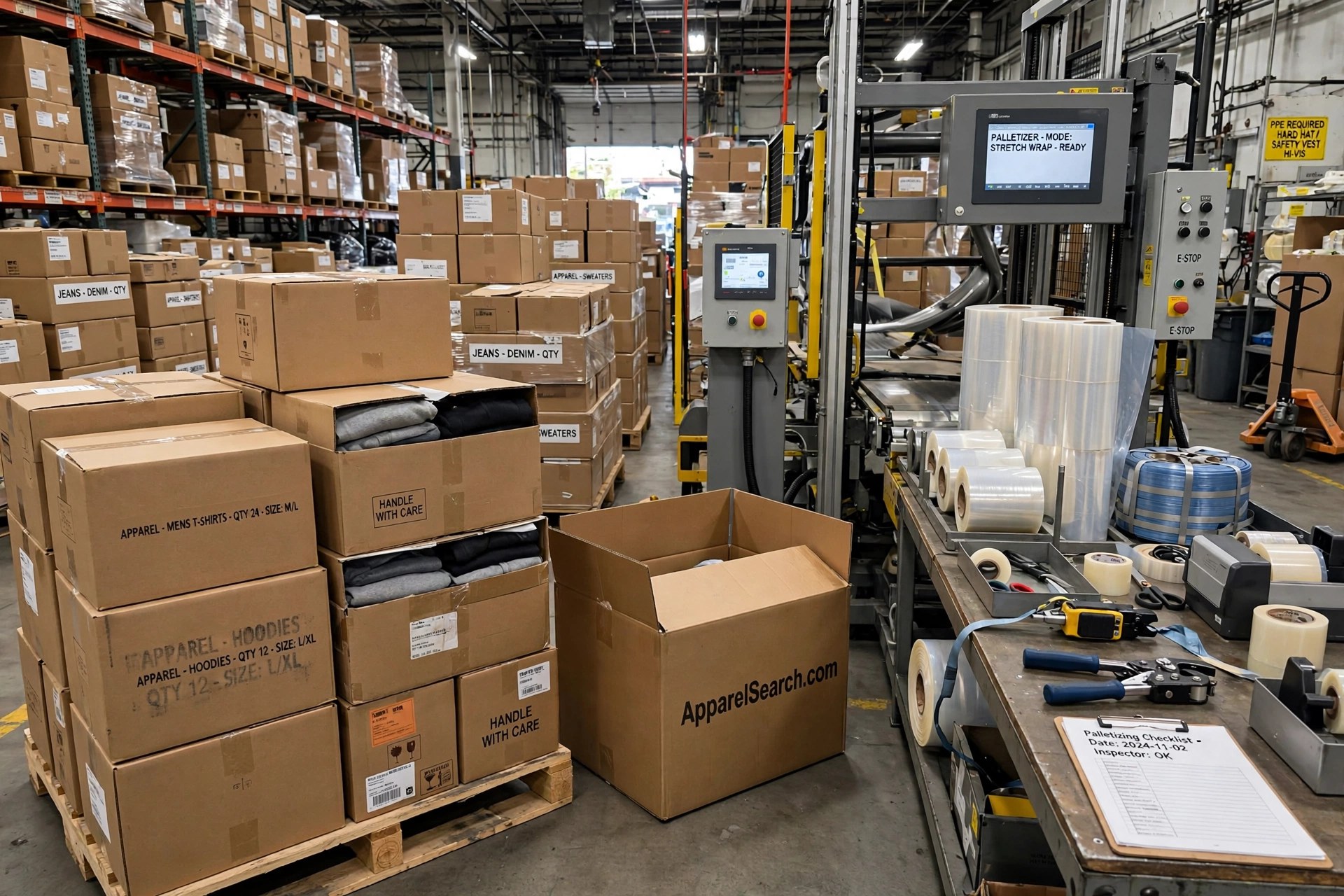
Shrink Wrap is the film stretched or shrunk around a built pallet load so the cartons travel as one unit. For clothing cartons the film does three jobs at once: it stops individual boxes shifting or toppling when the pallet is lifted and racked, it keeps dust and warehouse dirt off the outer cartons in storage, and it gives a quick visual check that a load has not been opened in transit. Wrap is applied by hand with a dispenser for occasional loads, or by a wrapper machine where a warehouse builds pallet loads all day, and it works alongside strapping rather than instead of it on heavy or tall loads.
Strapping Machinery: Banding the Load
Strapping Machinery applies and tensions the bands that lock a load to its pallet. Strapping matters most where film alone cannot hold the shape of the load — tall stacks, mixed carton sizes, or loads that will be handled several times between the factory and the store. Hand tools suit low volumes; semi-automatic and automatic strapping machines suit packing lines that band cartons and pallet loads continuously. Choosing between film, strap or both is a practical decision about how far the load travels, how often it is lifted, and how much protection the garments inside need from crushing and shifting.
Palletizers: Building the Load by Machine
Palletizers are the machines that place cartons onto pallets in a planned pattern, replacing hand stacking at the end of a packing line. A consistent machine-built pattern stacks squarer and more stably than a hurried hand build, which protects the clothing cartons at the bottom of the stack and makes the finished load easier to wrap, strap and rack. Palletizing machinery is a factory and high-volume warehouse purchase; smaller operations achieve the same result with a careful hand pattern, a pallet truck and good wrap.
Planning the Load
Are you looking for actual pallets? That page covers the manufacturers and the wood and plastic choices. For the load itself, learn about loading pallets from the pallet load calculator: plan how many cartons fit each layer and how high the stack can safely go for the pallet footprint in use, so the pattern interlocks, nothing overhangs the deck, and the finished load matches what the racking and the truck can accept. The Pallet Information page linked above covers the pallet types, sizes, covers, trucks and rack systems behind those decisions in full.
Choosing Palletizing Supplies for Apparel Cartons
Start from the carton, not the catalogue. Clothing cartons are light but bulky, and their corners crush long before their weight troubles a pallet, so the supply set should protect shape first: a wrap weight that holds the stack without pulling the top layer inward, strapping positioned over the strongest carton edges rather than across unsupported faces, and a stacking pattern the palletizer or the packing team can repeat identically on every load. Warehouses shipping mixed sizes benefit from keeping two film gauges and both hand and machine strapping on hand, while a single-product factory can standardize on one combination and buy it in bulk. Cost per load is the right comparison — a cheaper film that needs twice as many revolutions, or a strap that snaps and forces a rebuild, costs more in labour and damaged cartons than the supply it replaced.
Slip Sheets: The Supply That Replaces the Pallet
One supply in this directory takes the opposite approach: the slip sheet, a thin sheet of plastic or fibreboard placed under the load and pulled by a push-pull forklift attachment, removes the pallet from the shipment entirely. Slip sheets cost less than pallets, store almost flat and add no pallet height or weight to a load, which suits regular routes between equipped warehouses. They need the right attachment at both ends of the journey, so they complement rather than replace the wrap, strapping and palletizing supplies above for general warehouse use.
Common Questions
What counts as a palletizing supply?
Palletizing supplies are the materials and machines that turn loose cartons into a stable pallet load: shrink wrap and other packaging films that hold and protect the load, strapping and strapping machinery that band it, and palletizers that stack cartons onto pallets mechanically. The pallets themselves are covered separately on the Pallets page.
How do I work out how cartons should be loaded on a pallet?
Use the pallet load calculator linked on this page to plan the pattern before building the load: it works from the carton and pallet sizes so cartons sit squarely on the deck without overhang, which protects carton corners and keeps the wrapped load stable in racking and in transit.
Do palletizing supplies replace the pallet?
No. Wrap, straps and palletizing machinery all work with a pallet underneath the load. Warehouses that want to work without a pallet at all use slip sheets instead, pulled by a push-pull forklift attachment, and the Slip Sheets page linked above covers the manufacturers.