Pallet Trucks and Pallet Jacks
Manual, motorized and rider pallet trucks compared — the floor-level movers of the warehouse.
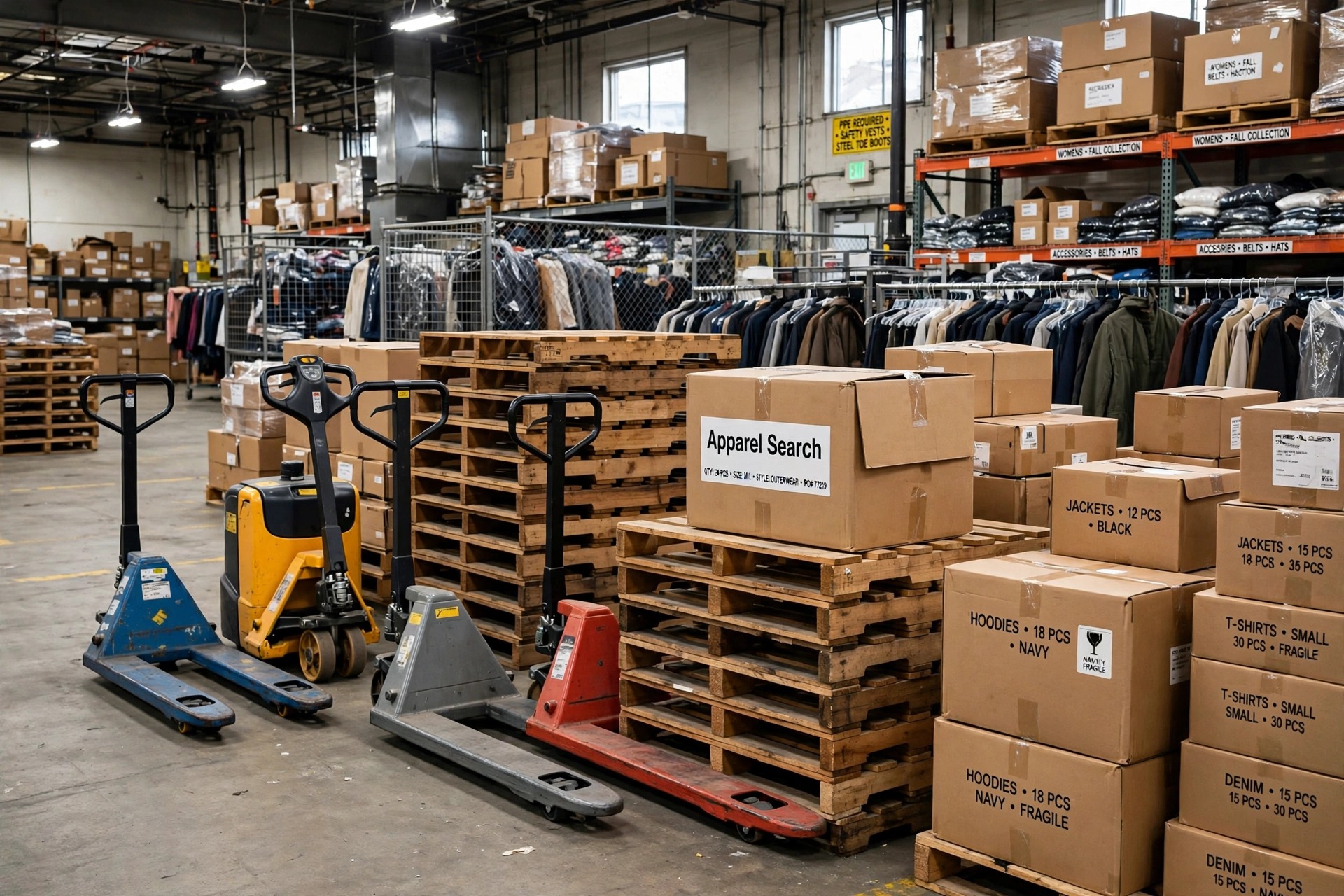
Pallet trucks — pallet jacks — are the floor-level movers of the warehouse: forks that slide into a pallet, lift it a few inches, and roll it where it needs to go. They come in three families that share this page as their overview: manual hand trucks pumped and pulled by the operator, motorized walkies that power the travel while the operator walks, and electric riders for long dock runs. Between them they handle more individual pallet moves in a clothing warehouse than every other machine type combined.
Fork Lift & Pallet Truck Types
- Counter Balanced Trucks
- Cushion Tire Truck
- Electric Rider Trucks
- Fork Lifts and Pallet Trucks
- Hand Pallet Trucks (Manual)
- Hand Pallet Trucks (Motorized)
- Narrow Isle Pallet Trucks
- Order Picker Trucks
- Pneumatic Tire Truck
- Reach Trucks
- Side Loaders
- Stackers
- Stock Selectors
- Straddle Trucks
- Used Fork Lifts
The Pallet Truck Family
A manual pallet jack is a hydraulic lever on wheels: a few pumps of the handle raise the forks, and a standard truck carries around 5,000 pounds without any power source at all. A motorized hand truck adds battery drive to the same compact shape, trading a little size for powered pulling on longer or heavier work. An electric rider carries the operator on a platform and doubles typical travel speed on the long runs of a distribution centre. Each family has its own page in this section with full detail.
Forks and wheels decide what a pallet truck can actually do in a given building. Fork overall width and length must match the pallets in use — standard, half, euro-style and the mixed import pallets apparel warehouses receive. Wheel compounds trade rolling effort against noise and floor care: nylon is hard and easy-rolling, polyurethane is the quiet all-rounder for sealed floors, rubber grips ramps and dock plates best.
Special versions fill the gaps: low-profile trucks for shallow import pallets, long-fork trucks for double pallets and garment-on-hanger loads, stainless and washdown trucks where hygiene rules, scale trucks that weigh as they lift, and high-lift scissor trucks that raise a pallet to working height as a mobile bench at packing stations.
Pallet Trucks in the Clothing Warehouse Day
Follow a carton through an apparel building and a pallet truck touches it at almost every stage. Inbound pallets are pulled from trailers and staged by truck. Cartons move to inspection benches, to storage aisles, to pick faces. Picked orders travel to packing, packed cartons to wrapping and shipping lanes, and returns back to inspection — nearly all of it at floor level, on pallet trucks, because the distances are short and the lifts are someone else's job.
That division of labour is the healthy pattern: pallet trucks move loads horizontally, and they hand over to stackers, reach trucks and counter balanced forklifts wherever a pallet must rise into rack. Warehouses get into trouble when pallet trucks are asked to do lifting work with ramps and improvised stacking, or when lifting trucks are wasted on floor-level shuttling that a pallet jack would do quicker.
Fleet discipline is light but real. Hand jacks need hydraulic oil, grease and wheel replacement; powered trucks add battery care and charger management. Parking with forks down, keeping trucks out of travel lanes when idle, and retiring bent forks promptly are the habits that keep a cheap, reliable machine type cheap and reliable.
Pallet Truck Manufacturers and Suppliers
Airtrax
Airtrax is a manufacturer of fork lift trucks listed here for its pallet truck range — a specialist maker among the larger full-line suppliers on this page.
Supplies: Fork lift trucks and pallet trucks
Big Joe Manufacturing Company
Big Joe began in 1951 with the IBH truck, created for loads too large for a person but too small to justify a sit-down forklift. Its walkie family grew to six styles and more than 250 models, manually propelled and power-drive, with lift capacities of 1,000 to 6,000 pounds and lift heights up to 204 inches, backed by a dealer network serving end users directly.
Supplies: Walkie pallet trucks and lift trucks, 1,000–6,000 lb
Clark Manufacturing
Clark is a pallet truck manufacturer whose lines also span trucks of 1,500 to 16,500 pound capacity — LPG, gasoline, dual fuel and diesel models, narrow-aisle stackers, electric riders and powered hand trucks. Over 250,000 Clark trucks work in North America and 350,000 worldwide, supported by more than 230 North American dealer locations and over 550 locations in more than 80 countries.
Supplies: Pallet trucks, powered hand trucks and electric riders
Hyster Global
Hyster's comprehensive line includes pallet trucks among more than 130 models, manufactured in 14 facilities and supported by over 600 dealers in more than 100 countries. The firm traces to the Willamette-Ersted Company of 1929, adopted the Hyster name in 1934 from the loggers' 'Hoist 'er!' call, joined NACCO in 1989 and is headquartered in Greenville, North Carolina.
Supplies: Pallet trucks from hand models to powered riders
Komatsu Ltd.
Komatsu, founded in Tokyo in 1921 and building forklifts since 1945, offers electric, gasoline, LPG and diesel trucks from 2,000 to more than 35,000 pounds through over 145 dealers in the Western Hemisphere. Its United States forklift operations date to 1976, with American manufacturing from 1987 and a consolidated Komatsu Forklift U.S.A. from 1993.
Supplies: Pallet trucks within a 2,000–35,000+ lb forklift range
Raymond Corporation
Raymond made the first hydraulic hand pallet truck in 1930 and today builds hand pallet jacks, walkie pallet trucks, walkie stackers and end- and centre-rider pallet trucks. Operating since 1922, the company pairs its trucks with warehouse planning, operator training and parts and service support aimed at total operating cost.
Supplies: Hand, walkie and rider pallet trucks — including the first hydraulic hand truck of 1930
TCM Fork Lifts
TCM is one of the world's leading lift truck producers, recognised for research and development across lift trucks and other material handling products, using current technology, product experience and customer input to improve its range, which includes pallet trucks for warehouse work.
Supplies: Pallet trucks and lift trucks
Yale Materials Handling Corporation
Yale sells pallet trucks across its class system — motorized hand trucks and electric riders among them — through authorised dealers, as part of the NACCO Materials Handling Group. Yale trucks are manufactured in the United States, the United Kingdom, the Netherlands, Brazil, Ireland, Italy, Japan, Mexico and Scotland, and the range is supported by dealer service technicians and fleet financing and management services.
Supplies: Motorized hand and rider pallet trucks with dealer support
Buying Pallet Trucks for Apparel Work
Count moves before money: how many pallet moves a day, over what distance, at what weight. Occasional short moves need hand jacks; daily trailer work justifies walkies; big-building dock runs justify riders. Match fork dimensions to your true pallet mix — including the shallow import pallets that standard forks sometimes cannot enter — and standardise wheel compounds across the fleet so spares are simple.
The suppliers below cover the family from hand jacks to riders. For specifications and model-level advice, contact the supplier for the type you need — the manual, motorized and rider pages in this section each list their own suppliers as well.
Common Questions
Is a pallet truck the same as a pallet jack?
Yes — the two names describe the same machine. 'Pallet jack' is the common North American term, especially for the manual hydraulic type; 'pallet truck' is the broader term covering manual, motorized walkie and rider versions. Suppliers in this guide use both, and the pages in this section treat them as one family.
How high does a pallet truck lift?
Only a few inches — typically three to four inches of fork lift, just enough for the pallet to clear the floor and roll. Pallet trucks are horizontal transport. High-lift scissor models reach bench height for packing work, but storing pallets in racking is the job of stackers, reach trucks and forklifts.
How long do pallet truck wheels and forks last?
Load rollers and steer wheels are wear items: on busy apparel docks, polyurethane wheels commonly need replacement every year or two, sooner if they run over strapping and debris. Forks last the life of the truck unless bent by misuse — prying, towing or carrying point loads on the fork tips — which is why bent-fork trucks should be retired at once.