Stock Selectors
Light operator-up trucks for selecting individual items in stockrooms and smaller warehouses.
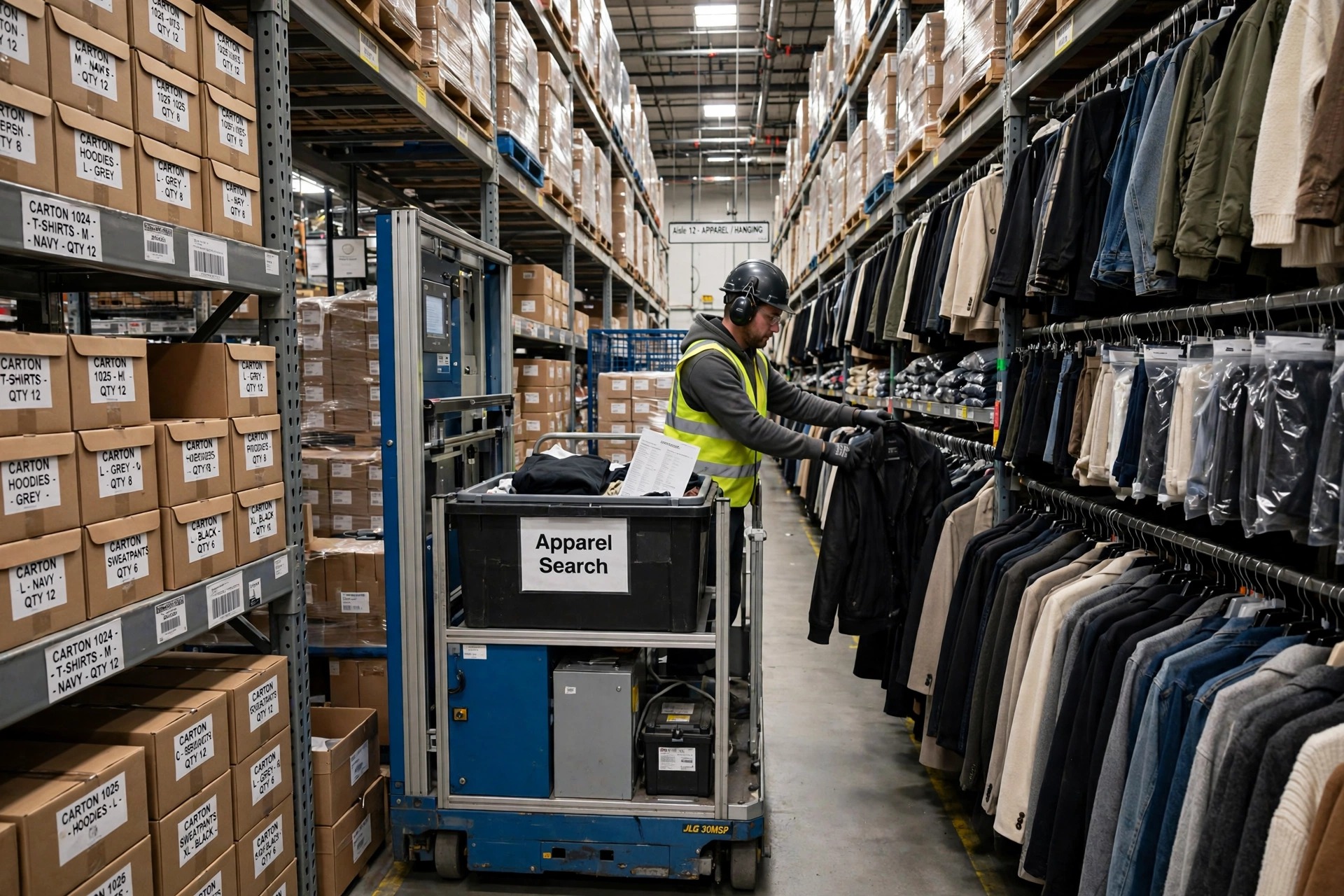
A stock selector is a light operator-up truck: the operator stands on a platform that rises with the load forks or tray, drives along the shelving, and selects individual items — a carton here, a garment there — for orders, counts or replenishment. It is the smaller, simpler relative of the order picker truck, sized for stockrooms, parts and trim stores, and the picking aisles of small and mid-size clothing warehouses where a full distribution order picker would be too much machine.
Fork Lift & Pallet Truck Types
- Counter Balanced Trucks
- Cushion Tire Truck
- Electric Rider Trucks
- Fork Lifts and Pallet Trucks
- Hand Pallet Trucks (Manual)
- Hand Pallet Trucks (Motorized)
- Narrow Isle Pallet Trucks
- Order Picker Trucks
- Pallet Trucks / Pallet Jacks
- Pneumatic Tire Truck
- Reach Trucks
- Side Loaders
- Stackers
- Straddle Trucks
- Used Fork Lifts
What a Stock Selector Does
The platform rises just high enough to put every shelf within comfortable reach — in stock selector terms that usually means working levels up to about four or five metres, though the class shades into order pickers above that. The load deck or forks carry a pallet, a tote or a cage, and the operator builds the selection as the truck travels: this size run for one store, those trims for a production order, a counted quantity for a stock check.
Because the work is items rather than pallets, the machine is judged by access, not capacity: how precisely it stops at a location, how safely the operator reaches both sides, how the controls travel with the platform, and how quickly it lowers and moves on. Loads are light — a few hundred pounds of garments and cartons — and the trucks are correspondingly compact, with tight turning for stockroom aisles.
Fall protection and platform discipline follow the order picker pattern: harness and lanyard at height, gates closed to travel, reduced speed when raised, and no loads carried on the platform rails. The machines are electric, quiet and clean, made for indoor work around stock that dust and exhaust would damage.
Stock Selection in Apparel Stockrooms
The classic stock selector jobs in the clothing industry are selection jobs. Store replenishment in a brand's own distribution stockroom: one of each size and colour, gathered from many shelves into one cage. E-commerce and sample-room picking: small, mixed, accuracy-critical selections. Trim and findings stores in factories: buttons, zips, labels and thread selected against a production bill of materials. Cycle counting everywhere: the selector takes the counter to the stock instead of bringing stock down to be counted.
Accuracy is the economic argument. A selector route directed by the warehouse system — location by location, scan by scan — makes far fewer errors than ladder-and-trolley picking from the same shelves, and it removes the manual handling injuries that come with carrying cartons down ladders and steps. For high-value garments the security of a directed, scanned selection also matters.
Where selection volume grows into full-shift case picking from tall racking, the work graduates to order picker trucks, which are built heavier for exactly that duty — the order picker page in this section describes the step up.
Companies Supplying Stock Selectors
Big Joe Manufacturing Company
Big Joe's walkie lift truck family — born with the IBH truck of 1951, designed for work too big for a person and too small for a sit-down forklift — grew to six styles and over 250 models in manual and power-drive forms, with lift capacities of 1,000 to 6,000 pounds and lift heights up to 204 inches. Its stock selector and stacker types serve exactly the operator-up selection work this page covers.
Supplies: Stock selectors and walkie lift trucks, 1,000–6,000 lb
Stock Selectors Versus Ladders and Steps
Many stockrooms still pick from rolling ladders and mobile steps, and for genuinely occasional access that is fine. The selector earns its place when access is daily: it is faster between locations, carries the picked goods with it, keeps the operator's hands free at a stable working height, and removes the climb-with-carton problem entirely. The dividing line is frequency and height — daily picking above the second shelf level is selector work.
Buy for your aisle width and your top shelf, keep the harness inspection in the same routine as the truck's daily check, and the machine will quietly organise a stockroom's whole working day.
Common Questions
How is a stock selector different from an order picker?
Scale and duty. A stock selector is the lighter machine, built for selecting individual items, counting and replenishing in stockrooms and smaller warehouses at low and medium heights. An order picker is heavier distribution equipment for full-shift case picking from tall racking. Suppliers use the terms loosely, so compare platform height, capacity and duty rather than the name alone.
What work suits a stock selector in a clothing business?
Small mixed selections: store replenishment picks of one or two pieces per size and colour, sample and e-commerce picking, trim and findings selection against production orders, returns put-away, and cycle counting. Anywhere an operator repeatedly needs to reach shelves above ground level and carry selected goods away, the selector is the tool.
Do stock selector operators need a harness?
Yes, whenever working at height on the raised platform: a full-body harness with the lanyard attached to the machine's anchor, gates closed before travel, and specific training for operator-up equipment. The rule is the same as for order pickers — the platform is a workplace at height, and it is equipped and treated like one.