Stackers
Pallet trucks with a mast — lifting into low and medium racking without a full forklift.
A stacker is a pallet truck with a mast: it moves pallets at floor level like a walkie, then lifts them — typically two to five metres — to stack them or place them in low and medium racking. Stackers fill the gap between the pallet jack, which cannot lift to storage at all, and the forklift or reach truck, which costs far more and needs more room. For small and mid-size clothing warehouses, stockrooms and factory stores, a stacker is very often the first — and only — lifting truck the business needs.
Fork Lift & Pallet Truck Types
- Counter Balanced Trucks
- Cushion Tire Truck
- Electric Rider Trucks
- Fork Lifts and Pallet Trucks
- Hand Pallet Trucks (Manual)
- Hand Pallet Trucks (Motorized)
- Narrow Isle Pallet Trucks
- Order Picker Trucks
- Pallet Trucks / Pallet Jacks
- Pneumatic Tire Truck
- Reach Trucks
- Side Loaders
- Stock Selectors
- Straddle Trucks
- Used Fork Lifts
Straddle, Counter Balanced and Rider Stackers
Three layouts organise the family. Straddle stackers carry the load between outrigger legs that pass on either side of the pallet — simple, stable and light, but the legs need open-bottom pallets or rack arrangements they can enter. Counter balanced stackers use a rear counterweight like a small forklift, so they can pick any pallet from the floor or a dock, at the price of a longer, heavier machine. Rider stackers add a fold-down platform and higher travel speeds for buildings where the stacker also does the horizontal transport.
Power is electric throughout the modern family, with manual and semi-powered versions at the light end for stockrooms. Capacities run from about 1,000 pounds on compact walkie stackers to around 6,000 pounds on the largest walkie and rider models, with lift heights to roughly 200 inches on the tallest — figures the suppliers below publish for their ranges. Forks may be adjustable in width on straddle models to suit different pallet sizes.
The stacker shares its controls and its walking-operator safety logic with the motorized pallet truck: tiller steering, powered travel and lift, automatic speed reduction at tight tiller angles, and a reversing safety switch. Operators walk the same routes and need the same training discipline.
Stackers in Small and Mid-Size Apparel Warehouses
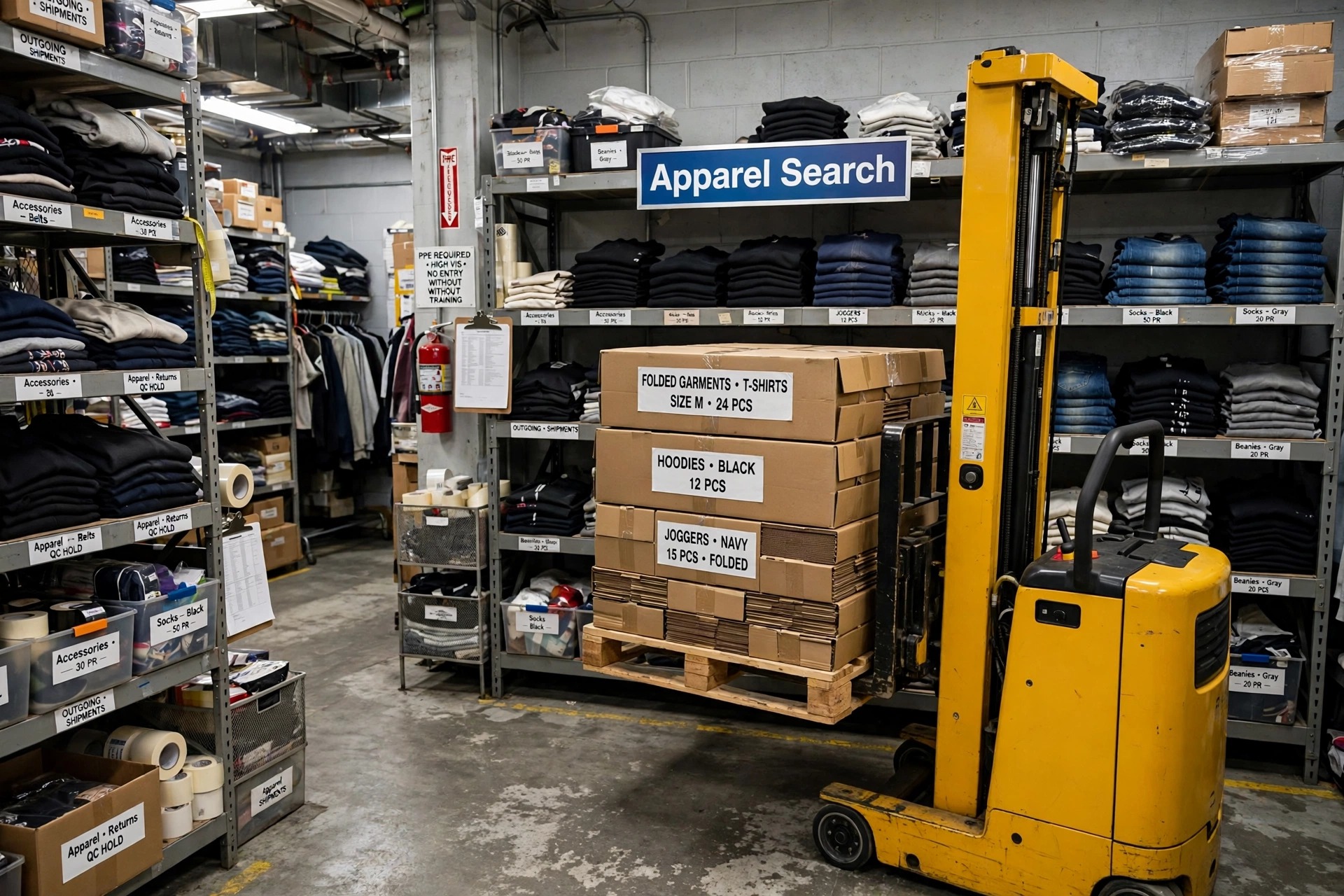
The stacker's natural work is the racking of a growing apparel business: inbound pallets lifted into the first two or three beam levels, case picking replenished from the stacker itself, finished cartons stacked ready for collection. It loads and unloads vans and small trucks at dock level, works inside mezzanine goods areas where a forklift cannot go, and stores fabric rolls and trims in factory stockrooms between production runs.
The limits arrive with scale. Stackers are slower than reach trucks, lift lower, and work one pallet at a time with a walking operator — at distribution volumes the labour cost per pallet overtakes the machine saving. Aisle width is the other boundary: a straddle stacker still needs room to turn with its load, so high-density narrow aisle storage belongs to reach trucks and the narrow aisle family.
Maintenance is light: battery care, mast chain and roller inspection, fork and leg straightness checks. Because stackers often work close to pedestrians in stockrooms, the daily walk-around — horn, controls, safety switch, wheels — matters more than the machine's simplicity suggests.
Companies Supplying Stackers
Komatsu Ltd.
Komatsu lists stacker trucks within a forklift range of 2,000 to more than 35,000 pounds in electric, gasoline, LPG and diesel models. The company was founded in Tokyo in 1921, has manufactured forklifts since 1945, began United States sales in 1976 and manufacturing in 1987, and distributes through more than 145 authorised dealers in the Western Hemisphere.
Supplies: Stacker trucks and a full materials handling range
Raymond Corporation
Raymond builds walkie stackers among hand pallet jacks, walkie pallet trucks, rider pallet trucks, counterbalanced trucks, Reach-Fork trucks, order selectors and swing-reach machines. The company introduced the first hydraulic hand pallet truck in 1930 and the first narrow aisle lift truck in 1951, and offers warehouse layout consulting alongside the trucks — useful when a stacker purchase is really a first-racking decision.
Supplies: Walkie stackers and warehouse layout consulting
Choosing a Stacker
Start from the pallet and the rack: open-bottom pallets and low rack point to a simple straddle model; closed pallets, dock work or mixed pallet types point to counter balanced. Then the heaviest load at full lift height — stackers derate steeply with height — and the travel distances, which decide walkie against rider. Check the lowered mast height against doorways and mezzanine edges; more stackers are ruled out by a lintel than by a load chart.
For higher racking or faster cycles, step up to the reach truck page; for floor-level moves alone, the pallet truck pages are the cheaper answer.
Common Questions
How high can a stacker lift?
Typical stackers lift from about 2 metres to just over 5 metres (roughly 200 inches on the tallest walkie models) — enough for two or three beam levels of racking. Capacity falls as lift height rises, so check the rating at your top beam, not at floor level, before buying.
Does a stacker need open-bottom pallets?
Straddle stackers do: their outrigger legs pass either side of the pallet, so the pallet must let the legs through and the forks in. Counter balanced stackers carry the load on a counterweight instead and can pick up any pallet, including closed-bottom and floor-standing loads — one reason they cost more.
Can a stacker replace a forklift?
For low racking, moderate volumes and indoor work, often yes — that is the stacker's purpose. It cannot match a forklift's lift height, speed, outdoor ability or capacity, and it works with a walking operator, so busy docks and tall distribution racking still belong to forklifts and reach trucks.