Straddle Trucks
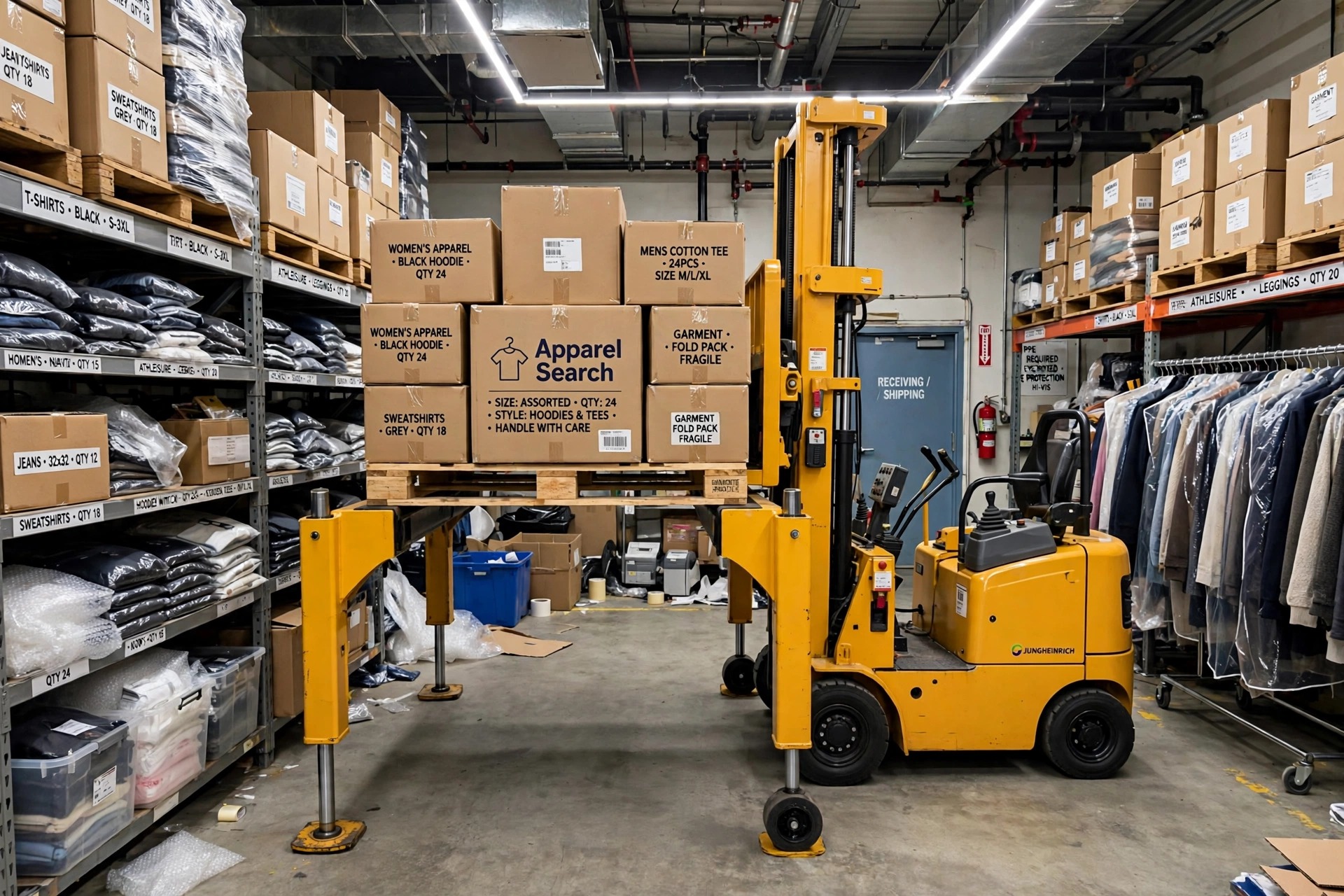
Outrigger legs that straddle the pallet — stability from geometry, no counterweight.
A straddle truck carries its load between two outrigger legs that straddle the pallet — one leg passing on each side — so the load's weight sits inside the machine's own footprint. With no counterweight needed, a straddle truck is shorter, lighter and cheaper than a counter balanced machine of similar capacity, and stability comes free from the geometry. In clothing warehouses the type appears as the straddle stacker: a walkie or rider machine that lifts pallets into low and medium racking in stockrooms, factories and smaller distribution buildings.
Fork Lift & Pallet Truck Types
- Counter Balanced Trucks
- Cushion Tire Truck
- Electric Rider Trucks
- Fork Lifts and Pallet Trucks
- Hand Pallet Trucks (Manual)
- Hand Pallet Trucks (Motorized)
- Narrow Isle Pallet Trucks
- Order Picker Trucks
- Pallet Trucks / Pallet Jacks
- Pneumatic Tire Truck
- Reach Trucks
- Side Loaders
- Stackers
- Stock Selectors
- Used Fork Lifts
Stability from Geometry
Every lifting truck is a balance problem. A counter balanced forklift solves it with weight at the back; a straddle truck solves it by making the load part of the machine's base — the pallet sits between the front legs, over the wheelbase, so there is no tipping moment to counter. The forks rise from between the legs, and adjustable fork width on many models lets one truck suit several pallet sizes.
The geometry imposes one firm requirement: access. The legs must pass on either side of the load, so pallets must be open-bottomed, or loads must stand on rack beams, stillages or raised supports the legs can roll under. A closed-bottom pallet sitting flat on the floor defeats a straddle truck completely — it cannot get its legs in position. That single fact decides most straddle purchases, and it is why warehouses standardise pallet types when they standardise on straddle equipment.
Capacities and heights follow the stacker family the type belongs to: walkie straddle stackers commonly lift 1,000 to 6,000 pounds to heights up to about 200 inches, derating with height, and rider versions travel faster over longer routes. Electric power, tiller control and the usual walkie safety systems apply throughout.
Straddle Trucks at Work in Apparel Buildings
The straddle stacker's home ground is the organised smaller warehouse: palletised cartons in a few levels of racking, a standard house pallet across the building, steady but not frantic volumes. It puts inbound pallets away, pulls them for picking and dispatch, stacks finished goods in factory warehouses, and handles the fabric and trim stores where loads are moderate and the same pallets circulate for years.
It is also the training-wheels machine of warehouse fleets in the best sense — the truck on which new operators learn load handling, rack discipline and pedestrian awareness before graduating to reach trucks and forklifts, because its speeds are low, its stability is inherent and its controls match the walkie pallet trucks the operator already knows.
Watch two failure modes. Mixed pallet fleets — a closed import pallet arriving among house pallets — strand the straddle truck until a counter balanced machine helps out, so keep one alternative lifting method in the building. And legs sliding under racking or stillages need floor-level beams arranged for them; rack bought without the truck in mind can block the legs from the very bays they were bought to serve.
Companies Supplying Straddle Trucks
Big Joe Manufacturing Company
Big Joe, founded in 1951 on the IBH truck — built for tasks too large for a person but too small for a sit-down riding forklift — developed six styles of walkie lift truck in over 250 manual and power-drive models. Its straddle types offer lift capacities of 1,000 to 6,000 pounds and lift heights up to 204 inches, the classic straddle stacker envelope for warehouse work.
Supplies: Straddle stackers and walkie lift trucks, 1,000–6,000 lb, lifts to 204 inches
Straddle or Counter Balanced Stacker?
If your pallets are standardised and open-bottomed, and your racking is arranged for legs, the straddle stacker is the lighter, cheaper, inherently stable choice. If loads arrive on whatever pallet the supplier chose, stand on the floor in mixed forms, or must be picked from dock plates and vehicles, the counter balanced stacker or a small forklift earns its extra cost by picking anything up. The stackers page in this section covers the family as a whole.
Buyers sometimes meet the same word in 'straddle carrier' — a giant yard machine for containers. That is a different species entirely; this page is about the warehouse straddle stacker.
Common Questions
Why can't a straddle truck pick up a closed-bottom pallet?
Its outrigger legs must roll in on either side of the load so the forks can rise between them. A closed-bottom pallet flat on the floor blocks the legs entirely. Straddle trucks need open-bottom pallets, or loads raised on rack beams, stillages or supports that leave room for the legs to pass underneath.
Are straddle trucks safer than counter balanced trucks?
They are inherently stable in one specific way: the load rides inside the wheelbase, so there is no counterweight balance to lose by overloading forward. They can still be misused — overloaded, driven with loads raised, or turned sharply with a high load — so training and load charts matter just as much as on any other truck.
What lift heights do straddle stackers reach?
Depending on model, up to about 200 inches — enough for two or three levels of racking in a smaller warehouse. Capacity reduces as height increases, and the tallest models are at their best with moderate apparel-weight pallets rather than maximum loads at maximum height.