Narrow Aisle Pallet Trucks
Trucks for high-density storage in aisles barely wider than the load itself.
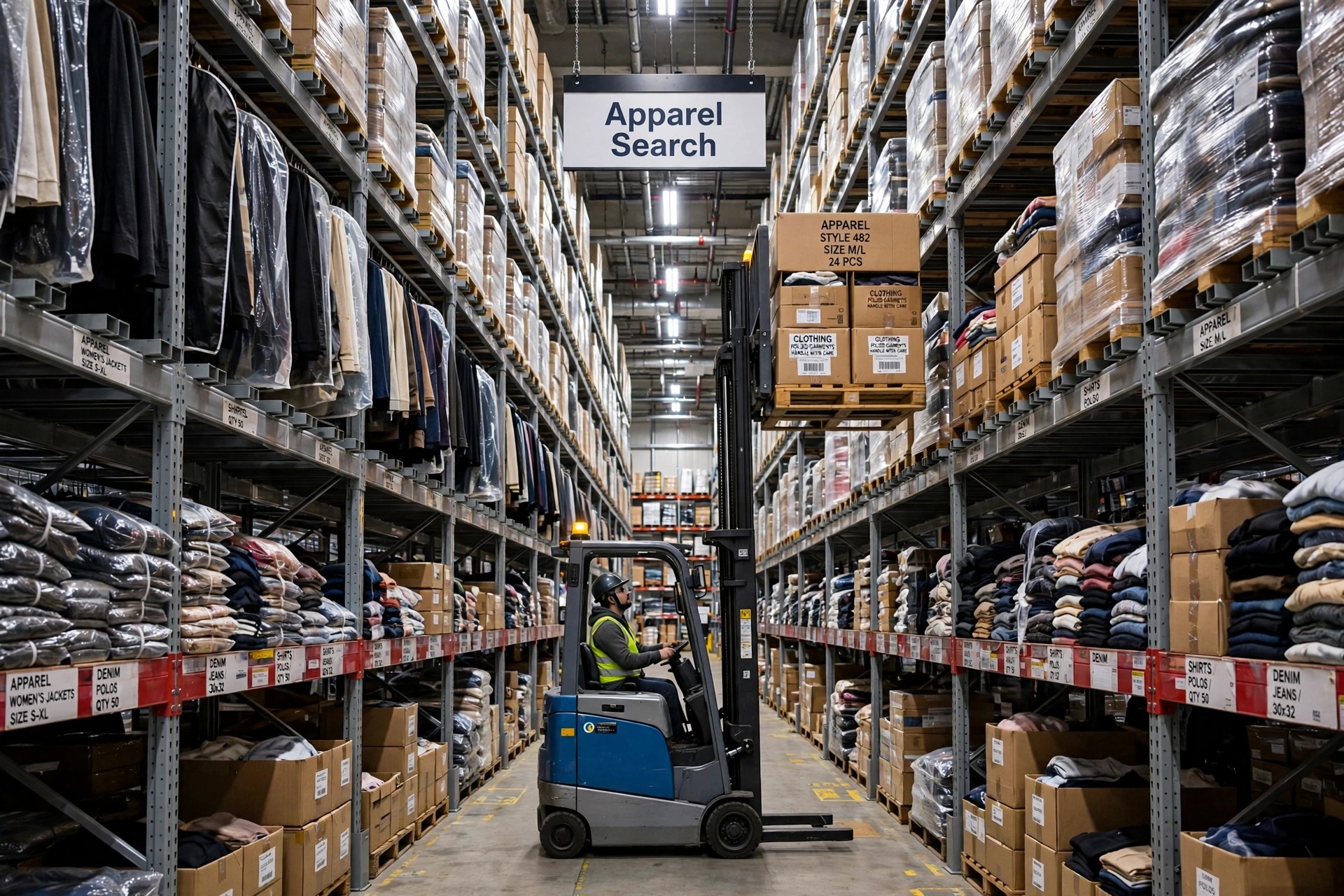
A narrow aisle truck is built to store pallets in aisles barely wider than the load itself — aisles of six to eight feet, and in very-narrow-aisle layouts even less, where a counter balanced forklift could not turn at all. (The filename of this page keeps the long-standing 'isle' spelling of the address; the equipment is the narrow aisle family.) Every foot saved from aisle width becomes another row of rack, so in high-density clothing distribution — thousands of SKUs of sized, coloured garments stored by the pallet and the carton — narrow aisle machines are what make the building's storage density possible.
Fork Lift & Pallet Truck Types
- Counter Balanced Trucks
- Cushion Tire Truck
- Electric Rider Trucks
- Fork Lifts and Pallet Trucks
- Hand Pallet Trucks (Manual)
- Hand Pallet Trucks (Motorized)
- Order Picker Trucks
- Pallet Trucks / Pallet Jacks
- Pneumatic Tire Truck
- Reach Trucks
- Side Loaders
- Stackers
- Stock Selectors
- Straddle Trucks
- Used Fork Lifts
The Narrow Aisle Family
Three designs dominate. The reach truck, the commonest, keeps its mast vertical and extends the forks forward on a pantograph to place the pallet, travelling with the load retracted over its outrigger legs. The swing-reach or turret truck rotates its fork head sideways, so it can store and retrieve on either side of the aisle without turning the truck at all. Articulating counter balanced trucks bend in the middle, combining narrow aisle storage with dock work in one machine. Each design has its own page or close relatives in this section — reach trucks and straddle trucks among them.
Guidance is what makes very narrow aisles practical. Trucks are steered by wire guidance buried in the floor or by rail guidance on the rack, freeing the operator from steering and letting the machine travel fast and straight within inches of the rack faces. End-of-aisle controls, height selectors and camera systems on the forks help the operator place pallets accurately ten metres up, where judging fork position from the floor is genuinely hard.
The loads ride low and retracted between outriggers or within the truck's footprint, which is why these machines are stable despite their height. Capacities are lower than dock forklifts — commonly 3,000 to 5,500 pounds — and fall with lift height, which apparel pallets usually accommodate easily.
Why Apparel Warehouses Go Narrow
Fashion inventory is wide rather than heavy: many styles, each in sizes and colours, replenished in waves and picked in small quantities. Storage density and pick access both matter, and narrow aisle racking serves both — more pallet positions per square foot, with every position reachable by the truck. Seasonal peaks make the density argument stronger: a building sized for peak season with wide aisles wastes money all year, while narrow aisle layouts buy peak capacity in the same footprint.
The costs are real and should be counted. The floor must be flatter and better than for ordinary trucks — at ten metres of lift, a small floor deviation becomes a large sway at the top beam. Racking must be installed to tighter tolerances, guidance systems cost money, and the trucks themselves need trained operators and proper maintenance. Narrow aisle conversion is a building project, not just a truck purchase.
Order picking integrates with the family: many narrow aisle trucks have rising operator platforms, and dedicated order picker trucks and stock selectors — covered on their own pages — share the same tight aisles when the work is picking cartons and garments rather than moving whole pallets.
Companies Supplying Narrow Isle Pallet Trucks
Clark Manufacturing
Clark's five product lines include narrow-aisle stackers alongside trucks from 1,500 to 16,500 pound capacities in LPG, gasoline, dual fuel and diesel, plus electric riders and powered hand trucks. More than 250,000 Clark trucks operate in North America and 350,000 worldwide, with over 230 North American dealer locations and representation in more than 80 countries.
Supplies: Narrow-aisle stackers and a broad lift truck line
Hyster Global
Hyster's range runs from pallet trucks through narrow aisle trucks to order pickers and container handlers — more than 130 models from 14 manufacturing facilities, sold through over 600 dealers in more than 100 countries. Founded as Willamette-Ersted in 1929 and renamed Hyster in 1934, the company joined NACCO in 1989 and is based in Greenville, North Carolina.
Supplies: Narrow aisle trucks and order pickers
Raymond Corporation
Raymond built the first narrow aisle lift truck in 1951 and remains centred on narrow aisle warehousing: reach trucks, swing-reach trucks, order selectors and pallet trucks, supported by warehouse planning services. The company, founded in 1922, also introduced the first hydraulic hand pallet truck in 1930, and backs its trucks with operator training and guaranteed operating cost programmes.
Supplies: Reach trucks, swing-reach (turret) trucks and narrow aisle systems
Yale Materials Handling Corporation
Yale designates its narrow aisle machines as Class II trucks, within a full line running from electric riders to cushion and pneumatic tire forklifts, sold and serviced through authorised dealers. Its parent, the NACCO Materials Handling Group, manufactures lift trucks in the United States, the United Kingdom, the Netherlands, Brazil, Ireland, Italy, Japan, Mexico and Scotland.
Supplies: Class II narrow aisle trucks
Planning a Narrow Aisle Layout
Work from the load outwards: pallet size and quality first (narrow aisle trucks are unforgiving of broken boards and leaning loads), then rack beam heights, then the aisle width the chosen truck needs, then the floor specification. Pallet consistency matters so much that many narrow aisle apparel warehouses re-palletise inbound freight onto house pallets at the dock.
Leave transfer aisles at the ends generous enough for the dock fleet — counter balanced trucks, rider pallet trucks — to hand loads over, because narrow aisle trucks rarely leave their aisles. The handover points, not the storage aisles, are where most narrow aisle buildings queue.
Common Questions
How narrow is a narrow aisle?
Conventional forklift aisles run about 11 to 13 feet for right-angle stacking. Narrow aisle layouts typically run 8 to 10 feet, and very-narrow-aisle (VNA) layouts can go below 7 feet — little more than the pallet itself. The saving converts directly into extra rack rows, which is the economic point of the trucks that work in them.
Do narrow aisle trucks need special floors?
Yes. At high lift, small floor unevenness is magnified into sway at the fork tips, so VNA buildings specify flatter, better-controlled concrete than ordinary warehouses, plus racking installed to tighter tolerances. Wire or rail guidance keeps the truck centred, but the floor and rack specification is part of the system, not an optional extra.
Why does this page's address say 'isle' instead of 'aisle'?
The address narrow_isle_pallet_trucks.htm is the long-standing published URL for this page, and addresses are kept stable so that bookmarks, links and search listings built up over years keep working. The equipment itself is the narrow aisle family: reach trucks, turret trucks and articulating trucks for high-density storage.