Order Picker Trucks
Operator-up trucks that take the picker to the product for carton and item picking.
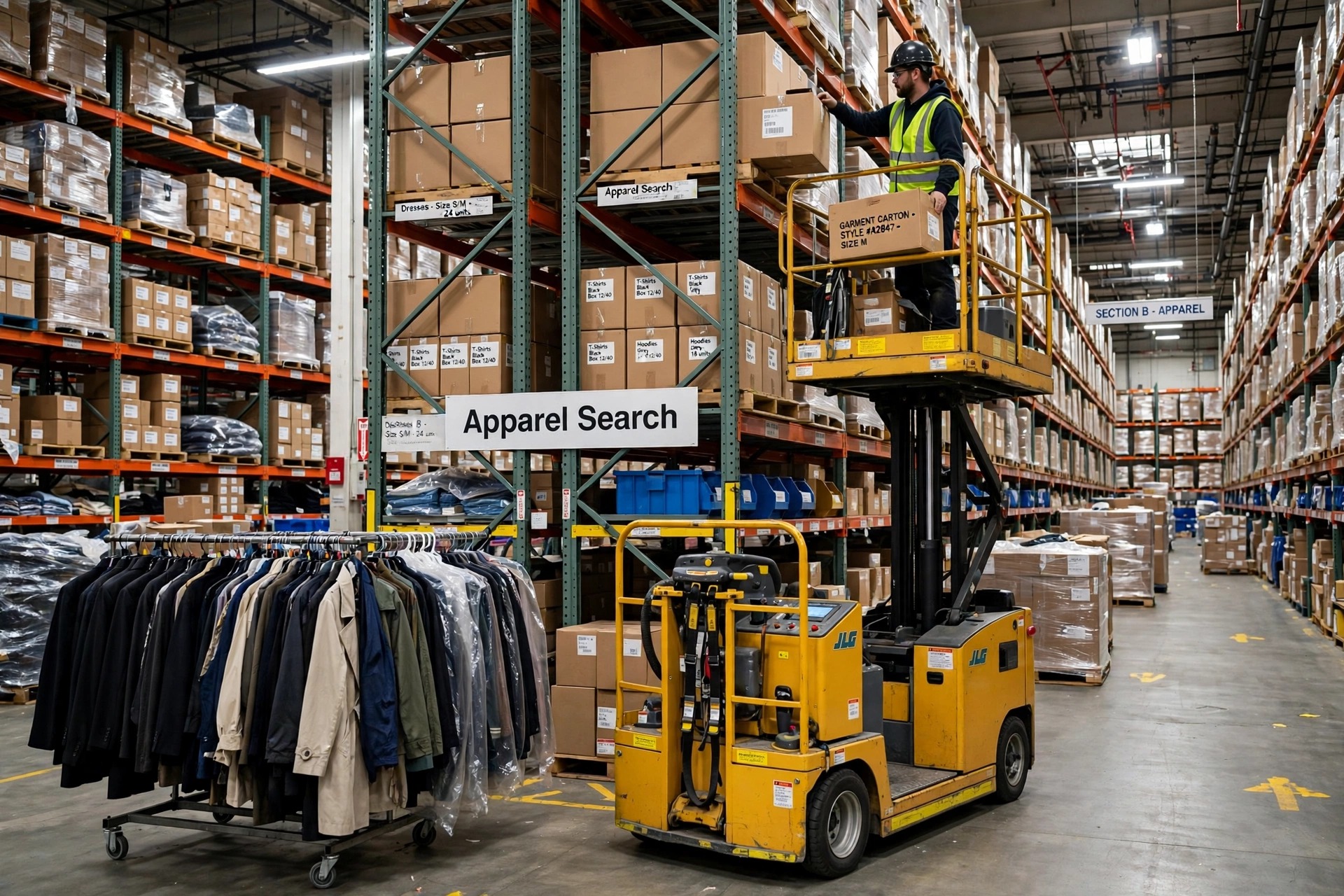
An order picker truck turns the usual warehouse arrangement upside down: instead of bringing a pallet down to the operator, it takes the operator up to the product. The operator stands on a platform that rises with the forks, drives along the rack face, and picks individual cartons or items onto a pallet or cage at the platform. For clothing distribution — where orders are assembled size by size and colour by colour from thousands of stored SKUs — the order picker is the machine that makes each-picking from rack storage practical.
Fork Lift & Pallet Truck Types
- Counter Balanced Trucks
- Cushion Tire Truck
- Electric Rider Trucks
- Fork Lifts and Pallet Trucks
- Hand Pallet Trucks (Manual)
- Hand Pallet Trucks (Motorized)
- Narrow Isle Pallet Trucks
- Pallet Trucks / Pallet Jacks
- Pneumatic Tire Truck
- Reach Trucks
- Side Loaders
- Stackers
- Stock Selectors
- Straddle Trucks
- Used Fork Lifts
How Order Pickers Work
The operator platform, forks and a pallet travel together up the mast, so the picker always works at a comfortable height relative to the shelf. Low-level pickers work the first one or two beam levels from a standing platform that barely rises; medium and high-level machines rise with the operator to the top beams of tall racking, ten metres or more, with wire or rail guidance keeping the truck centred in the aisle. The operator wears a harness with a lanyard attached to the machine whenever working at height.
Picking is the point, so the details serve the pick: controls travel with the platform so the operator can inch along the rack face, forks carry an empty pallet or a roll cage, and warehouse software directs the operator from pick to pick in a sequence that minimises travel. In apparel work the picks are cartons of a size run, replenishment quantities for a store order, or individual high-value garments — each placed, scanned and confirmed at the shelf.
The contrast with pallet trucks and forklifts is fundamental: those machines move whole pallets, efficiently, between floor-level points or into storage. The order picker trades pallet productivity for access — any carton, at any height, in any aisle the truck serves.
Order Picking in Fashion Distribution
Fashion orders rarely ship as full pallets of one product. A store order is a mix — a few pieces per size and colour across dozens of styles — assembled from storage that is organised by product, not by order. Order pickers bridge that gap, working reserve racking directly: the picker builds the order carton by carton at height, then lowers the finished pallet for wrapping and shipping. For slower-moving styles, this avoids maintaining a separate ground-level pick face for every SKU.
The economics trade against pick-face systems. Where fast movers justify dedicated pick faces replenished by reach truck, order pickers handle the long tail — the thousands of slower styles that make fashion assortments wide. Many apparel distribution centres run both systems side by side in the same building, routing each order line to whichever system holds that SKU.
Accuracy systems matter as much as the truck: pick-to-light is impractical on a moving platform, so order pickers pair with voice picking or handheld scanning, with the check-scan at the shelf catching size and colour errors before the carton joins the order. Returns processing — a heavy flow in apparel — also uses order pickers to put inspected garments back into reserve storage one carton at a time.
Companies Supplying Order Picker Trucks
Komatsu Ltd.
Komatsu's forklift range, spanning 2,000 to more than 35,000 pounds across electric, gasoline, LPG and diesel power, includes the order picker and stacker types listed for this page. The parent company was founded in 1921 in Tokyo; its forklift division began manufacturing in 1945, established a United States company in 1976 and consolidated American distribution and manufacturing as Komatsu Forklift U.S.A. in 1993, selling through over 145 dealers in the Western Hemisphere.
Supplies: Order pickers and a full forklift range, electric and engine powered
Order Pickers and Stock Selectors
The two terms overlap, and suppliers use them loosely. In this guide's usage, order pickers are the heavier machines built for case and each picking through a full shift at any level, while stock selectors — covered on their own page — are the lighter class of operator-up trucks used for smaller-item selection, stock counting and light replenishment in stockrooms and smaller warehouses.
Both share the safety discipline of working at height: harness on, platform gates closed, no riding on forks, and travel at height only at the reduced speeds the machine allows.
Common Questions
What does an order picker operator actually do?
The operator rides the platform up to the storage location, picks the required cartons or items onto a pallet or cage carried on the forks, scans or confirms each pick, and drives to the next location. At the end of the route the completed pallet is lowered and taken to packing or shipping, and the process repeats.
Is an order picker the same as a stock selector?
They are close relatives — both carry the operator up to the product. Order pickers are generally the heavier, higher-reaching machines used for case picking in distribution racking; stock selectors are lighter trucks for smaller items, counting and replenishment. This guide gives each its own page because suppliers list them separately and warehouses buy them for different budgets.
Do order picker operators need fall protection?
Yes. Operators working on a raised platform wear a full-body harness with a lanyard attached to the machine's anchor point, keep platform gates closed while travelling, and are trained and authorised specifically for operator-up trucks. The harness is standard practice on medium and high-level machines in apparel distribution centres.