Reach Trucks
Stand-up trucks whose forks reach into racking from narrow aisles.
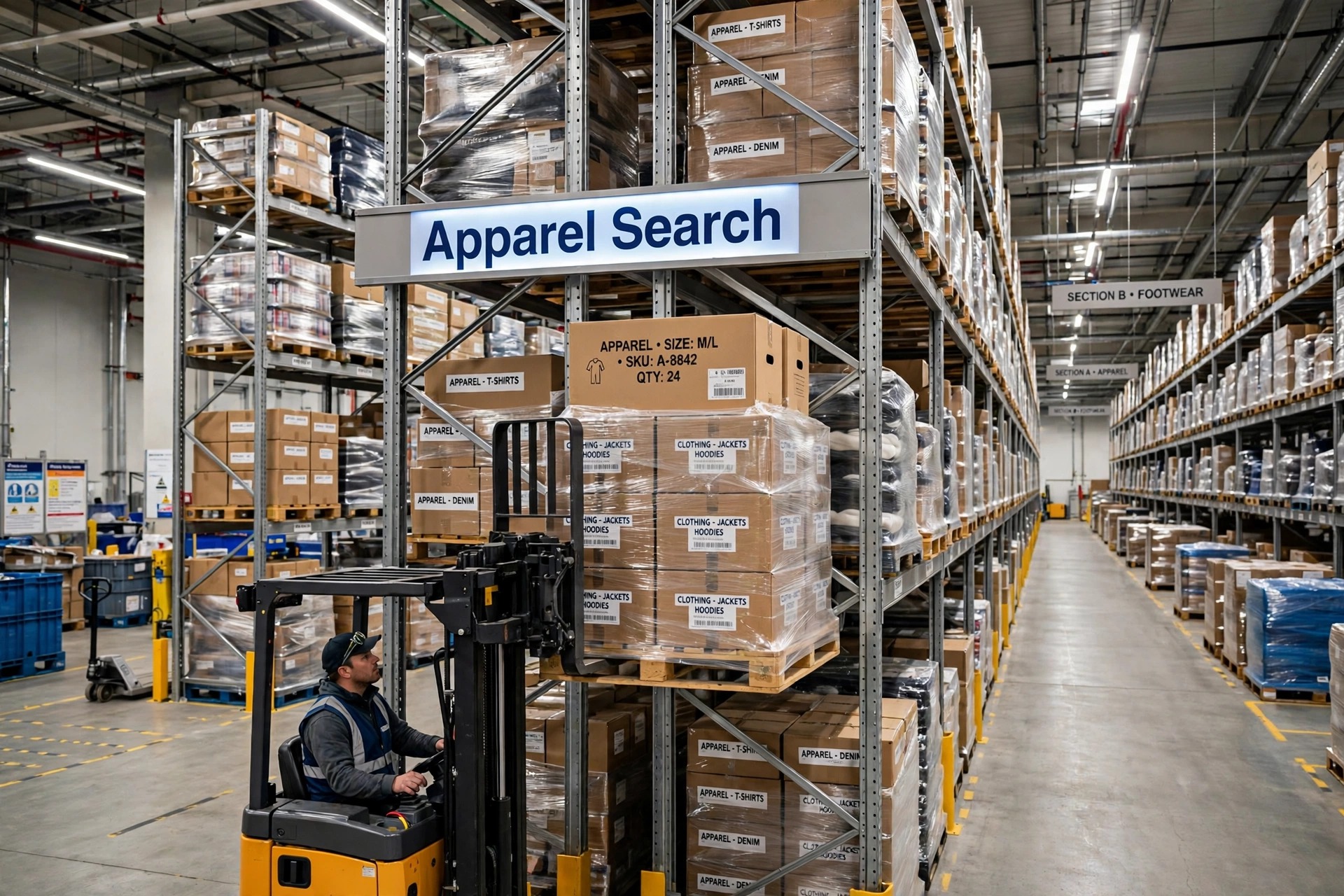
A reach truck is a stand-up electric truck whose mast stays at the rack face while its forks reach forward — on a pantograph mechanism — to place or retrieve a pallet. The operator stands sideways in the cab, drives the truck along the aisle, stops square to the bay, and reaches the load in or out without the truck ever turning into the rack. That geometry lets reach trucks store pallets in aisles several feet narrower than a counter balanced forklift needs, at heights well beyond a stacker's reach — the standard put-away machine of the apparel distribution centre.
Fork Lift & Pallet Truck Types
- Counter Balanced Trucks
- Cushion Tire Truck
- Electric Rider Trucks
- Fork Lifts and Pallet Trucks
- Hand Pallet Trucks (Manual)
- Hand Pallet Trucks (Motorized)
- Narrow Isle Pallet Trucks
- Order Picker Trucks
- Pallet Trucks / Pallet Jacks
- Pneumatic Tire Truck
- Side Loaders
- Stackers
- Stock Selectors
- Straddle Trucks
- Used Fork Lifts
How the Reach Mechanism Works
The truck carries its load retracted, forks pulled back over the outrigger legs, so the pallet rides within the wheelbase and the machine stays compact and stable. At the bay, the reach carriage extends forward — the whole mast on some designs, a scissor pantograph on others — pushing the forks into the rack to deposit or collect the pallet. Single-reach trucks serve the front pallet position; double-reach versions extend twice as far and serve two-deep racking, trading a little capacity and speed for nearly double the storage in the same aisle.
Standing sideways is deliberate: the operator faces the direction of work, sees both forks and load clearly, and steps on and off constantly through a shift of short put-away and replenishment cycles. Controls combine steering, travel, lift and reach in one or two levers, and modern trucks add fork cameras, height displays and preset level selectors that speed accurate placement at the top beams.
Capacities typically run 3,000 to 5,500 pounds and derate with height and reach extension — double-reach at full extension carries noticeably less. Lift heights of 30 feet and more are routine in distribution buildings, which is why reach truck aisles sit between conventional forklift aisles and true very-narrow-aisle layouts in width.
Reach Trucks in Apparel Put-Away and Replenishment
The reach truck's day in a fashion warehouse has two rhythms. Inbound put-away: pallets arrive from the dock on rider trucks or walkies, and the reach truck lifts them into reserve racking — full pallets of a style, stored by category until picking needs them. Replenishment: as pick faces empty, the reach truck brings reserve pallets down and feeds them forward, keeping the ground-level picking locations stocked through the shift.
Both rhythms suit apparel volumes. Reserve storage is dense, loads are moderate, and the work is a continuous cycle of single-pallet moves — precisely what a stand-up truck, quick to mount and precise at the bay, does better than a sit-down forklift that must turn in the aisle for every pallet. Operators also handle the exceptions: a damaged carton pulled from height, a pallet re-slotted to a faster-moving location, a size run consolidated onto one pallet.
Floor and pallet quality decide how well it works. Reach trucks run on small, hard wheels that transmit every floor defect to a tall mast; joints, cracks and debris in the aisle show up as sway at height. Sound pallets matter equally — a broken bottom board can jam on the outriggers or drop a carton when the load is retracted.
Companies Supplying Reach Trucks
Big Joe Manufacturing Company
Big Joe's walkie family — six styles, more than 250 models, capacities of 1,000 to 6,000 pounds and lift heights up to 204 inches — includes the reach and stacker types it pioneered from its first IBH truck of 1951, built for work between hand work and full rider forklifts. The company emphasises long-term value for end users and dealers and supports the range with accessories for each style.
Supplies: Walkie reach trucks and stackers, 1,000–6,000 lb
Komatsu Ltd.
Komatsu's forklift line — electric, gasoline, LPG and diesel models from 2,000 to more than 35,000 pounds — covers the reach and stacker types supplied to clothing warehouses. The Tokyo-founded company (1921) has built forklifts since 1945, sells in the Americas through more than 145 dealers, and consolidated its United States arm as Komatsu Forklift U.S.A. in 1993.
Supplies: Reach and stacker trucks within a full forklift range
Raymond Corporation
Raymond's Reach-Fork trucks are a core line for the company that introduced the first narrow aisle lift truck in 1951 and the first hydraulic hand pallet truck in 1930. Founded in 1922, Raymond builds reach trucks alongside swing-reach machines, order selectors and pallet trucks, and supports them with warehouse planning, operator training and worldwide parts and service.
Supplies: Reach-Fork trucks and narrow aisle warehouse systems
Reach Truck, Stacker or Counter Balanced Forklift?
Choose by aisle width and lift height. Wide aisles and low rack: the counter balanced truck is simpler and also works the dock. Low rack, tight budget, walk-up work: the stacker. Distribution-height racking in aisles too narrow for a forklift to turn in: the reach truck is the purpose-built answer, which is why it anchors most apparel reserve storage.
The narrow aisle page in this section covers the next step in density — turret and swing-reach trucks for aisles narrower still.
Common Questions
Why do reach trucks have outrigger legs?
The load rides retracted over the outriggers, inside the truck's wheelbase, which keeps a tall, narrow machine stable without a counterweight. The legs also define what the truck can serve: pallets must be open-bottomed or positioned so the outriggers can straddle or pass beside them, and racking needs a low beam or floor-level arrangement that clears the legs.
What is double-deep reach?
A double-reach truck's pantograph extends far enough to store pallets two deep in the rack from one aisle. It nearly doubles storage density in the same aisle, at the cost of lower capacity at full extension, slower cycles, and needing the front pallet moved to reach the one behind — a good trade for reserve storage of full apparel pallets.
How high can a reach truck lift?
Distribution reach trucks commonly lift beyond 30 feet, with capacity reducing as height increases. The practical limit is usually the building — rack height, floor flatness and sprinkler clearance — rather than the truck catalogue. Fork cameras and height presets help operators place pallets accurately at the top levels.