Apparel Search Consumer Guides
What to Wear in Humid Weather
When the air is already full of water, sweat cannot cool you. Dress for evaporation instead: open weaves, fast-drying fabrics and fits that let air reach the skin.
Humidity is the condition that humbles wardrobes. A hot, dry day is easy to dress for; a hot, humid one defeats the obvious choices one by one — the favorite T-shirt turns heavy, the smart blouse clings, the suit becomes a sauna with buttons. This page explains why, and then builds the wardrobe that still works: it is part of our dressing for the climate guide, and everything here follows from one piece of physics.
Why Humidity Changes Everything
Your body cools itself by evaporation: sweat carries heat away as it turns to vapor. Evaporation, though, needs somewhere for the vapor to go. On a dry day the air accepts it readily. On a humid day the air is already holding nearly all the moisture it can, so sweat evaporates slowly or not at all — it pools on the skin, soaks into clothing, and the cooling simply does not happen. You are not imagining that a humid 85°F feels worse than a dry 95°F; your cooling system has been switched off at the wall.
Clothing for humidity is therefore an evaporation strategy with three levers: choose fabrics that do not hold water against the skin, choose weaves that let air move through, and choose fits that keep a layer of air between cloth and body so what evaporation remains can work. Every recommendation below is one of those three levers in disguise.
Dew Point, Again
The steady measure of moisture in the air is the dew point, and humid-weather dressing starts when it climbs into the 60s Fahrenheit (around 16–21°C). At a dew point of 70°F or higher, plan for the full strategy on this page — open weaves, loose fits, fast-drying fabrics — whatever the thermometer says. Our climate guide explains how to find and read it in any forecast.
The Fabrics That Cope
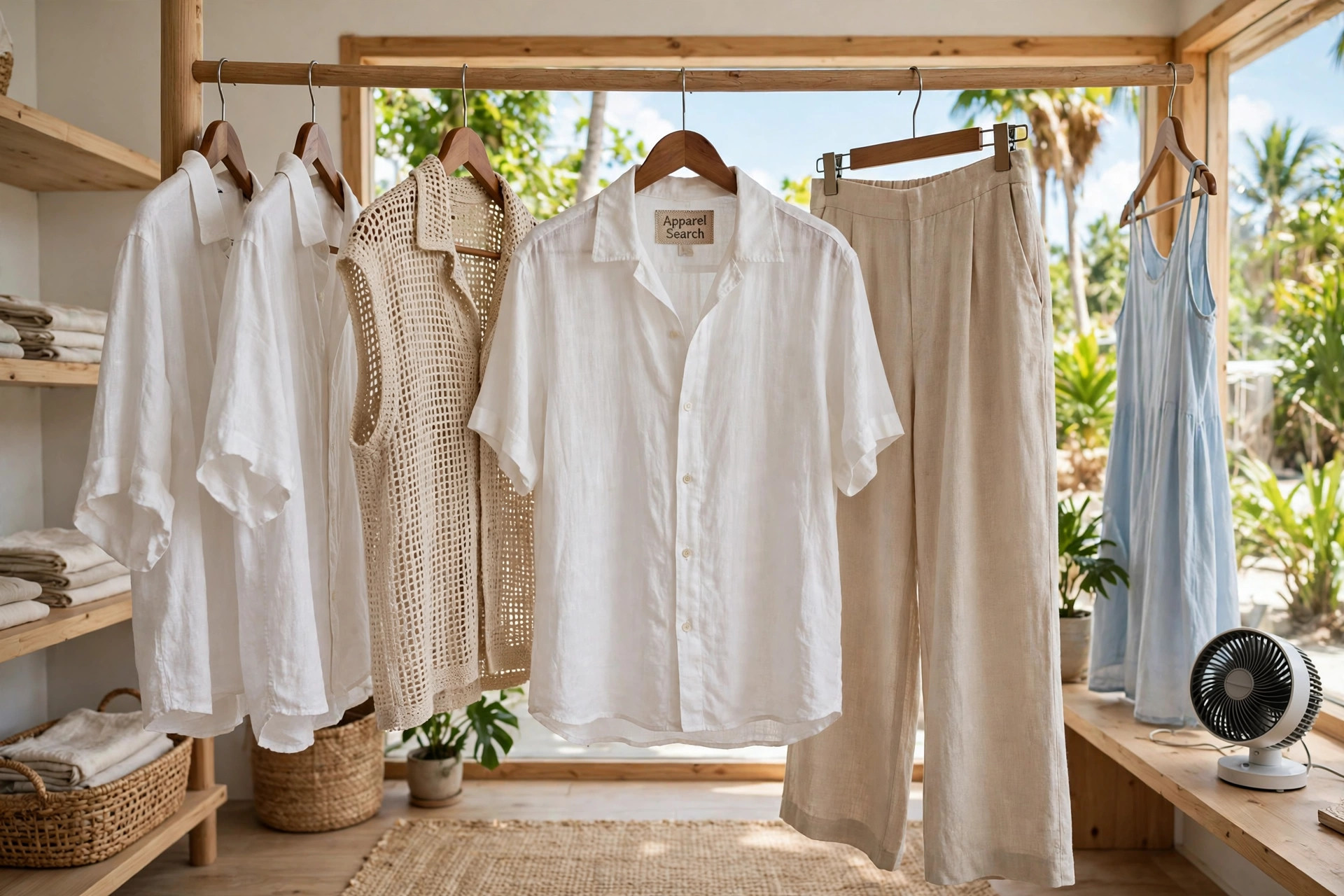
- Linen is the classic answer. Flax fibers take up moisture without the clammy feel cotton develops, linen cloth is usually woven openly enough to pass air, and it dries faster than cotton of similar weight. Accept the creasing — in humid places, rumpled linen reads as dressing correctly.
- Open-weave cottons — seersucker, voile, eyelet, gauze, lawn and loose plain weaves — behave nothing like a cotton T-shirt. Seersucker's puckered stripes hold most of the cloth off the skin by design; voile and gauze are closer to organized air than fabric. Cotton still absorbs water and dries slowly, so keep these light and loose, and they work.
- Moisture-wicking synthetics — the polyester and nylon fabrics engineered for sport — move sweat along the fiber surfaces and spread it thin to dry, and they are the right choice for activity: walking tours, outdoor work, anything that raises a real sweat. Construction matters as much as fiber; mesh panels and vented backs are what make them work.
- Lightweight open-weave wool — tropical or fresco wool — is the surprise entry, and the office hero. In an unlined, loosely woven jacket or trouser it breathes, handles moisture vapor well and keeps a professional line that linen cannot. It predates air conditioning because it had to work without it.
- Rayon and viscose sit in the middle: they breathe and drape coolly against the skin, but they absorb water, weaken when wet and can feel heavy in real humidity. Fine for an evening dress or blouse in moving air; a poor choice for a long day outdoors.
The Fabrics That Fail
- Heavy cotton jersey — the standard T-shirt and sweatshirt cloth — absorbs sweat, holds it, and stays wet and heavy for hours. In humidity it is a sponge worn against the skin.
- Tight, smooth synthetics — satin-weave polyester blouses, dense nylon, anything that feels like plastic — trap a saturated layer of air at the skin. The fiber is not the problem; the airless construction is.
- Denim of any real weight combines cotton's absorbency with thickness and a tight weave. Lightweight chambray is a different, workable cloth; jeans are a humid-day endurance test.
- Leather and coated fabrics do not breathe at all. Save them for the dry season, and treat coated rain shells worn without vents with suspicion on warm rainy days — waterproof and breathable are claims that need pit zips and vents to back them up in heat.
Fit: The Air Gap Is the Garment
In humidity, fit does as much work as fabric. Cloth that touches skin everywhere leaves no room for air to circulate, sticks the moment it is damp, and shows every drop. The humid-weather silhouette stands away from the body: relaxed shirts worn untucked or half-tucked, wide-leg and pleated trousers, A-line and shift dresses that hang from the shoulders, shorts and skirts that free the legs. Sleeves, where needed, are short or worn rolled; a fitted long sleeve in humidity is a tube of warm air. Even underwear follows the rule — moisture-wicking or loose cotton beats tight synthetic, and an undershirt in a humid climate should be a wicking one or none at all.
Construction Details Worth Hunting For
- Vents and mesh: back vents on shirts, mesh yokes and underarm panels, perforated summer shoes — each is a deliberate chimney for warm air.
- Unlined and half-lined jackets: a full lining is a second, airtight garment. Unstructured, unlined tailoring in tropical wool or linen blends is the humid office uniform for a reason.
- Breathable footwear: leather soles and unlined uppers, woven and canvas shoes, and sandals where the setting allows. Feet sweat heavily, and sealed shoes in humidity stay damp all day.
- Hats with air around them: a wide-brimmed hat shades the face while leaving the head ventilated — better than a close cap in real heat, and it keeps sun off skin the way clothing should.
- Fewer, lighter layers: humidity is the condition to dress in single layers. Every extra garment is insulation you did not order.
Shop Linen & Breathable Summer Clothing on Amazon
Ready to shop? Product links are kept in one place on the Apparel Search shopping guide:
Shop Summer Clothing on AmazonThis link opens the Apparel Search shopping guide for Amazon, where the product links are kept in one place.
Looking Polished When It Is Swampy
The professional problem in humidity is that polish usually comes from layers and structure, and both are now working against you. The substitutes: get structure from cut rather than layering — a well-shaped single garment in tropical wool, linen with some body, or a seersucker suit reads as deliberate, not wilted. Choose patterns and mid-dark colors where sweat marks matter; a small print hides what a solid grey broadcasts. Plan for the crease curve — linen and cotton will look lived-in by afternoon, so lean into fabrics and styles where that reads as ease (the unlined jacket, the camp collar shirt, the drawstring trouser in a good cloth) rather than fighting for a pressed look the air will undo by ten o'clock. And use air conditioning strategically: commute in the lightest layer, and keep the jacket for the office if the office is cold — many humid-climate workers dress in two acts, and there is no shame in the costume change.
The Travel Case
Everything on this page doubles for humid destinations: the traveler landing somewhere tropical should pack the open weaves, leave the denim and the tight synthetics at home, and bring the wicking pieces for active days. Our travel capsule wardrobe method — few pieces, everything combining — plus this page's fabric rules will fit a swampy week into a carry-on.
Common Questions
What is the single best fabric for humid weather?
Linen, for most people and most purposes. Its fibers absorb moisture without feeling as clammy as cotton, its typical weaves are open enough for air to pass, and it dries comparatively fast. Its one honest cost is wrinkling — linen creases as it is worn, and in humid climates that rumpled look is the accepted uniform rather than a failure. Where linen is impractical, an open-weave cotton or a moisture-wicking synthetic built for sport are the two runners-up, for different jobs.
Why do I feel hotter in some synthetic clothes than in cotton?
Because synthetics vary enormously. A polyester or nylon fabric woven tight and smooth — a satin blouse, a cheap jersey — holds a layer of warm, saturated air against the skin and can feel like a plastic bag. A synthetic engineered for sport is a different object entirely: shaped fibers move moisture along the fabric and spread it out to dry, and mesh panels vent it. The fiber name on the label tells you little; the weave, weight and intended purpose tell you almost everything.
Can I wear wool in humid weather?
Yes — the right wool. Lightweight, open-weave wool (often sold as tropical or fresco wool) was developed for hot-climate tailoring long before synthetics existed. Wool absorbs a good deal of moisture vapor before it feels damp, breathes well in an open weave, and resists odor. A heavy worsted suit is miserable in humidity; a light, unlined tropical-wool one is among the best office options there are.
Do dark colors really make sweat more visible?
On most fabrics, yes. A wet patch darkens cloth, and the contrast is strongest on mid-tone solids — grey and khaki are famously unforgiving. Very dark colors and white show less contrast, and patterns break the eye's ability to spot a damp area at all. None of this changes how much you sweat; it changes how much the day advertises it, which in an office or at an event can matter almost as much.
Back to the Dressing for the Climate Guide
The full framework — heat, humidity, cold, wind and rain, and how to read a forecast for your clothes.