Belt
Clothing Definitions — definitions of garments and clothing terms from Apparel Search
Search Apparel Search
At a Glance
Definition: A belt is a flexible band of leather or cloth worn around the waist, fastened with a buckle or clamp, that holds clothing in place or serves as decoration.
Category: Clothing Definitions
The belt is one of the oldest and simplest items of dress: a band, a fastening, and a waist. Its basic job is mechanical — trousers and skirts that would slip are held where they belong — but the same band has always doubled as display, from a soldier's utility belt loaded with tools to the silk sash of a formal uniform. This page covers how a belt fastens, how it is sized and worn, and the family of related bands, from the utility belt to the Japanese obi.
How a Belt Fastens
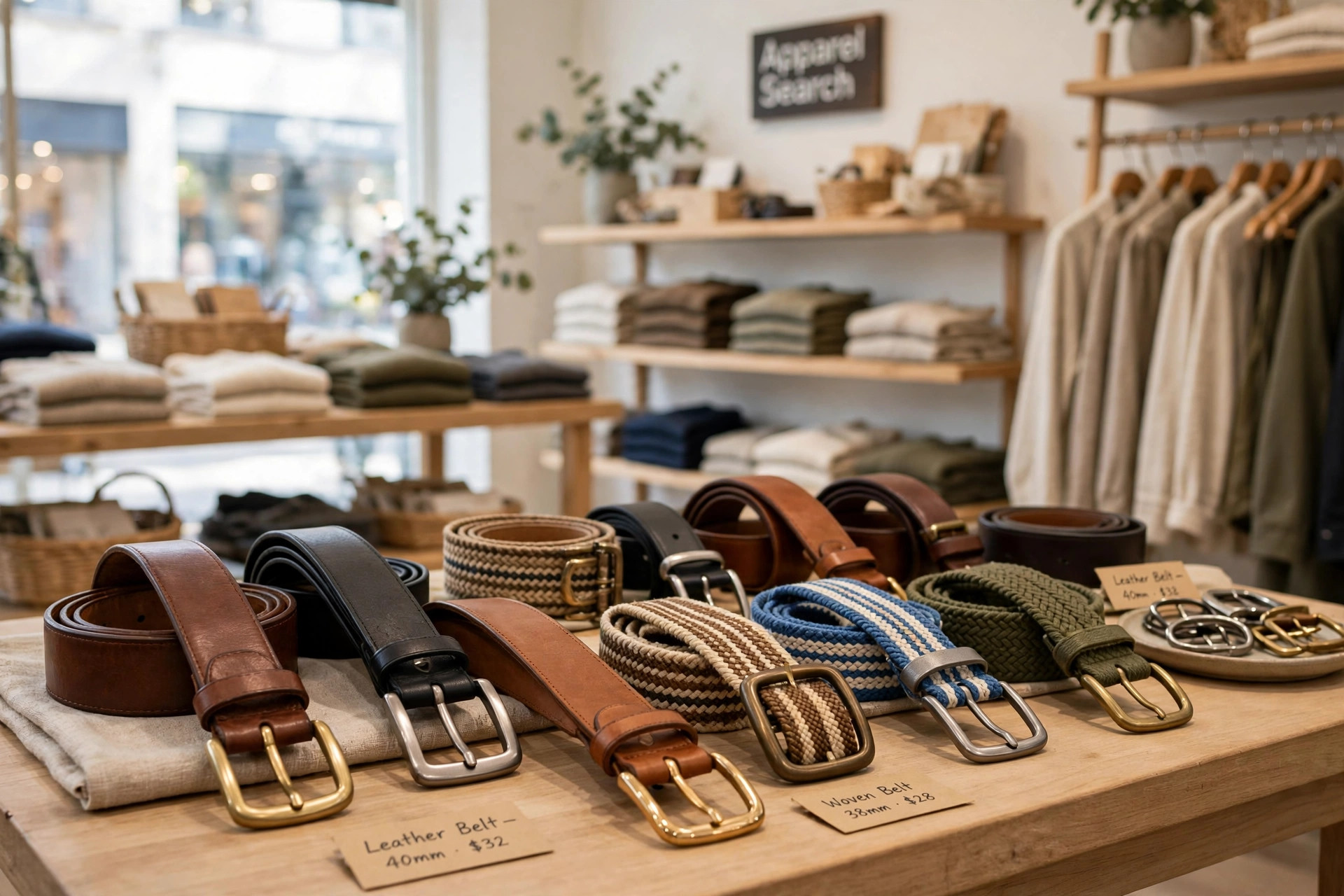
The classic belt fastens with a buckle. The buckle is fixed at one end of the band; the other end is punched with a row of holes, and the buckle's prong passes through the chosen hole to set the fit. A keeper loop holds the loose end flat. The alternative is a clamp or friction fastening, in which the band threads through a frame and is gripped under tension — no holes needed, and the fit adjusts continuously rather than hole by hole. Braided belts split the difference: the prong can pass through any gap in the weave, so they adjust almost as finely as a clamp belt.
Materials set the belt's register. Smooth leather is the formal standard; woven cloth, webbing and braided bands dress down; exotic skins, chain and metal dress up. Width does the same work: narrow belts read formal, wide belts read casual or decorative. Convention in Western dress threads men's belts through the loops in one direction and women's in the other, a habit inherited from older uniform and tailoring practice rather than any practical need.
Sizing and Wearing a Belt Well
A belt is sized to the waist it must hold, not the trouser label: as a rule the belt should fasten comfortably at its middle hole, leaving holes in reserve on both sides. Our step-by-step guide to how to measure belt size walks through measuring an existing belt or your waist, and how to wear a belt covers matching belt to shoes, choosing widths, and wearing belts with dresses and coats. The full range of modern styles — from braided and chain belts to the wide corset belt — is surveyed in our belt types and styles guide. For replacement buckles and belt hardware, see the Apparel Search belt buckles directory.
Worn with trousers, the belt also finishes the waistband: it covers the join between top and bottom halves of an outfit, which is why even trousers that need no holding up usually look incomplete without one. That finishing role is what lets a belt work purely as decoration — cinching a dress, breaking up a long line, or carrying a statement buckle — with the holding-up job reduced to an excuse.
The Utility Belt: A Belt as Equipment
One major variant treats the belt as a carrying system. The utility belt adds pockets, pouches and loops sized for the tools of a job, so that what the wearer needs promptly is at the waist and both hands stay free. Police officers, soldiers and repair and service workers are its typical users; the tool belts of carpenters and electricians are the civilian form of the same idea. Popular culture fixed the type in a single image: Batman's utility belt, the most famous fictional example, is simply the working utility belt drawn to its logical extreme.
Sashes and the Obi: The Belt's Cloth Cousins
The sash is the belt's cloth relative: a length of fabric tied at the waist, classically to hold a robe closed. Sashes belong to formal and ceremonial dress as much as to robes — they are part of traditional formal military attire, some honours such as the Légion d'honneur are worn with a special sash, and in South and Latin America a presidential sash marks the authority of the office, as our presidential sash page explains. A decorative sash may also pass diagonally from shoulder to hip rather than around the waist.
Japan's equivalent is the obi, the broad sash that holds a kimono or yukata together, tied in structured bows and knots that carry meaning of their own; our obi belt guide covers its forms in detail. The belt idea even survives inside other garments: the belted plaid of Highland dress is a blanket of tartan made into clothing by nothing more than a belt at the waist.
Not to Be Confused With
Belt vs. sash: a belt is a structured band fastened by a buckle or clamp; a sash is cloth tied at the waist — the form used to close a robe and, in its broad Japanese form, the obi worn with a kimono.
Common Questions
What is a belt?
A belt is a flexible band of leather or cloth worn around the waist. It fastens with a buckle whose prong passes through holes in the band, or with a clamp that needs no holes, and it holds clothing such as trousers in place or serves purely as decoration.
How should a belt fit?
A belt should fasten comfortably at its middle hole, leaving adjustment in both directions. Belt size is measured to the wearer's waist rather than taken from a trouser label; measuring an existing well-fitting belt from buckle to the hole in use gives the most reliable size.
What is the difference between a belt and a sash?
A belt is a band of leather or sturdy cloth fastened with a buckle or clamp. A sash is a length of cloth tied at the waist, used to hold a robe together or worn ceremonially; the Japanese obi, worn with a kimono, is a formal, structured form of sash.