Men's Bow Ties Guide
A men's bow tie is the neckwear that ties into a bow at the throat - the signature of black tie dress, a punctuation mark in everyday tailoring, and the rare accessory whose ready-made shortcut is universally detectable. Bow ties reward the man who learns the one knot: a self-tie bow, slightly imperfect by the nature of hand-tying, carries an ease that no pre-tied band has ever convincingly faked.
Shop Men's Bow Ties Now
Shop Men's Bow Ties on Amazon Shop Men's Bow Ties on eBayThe Amazon and eBay links on this page are affiliate links. If you make a purchase through them, Apparel Search may earn a commission.
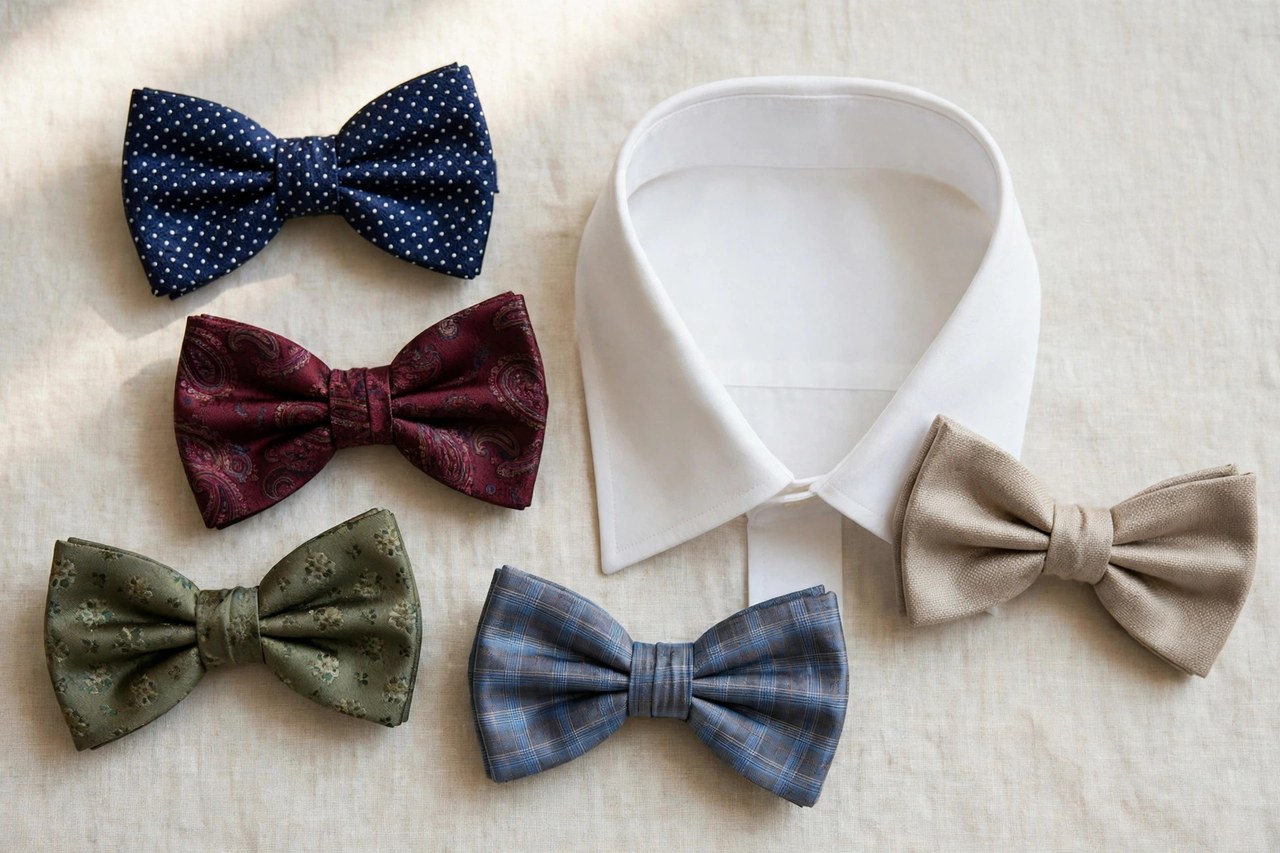
A men's bow tie is the neckwear that ties into a bow at the throat - the signature of black tie dress, a punctuation mark in everyday tailoring, and the rare accessory whose ready-made shortcut is universally detectable. Bow ties reward the man who learns the one knot: a self-tie bow, slightly imperfect by the nature of hand-tying, carries an ease that no pre-tied band has ever convincingly faked. This guide covers the styles worth knowing, the fit points that decide comfort, the fabrics and construction that separate a good buy from a regret, and the simple care that makes the garment last.
Styles and Construction
Shapes carry names worth knowing: the butterfly (the standard, moderate wings), the big butterfly for formal drama, the batwing (narrow, straight-sided, modern and sleek), the diamond point with its asymmetric tips, and the club round. Silk satin and grosgrain serve evening; linen, cotton, seersucker, knit and wool serve the day and the seasons. A bow tie is sized like a collar, not a scarf - better makers sell by neck size, and an adjustable band should be set to yours and left alone once set.
With accessories, materials and hardware decide value far more than branding. Solid metal beats plated pot metal, full-grain material beats corrected or bonded substitutes, and stitching beats glue wherever the two compete. Check moving parts - clasps, hinges, buckles, zippers - through their full travel before buying, because an accessory is usually a mechanical object as much as a decorative one. Care is part of the purchase too: an accessory you can maintain with a cloth and conditioner will outlast a finer one that needs specialist attention you will never give it.
Fit and Sizing
Proportion is the fit: the bow's width should roughly match the distance between the outer edges of your eyes - wider reads jovial, narrower reads sharp - and the tie should sit snug at the collar without strangling it. Learn the knot on a leg or a chair back first; the bow tie knot is the shoelace knot performed at the neck, and the finishing touch is deliberate imperfection: pinch, pull and leave one loop slightly human. Practice before the wedding day, not during it.
Accessories fit too, and their measurements are exact ones: belt size is measured to the middle hole of a belt you own, hat size is a head circumference, and a watch case should sit within the width of your wrist rather than beyond it. Where a maker publishes a size chart, measure yourself and use it rather than ordering your usual letter - accessory sizing varies more between brands than almost any other category, and returns on a two-inch error are entirely avoidable with ninety seconds and a tape measure.
Wearing and Care
Untie a self-tie bow properly rather than pulling it apart - the knot releases by finding the loop that collapses it. Silk bows rest rolled or hung, spot-clean only, and store away from light that fades one wing more than the other. A bow worn twice a month and stored flat will outlast its owner; the same bow crushed in a pocket dies as a creased ribbon.
Store accessories as deliberately as you bought them: belts rolled or hung by the buckle rather than folded, leather goods out of direct sun, metal kept dry and occasionally polished with the right cloth for its finish. Condition leather accessories a few times a year, keep them in breathable bags rather than plastic, and repair hardware early - a loose screw or tired spring bar is a small fix that becomes a lost item if ignored. Rotation helps here too: two everyday pieces worn alternately outlast one worn daily.
Common Questions
How can you tell a self-tied bow tie from a pre-tied one?
By the knot's honest imperfection: a hand-tied bow is very slightly asymmetric, its loops have living folds rather than molded uniformity, and the wings move when the wearer does. Pre-tied bows are perfectly symmetrical, rigid, and identical from every angle - which is exactly the giveaway. The difference reads at conversation distance to anyone who ties their own.
What size bow tie should you buy?
By neck size: proper bow ties come sized to your collar measurement, and adjustable ones should be set to it. Then proportion the shape to your face - the classic rule sets the bow's spread roughly equal to the distance between the outer corners of your eyes. A butterfly shape at that width suits most men; batwings suit smaller faces and modern collars.
Is a bow tie acceptable with a regular suit?
Yes - it is a legitimate style choice with day dress, especially in cotton, linen, knit or wool textures that lower its formality to match. Keep the rest of the outfit quiet while the bow speaks, choose a spread collar that gives the knot room, and accept the two honest costs: bow ties attract comment, and they must be tied by hand to look right.
More in Men's Clothes Guide B
The Three Types of Bow Tie
A bow tie is a type of necktie. The bow tie version of neckwear consists of a ribbon of fabric tied around the collar of a shirt in a symmetrical manner so that the two opposite ends form loops. There are generally three types: the pre-tied, in which the bow is sewn onto a band that goes around the neck and clips to secure; the clip-on, some of which dispense with the band altogether and clip straight to the collar; and the self tie — also called tie-it-yourself or freestyle — consisting of a strip of cloth the wearer ties by hand. Bow ties may be made of any fabric, but most are silk, polyester, cotton or a mixture, with wool and velvet much less common than in four-in-hand neckties; and a modern bow tie is tied using the common shoelace knot, also called the bow knot.
Photos

Looking for Men's Clothing Stores?
This guide explains men's bow ties. To browse where to buy, visit our men's clothing store directory, where you can find retailers that carry them.