The Complete Guide
More Than a Way to Keep Your Neck Warm
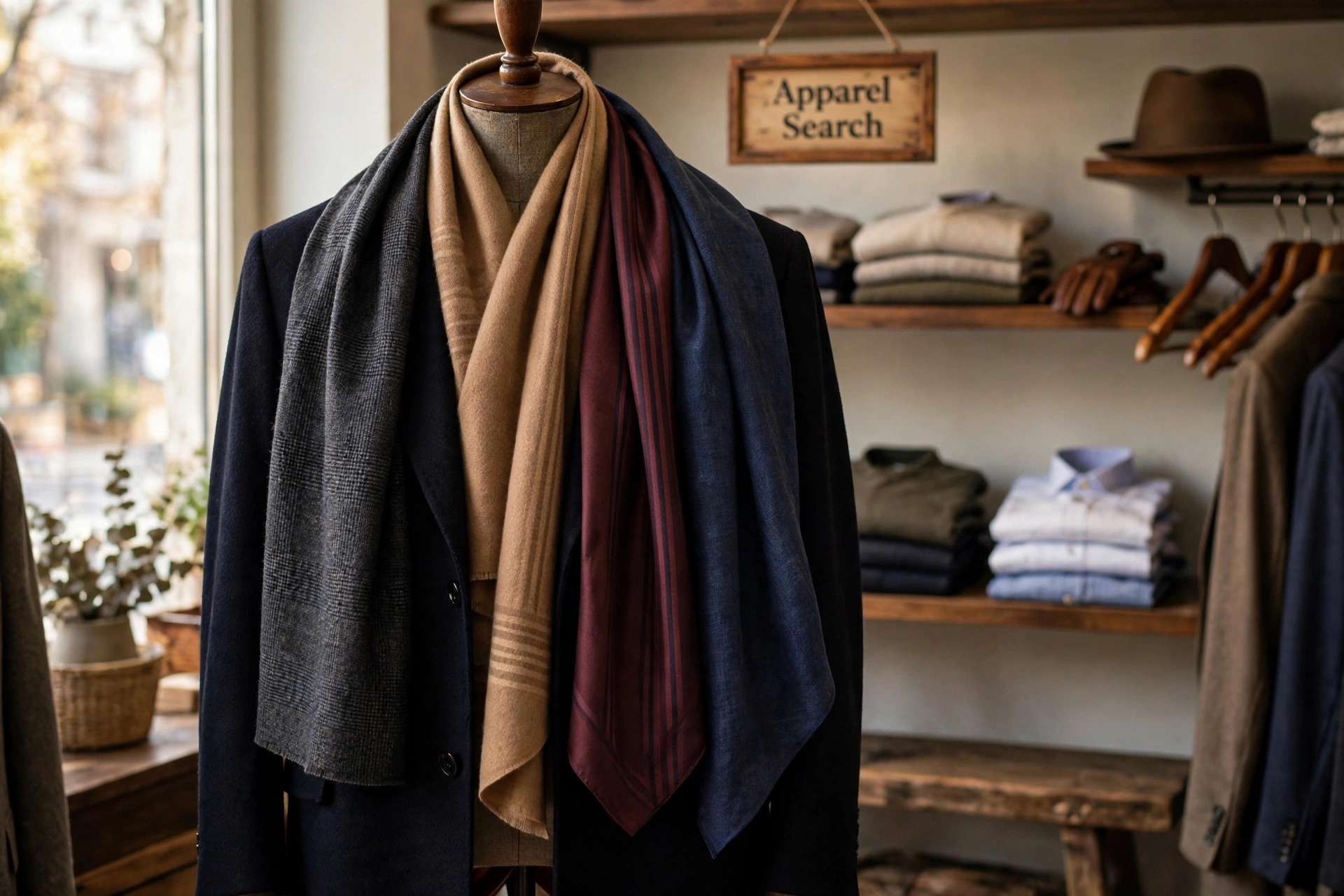
A scarf is the hardest-working accessory in a man’s winter wardrobe: it closes the gap between collar and chin that no coat fully covers, and it is often the only piece of colour or pattern in an otherwise plain outfit. Yet most men own exactly one, bought in a hurry, in a fibre chosen by price rather than by weather. This guide works through the four fibres that matter, the weights that suit each season, and how to match colour and pattern to the coat underneath.
A good scarf wardrobe is small. One heavy winter scarf, one midweight all-rounder and one light scarf for cool evenings cover nearly everything, and each of the three earns its place by doing a job the others cannot.
Fabrics
Wool, Cashmere, Silk and Linen
Wool is the default for a reason: it insulates even when damp, resists odour, and comes in weights from a fine merino gauze to a chunky brushed lambswool. The dedicated men’s wool scarves guide covers the weaves in depth. Cashmere is warmer for its weight and far softer against the neck, which matters on a long commute; it costs more and pills sooner, so it rewards gentle handling — see the men’s cashmere scarves guide for grades and care. Silk is the dress scarf: a slippery, light layer worn inside an open coat collar for polish rather than warmth, often printed. Linen is the summer scarf — breathable, dry to the touch, and just enough against air-conditioning or a coastal evening breeze.
Blends split the difference. Wool-cashmere mixes soften wool at a lower price; cotton-linen mixes wrinkle less than pure linen. Check the fibre label rather than the marketing name: “cashmere blend” can mean five per cent cashmere.
Weights by Season
Match the Weight to the Weather
Scarf weight matters more than scarf colour. A heavy scarf in a mild November looks as wrong as a silk square in a January wind, and the practical difference — overheating on a train, or shivering at a bus stop — is larger still. Read the three bands as a wardrobe plan: own one from each and the year is covered.
Heavyweight: thick wool or cashmere, wide and long enough to wrap twice. Brushed and knitted constructions trap the most air and seal a coat collar completely.
Midweight: fine wool, wool-cashmere or a woven cotton blend. Warm enough for a cold morning, light enough to carry over an arm by afternoon.
Lightweight: linen, silk or fine cotton gauze. Worn loose and open, more for finish and a cool breeze than for insulation.
Width and length follow weight: winter scarves run wider and longer for wrapping, summer scarves narrower and shorter so they sit flat and add no bulk.
Colour & Pattern
Wearing Colour and Pattern with Coats
Start from the coat, not the scarf rail. With a navy or charcoal overcoat, almost anything works, which is why burgundy, camel and deep green scarves are the classic first purchases — they add warmth of colour without clashing. With a camel coat, go darker for contrast: charcoal, navy or a dark check. With a patterned coat, keep the scarf plain; with a plain coat, the scarf can carry the pattern — a windowpane check, a herringbone weave, or a restrained stripe.
Under a trench coat in milder weather, a midweight scarf in a lighter tone keeps the outfit from reading wintry. Formal coats take formal scarves: silk or fine cashmere, worn inside the collar. Parkas and technical jackets take knitted wool, worn outside and wrapped. The rule throughout is contrast in at least one dimension — colour, pattern or texture — between scarf and coat, so the two read as separate, deliberate pieces.
Choosing & Care
Length, Width and Looking After Them
For most men a scarf around 175–185 cm long and 25–35 cm wide ties every knot comfortably; shorter scarves suit only the simple drape, and oversized blanket scarves overwhelm a tailored coat. Fringes are traditional on woven scarves and purely decorative. Fold wool and cashmere rather than hanging them — hanging stretches a knit — and store them clean, since moths are drawn to worn fibres. Silk and linen scarves roll well for travel and shake out with minimal creasing. How each scarf is actually tied is a subject of its own, covered in the scarf knots guide linked below, and the companion women’s scarf guide takes the same fibre-first approach for women’s scarves.
Questions
Common Questions
How many scarves does a man actually need?
Three cover the year for most men: one heavyweight wool or cashmere scarf for deep winter, one midweight scarf for autumn and spring, and one lightweight linen or silk scarf for cool summer evenings. More than that is taste, not necessity — extra scarves add colour and pattern options rather than new functions.
What colour scarf goes with a navy overcoat?
Almost any colour works with navy, which is why it is the easiest coat to accessorise. Burgundy, camel and deep green are the classic choices because they add warmth against the dark blue; a grey or charcoal check suits a more restrained look, and a plain lighter grey scarf gives the sharpest contrast.
Should a scarf be worn inside or outside the coat?
Both are correct, for different scarves. Dress scarves in silk or fine cashmere are traditionally worn inside an open coat collar, where they show as a finished layer at the neck. Heavy winter scarves are worn outside and wrapped, so they seal the collar against the wind — function decides.
More to Explore
Search Apparel Search