Women's Camouflage Robes Guide
Camo softened for slow mornings — gentle colorways, calm print scales, and how to judge print quality on plush lounge fabrics.
Shop Women's Camouflage Robes Now
Shop Women's Camouflage Robes on Amazon Shop Women's Camouflage Robes on eBayThe Amazon and eBay links on this page are affiliate links. If you make a purchase through them, Apparel Search may earn a commission.
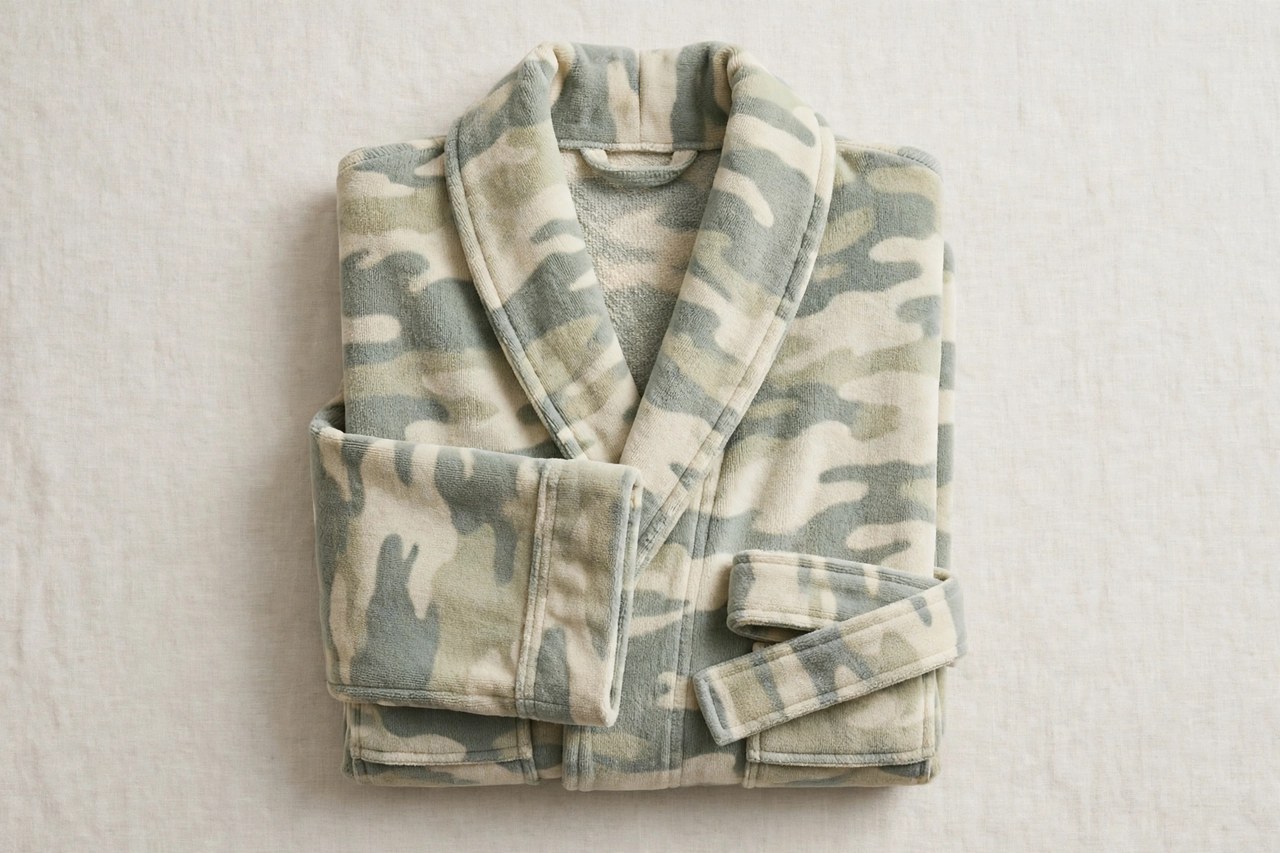
A camouflage robe takes a print designed for the outdoors and softens it for the quietest hours of the day. That shift in purpose changes everything about how the pattern should look and feel. On a robe, camo is not trying to hide anyone or make a street-style statement; it is a surface design for a garment worn with coffee in hand, over pajamas, or after a shower, so the best versions use gentler contrasts, calmer scales, and colors that feel restful at home. A harsh, high-contrast field print that looks great on a jacket can feel oddly aggressive on a plush wrap robe, while a muted sage, grey, or blush camo settles beautifully into a bedroom palette. This guide looks at camo robes purely as printed loungewear: the colorways that work at home, how print scale behaves on a long wrap garment, how printing holds up on fleece and other soft fabrics, and the simple checks that reveal a well-printed robe before you buy.
Softened Colorways for Life at Home
The most wearable robe colorways borrow camo's shapes and leave its battlefield palette behind. Sage and eucalyptus greens mixed with cream feel calm and spa-like. Grey and charcoal urban camo reads as a modern neutral and hides lint and pet hair better than almost any plain color, a practical bonus at home. Blush pink, dusty rose, and lilac camos are long-standing favorites in women's loungewear because they keep the fun of the pattern while matching typical sleepwear colors. Traditional woodland does appear on robes, usually washed down or printed at lower contrast so the browns and greens look heathered rather than sharp; it suits a rustic, cabin-style taste and pairs naturally with flannel pajamas. When choosing, hold the colorway against your existing pajamas and bedding in your mind: a robe is worn over other things every day, so a palette that clashes with everything you sleep in will quietly annoy you, while a harmonious one gets worn constantly.
Print Scale on a Long Wrap Garment
A robe is a large garment, but it is almost always seen gathered, belted, and folded over itself, which changes how scale reads. Very large camo motifs can disappear into the wrap, leaving one big pale shape across the chest and dark folds elsewhere, so the robe looks uneven rather than patterned. Very small, tight repeats can moiré and shimmer on plush fabrics, and on fleece they may blur into a general mottled texture. A calm mid-scale repeat is the sweet spot: the shapes remain recognizable when the robe hangs open, the pattern stays even when the front panels overlap, and the belt — ideally cut from the same printed fabric so the pattern continues across it — does not interrupt the design. Check the sleeves and the shawl collar or hood if there is one, since those are the parts most visible in the mirror; the print should run in a consistent direction there, not sideways on one panel and upright on another. Pockets printed to roughly continue the body pattern are a small but telling sign of care.
Fabric Print Quality: Fleece, Flannel, and Jersey
Most camo robes are printed on polyester fleece, cotton flannel, or jersey, and each base handles print differently. Fleece takes dye deep into its pile, so colors look rich, but a print that sits only on the very tips of the pile will look faded the moment the nap is brushed the other way; rub the fabric both directions and confirm the pattern stays even. Flannel prints crisply and feels traditional, though its colors soften with washing, which many wearers actually enjoy. Jersey and waffle-knit robes are lighter for warmer climates, and their prints should be checked stretched as well as relaxed, because a surface print on knit can crackle into pale lines when the robe is pulled on. Inside the garment, the print on a quality robe is visible but muted, showing dye penetration; a stark white interior under a dark print suggests a shallow surface application that may fade quickly. Seams, hems, and the belt should all use the same fabric batch so no panel looks like a different colorway.
Choosing and Caring for a Printed Robe
Beyond the print, a few robe basics decide daily satisfaction, and they are worth a brief check. Length is personal: knee-length robes feel lighter and suit warmer homes, while mid-calf and ankle lengths wrap more warmly and show off more of the pattern. A belt that is attached at the back or threaded through secure loops will not vanish in the wash, and an inner tie keeps the wrap closed without constant adjusting. For care, wash a printed fleece or flannel robe inside out in cool water with similar colors, since camo's mix of dark and pale shapes can pick up stray dye from other laundry. Avoid high dryer heat on fleece, which roughens the pile and dulls the print; a low setting or line drying keeps both texture and color kinder. Fold or hang the robe rather than crushing it on a hook behind a door, and the pattern you chose so carefully will greet you, crisp and even, every morning.
Related Women's Camouflage Guides
More to Explore on Apparel Search
- About Robes
- Camouflage Boots Guide
- Camouflage Bras Guide
- Camouflage Coats Guide
- Camouflage Fashion Blog
- Camouflage Fashion Guide
- Camouflage Hats Guide
- Camouflage Jackets Guide
- Camouflage Pants Guide
- Camouflage Shorts Guide
- Camouflage Skirts Guide
- Camouflage Underwear Guide
- Camouflage Uniforms Guide
- Camouflage Vest Guide
- Clothes
- Hunting Clothing
- Women's Robes
Looking for Women's Clothing Stores?
This guide helps you choose women's camouflage robes by colorway and fabric. To browse where to buy, visit our women's clothing store directory, where you can find retailers that carry them.