Women's Camouflage Boots Guide
Printed, coated, and molded — how camouflage patterns are applied to boots, how they wear, and how to style them.
Shop Women's Camouflage Boots Now
Shop Women's Camouflage Boots on Amazon Shop Women's Camouflage Boots on eBayThe Amazon and eBay links on this page are affiliate links. If you make a purchase through them, Apparel Search may earn a commission.
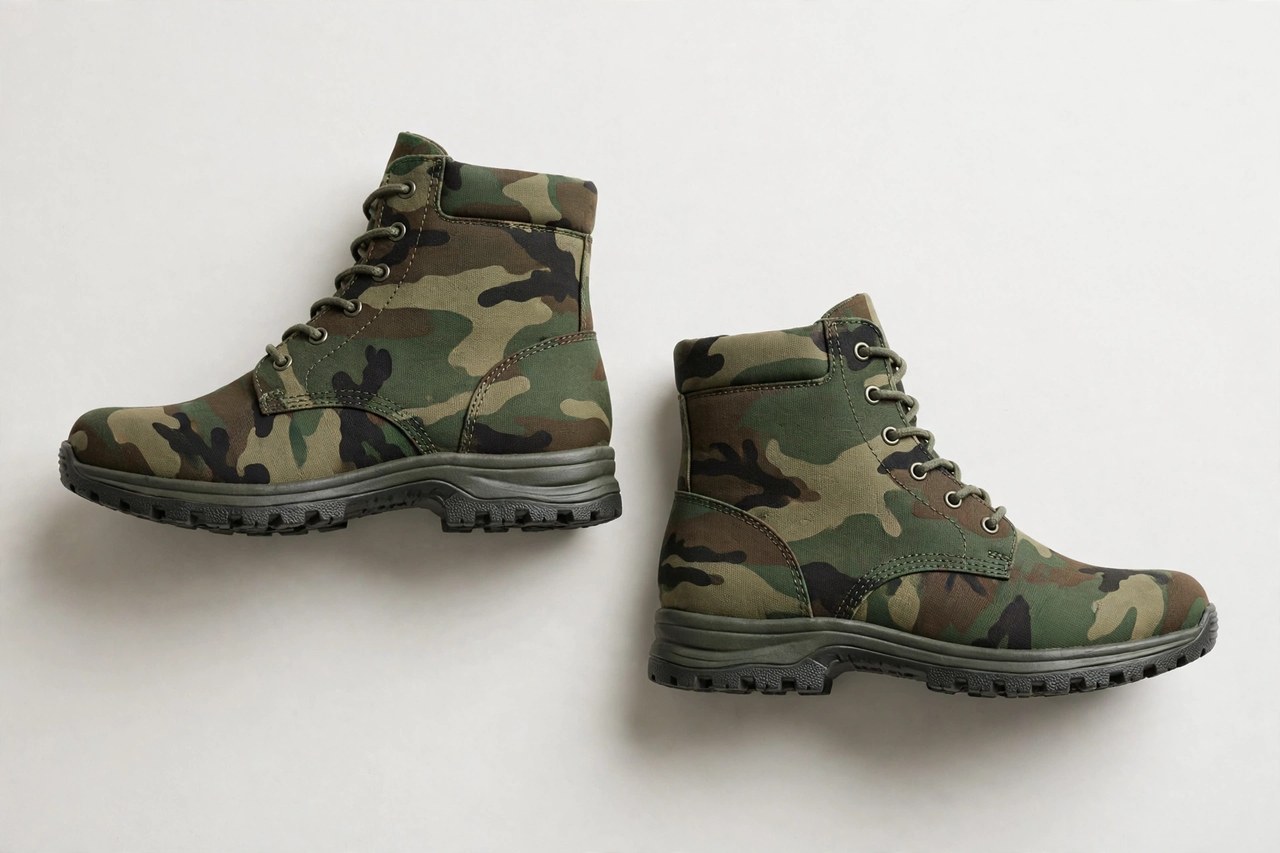
A camouflage boot is really two products in one: a boot, and a print that has to survive everything a boot goes through. This guide focuses on the pattern side of that pairing. Camo appears on women's boots in several distinct ways, and the method matters, because it decides whether the blotches still look crisp after a season of scuffs, puddles, and closet storage. Fashion boots usually carry the print on canvas, nylon, or coated synthetic uppers, while rain boots and garden boots often have the pattern molded directly into the rubber or printed under a clear glossy layer. Work and outdoor styles may use tough printed textiles borrowed from hunting gear. The garment basics are simple enough: ankle, mid-calf, and knee heights all exist in camo, with lace-up, pull-on, and zip styles. What separates a good camo boot from a novelty is print quality, so that is where this guide spends its time.
How the Pattern Gets Onto a Boot
Printed textile uppers are the most common route. Canvas and ballistic nylon take camouflage dye and screen printing well, hold fine detail, and let the boot use a small, neat repeat that wraps around curves without distorting. Coated and laminated fabrics add a water-resistant layer over the print, which slightly flattens the colors but protects them from rain and mud. Molded rubber boots work differently: the pattern may be applied as a film that is wrapped and cured onto the shaft, or printed onto the surface before a clear coat seals it. Film-wrapped boots show vivid color and a smooth finish, but a deep cut through the film can reveal plain rubber beneath. Some premium outdoor boots weave the pattern into the fabric itself using yarns in camo colors, which cannot peel or fade from the surface at all. When you shop, flex the boot and look closely at the creases; a quality print moves with the material instead of cracking across the fold.
Pattern Durability, Fading, and Care
Boots live a harder life than almost any other camo garment, so pattern durability deserves real attention. The toe and heel take abrasion first, and surface-printed patterns can rub pale at exactly those points if the print sits on top of the material rather than in it. Sunlight is the second enemy: long, bright exposure bleeds the greens and browns toward grey, which is why camo rain boots left by a sunny door can look washed out in a single summer. To slow both problems, wipe boots clean after wear rather than letting mud dry into the print, store them out of direct sun, and keep coated styles conditioned with products the maker approves so the protective layer does not dry and craze. A faded print is not ruined, though. Many wearers like the softened, vintage look of worn camo, and a uniformly faded boot reads as intentional in a way that one rubbed toe patch does not, so even wear is the goal.
Scale and Placement on Footwear
Footwear is a small canvas, and camouflage scale has to respect that. A boot shaft offers a few inches of visible height, so a very large woodland repeat may show only one or two blotches per side, which can look accidental rather than patterned. Small to medium repeats, with blotches roughly one to three inches across, wrap the ankle and foot gracefully and still read unmistakably as camo. Placement details separate thoughtful designs from cheap ones. Look for the pattern continuing sensibly across the tongue, quarters, and heel counter instead of restarting at every seam, and check that left and right boots feel balanced, even if the blotches are not mirror images. Some fashion boots use camo only as an accent, a printed shaft with a solid toe and sole, or a solid boot with a camo cuff and lining that peeks out when folded. Accent placement is a smart choice if you love the print but want the boot to work with more of your wardrobe.
Styling Camouflage Boots
Camo boots are the statement at the bottom of an outfit, so build upward with restraint. Skinny jeans and leggings in black, charcoal, or dark denim let the print show from ankle to toe and keep the silhouette clean, while a tucked-in pant leg displays a mid-calf pattern best. With dresses and skirts, camo ankle boots add an outdoorsy edge to floral and denim dresses; keep the dress pattern small or solid so the two prints do not compete. Desert and tan camo boots soften beautifully with cream knitwear and light-wash denim, while urban grey camo belongs with black and white outfits where its cooler palette makes sense. Pink camo boots, usually rain boots or fashion ankle boots, work as a playful single accent against grey and navy basics. Whatever the colorway, one rule holds: let the boots be the only camouflage in the outfit unless you are deliberately wearing a matched set, because a second unrelated camo print almost always clashes in scale or palette.
Related Women's Camouflage Guides
More to Explore on Apparel Search
- Camouflage Apparel Guide
- Camouflage Bras Guide
- Camouflage Coats Guide
- Camouflage Hats Guide
- Camouflage Robes Guide
- Camouflage Shirts Guide
- Camouflage Shorts Guide
- Camouflage Skirts Guide
- Camouflage Sleepwear Guide
- Camouflage Underwear Guide
- Camouflage Uniforms Guide
- Camouflage Vest Guide
- Clothes
- Hunting Apparel
- Women's Boots
Looking for Women's Clothing Stores?
This guide helps you choose women's camouflage boots by pattern and style. To browse where to buy, visit our women's clothing store directory, where you can find retailers that carry them.