Women's Camouflage Uniforms Guide
Why uniforms use the patterns they do — the main families, the idea of pattern standards, and what fashion copies leave out.
Shop Women's Camouflage Uniforms Now
Shop Women's Camouflage Uniforms on Amazon Shop Women's Camouflage Uniforms on eBayThe Amazon and eBay links on this page are affiliate links. If you make a purchase through them, Apparel Search may earn a commission.
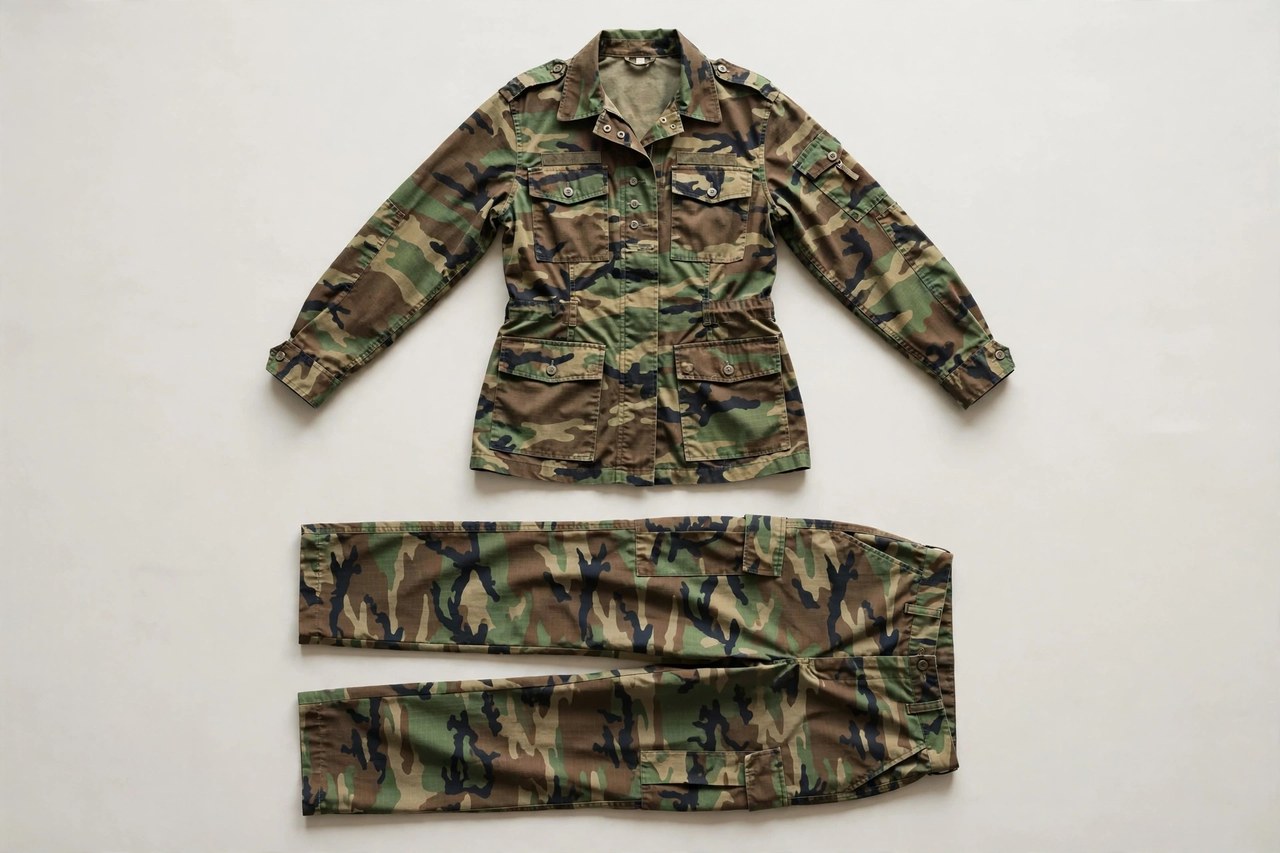
On a uniform, camouflage is not decoration. It is a specified working pattern, chosen for a particular environment, printed to a set standard, and worn identically by everyone in a unit so that the group blends into its surroundings and reads as one body. That purpose sets uniform patterns apart from every fashion camo in this section of the guide, and this page explains the pattern side of uniforms in general terms: the main families you will see, why different services and countries standardize on different designs, and what consistency means when a pattern is produced by many makers over many years. Garment fit and uniform regulations vary by organization and change over time, so treat what follows as background for understanding and comparing patterns — and for recognizing why a faithful uniform pattern looks subtly different from a fashion copy.
The Main Pattern Families
Uniform patterns group into a few broad families. Woodland patterns use large, flowing shapes in green, brown, black, and tan, designed for forests and temperate countryside; the classic four-color woodland became the visual shorthand for soldiering for decades. Desert families reduce the palette to tans, sand, and pale browns, sometimes in just two or three colors, for arid and rocky ground where green would stand out. Digital or pixelated families redraw the shapes as tiny stepped blocks, which helps the pattern work at both near and far distances and gives modern uniforms their distinctive squared texture. Transitional and multi-environment patterns try to compromise, using muted mid-tones and mixed shapes meant to perform acceptably in several landscapes rather than perfectly in one. Jungle, snow, and urban grey families round out the range for specific settings.
Why Each Service Uses Its Own Pattern
To an outsider, many uniform patterns look alike, but services adopt distinct designs for practical reasons. A pattern is tuned to the terrain where that force expects to operate, so a service focused on desert deployments and one focused on northern forests legitimately need different colorways. Distinct patterns also identify allegiance at a distance, which matters for recognition and morale, and they let an organization control its own specification, supply, and replacement cycle. Over the last few decades many forces moved from shared general patterns toward service-specific digital designs, then in some cases back toward a common multi-environment pattern when budgets and logistics favored one standard uniform. For women serving in those forces, the uniform pattern is simply the issued standard — the same design as everyone else in the unit — which is precisely the point of a uniform.
Pattern Standards and Consistency
A specified pattern is more than a picture. Standards describe the exact colors, the size of the repeat, the orientation of the shapes on each garment piece, and the fabric and printing method, so that a jacket made this year matches trousers made by a different contractor last year. Inspectors check production against physical color standards because dye lots drift, and a pattern whose greens shift noticeably between pieces would break up the very blending it exists to create. Orientation rules matter, too: shapes are usually aligned consistently rather than rotated at random, keeping the pattern's breakup effect even across seams. This discipline explains details a casual shopper might miss, such as why genuine uniform cloth often looks slightly matte and even in tone — the inks and finishes are chosen for consistent appearance, including under different light, not for shelf appeal.
Fashion Copies Versus True Uniform Patterns
Fashion camouflage borrows the look of these families while changing almost everything the standard controls. Colors are brightened or recolored entirely, repeats are resized to suit a dress or a handbag, shapes are rearranged for visual balance, and shiny or soft fashion fabrics replace matte uniform cloth. None of that is a fault — fashion camo is clothing, not equipment — but it explains why a high-street woodland often looks cheerier and cleaner than an authentic pattern, whose colors are deliberately duller and whose shapes are placed to disrupt an outline rather than to please an eye. Surplus and reproduction uniform pieces sit between the two: they follow the pattern closely, though quality and color accuracy vary by maker. If authenticity matters to you, compare the colors and repeat size against reference photos of the real pattern and be skeptical of any version that looks noticeably brighter.
Related Women's Camouflage Guides
More to Explore on Apparel Search
Looking for Women's Clothing Stores?
This guide helps you choose women's camouflage uniforms by pattern family and standard. To browse where to buy, visit our women's clothing store directory, where you can find retailers that carry them.