Women's Camouflage Hats Guide
The print is the whole hat — how camo wraps a crown, which colorways work hardest, and how to style a camo cap without overdoing it.
Shop Women's Camouflage Hats Now
Shop Women's Camouflage Hats on Amazon Shop Women's Camouflage Hats on eBayThe Amazon and eBay links on this page are affiliate links. If you make a purchase through them, Apparel Search may earn a commission.
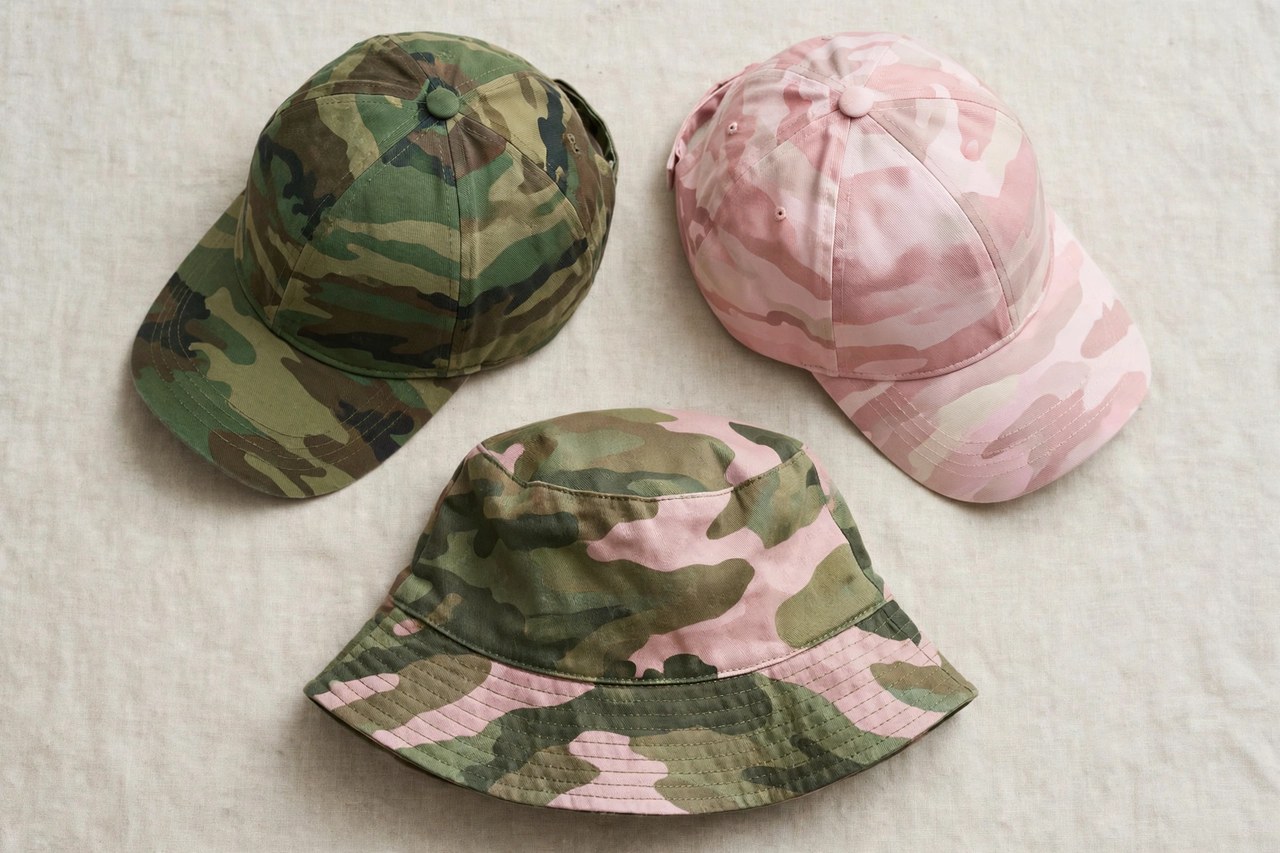
A camouflage hat is almost pure pattern. There is no large plain panel to rest the eye, no separate trim doing the styling work — the print covers the crown, the brim, and often the button on top, so the choice of camo family, scale, and colorway is the entire design decision. That is why two caps that look similar on a product list can feel completely different in person. A classic woodland print with large, flowing green and brown shapes reads outdoorsy and relaxed. A small-scale digital print in grey and black reads urban and graphic. A soft pink fashion camo reads playful and intentional, nothing like field gear. This guide focuses on the pattern itself: how it is cut and sewn around a hat, how scale changes the effect on a small curved surface, and how to pick a colorway that earns its place in your regular rotation rather than sitting in a closet as a novelty.
Pattern Continuity Around the Crown
Most camo caps are sewn from five or six panels, and what happens where those panels meet tells you a lot about quality. On a well-made hat the print flows across the seams with only minor interruption, because the fabric pieces were cut from the same stretch of printed cloth and aligned with some care. On a cheap hat each panel looks like a separate random sample, with half a leaf shape chopped at one seam and a mismatched blob starting on the next. Perfect matching is impossible on a curved crown — the fabric has to bend — but a jarring break at the front two panels is worth avoiding, since that is the part everyone sees. Check the brim as well: the pattern should continue sensibly from top to underside, and many better caps use a solid or contrasting underbrim, often grey or sand, which reduces glare and gives the busy top print a visual frame.
Camo Families and Colorways for Hats
Woodland camo, with its overlapping green, brown, and black shapes, is the most versatile hat print and pairs naturally with denim, olive, khaki, and black. Desert camo in tan, sand, and pale brown feels lighter and more summery, and it flatters warm skin tones without shouting. Urban and snow colorways in grey, white, and black turn the same shapes into a neutral graphic that works with monochrome outfits and athleisure. Digital pixelated prints have a smaller, busier repeat that suits structured six-panel caps and reads more modern and sporty. Fashion colorways — blush pink, lilac, mint, or faded vintage washes — keep the recognizable camo shapes but swap the palette entirely, which is the easiest way to wear the trend with dresses, white sneakers, and soft knits. If you hunt, hike, or fish, a terrain-matched print still matters; for everyday wear, treat colorway as a color choice first.
Print Scale on a Small, Curved Surface
Scale matters more on a hat than on almost any other garment because the canvas is tiny. A very large print motif may show only two or three shapes on the whole crown, so the hat can look blotchy rather than camouflaged, and the brim may end up nearly solid in one color. A very small, tight repeat can blur into an overall texture from a few feet away, which is actually a useful effect if you want the suggestion of camo without a bold statement. Mid-scale prints usually win on caps: the shapes stay recognizable, the repeat appears several times around the crown, and the hat still reads clearly in photos. Bucket hats and wide-brim styles offer a flatter, larger surface, so they carry bigger motifs better than a fitted cap does. When shopping online, look for a photo of the hat worn or next to a hand for scale rather than trusting a flat swatch image, which always makes the print look smaller than it will on your head.
Styling a Camo Cap Without the Costume Effect
The golden rule is one camo piece per outfit. A camo hat with a plain white tee, jeans, and clean sneakers is a finished casual look; add camo shoes or a camo jacket and it tips into costume. Let the hat be the accent against solid colors drawn from the print itself — olive, stone, black, or denim blue pulled straight from the colorway will always coordinate. For a softer, more fashion-led take, pair a pink or faded camo cap with a sundress or an oversized blazer to play the print against something deliberately neat. Keep hair simple, since a low ponytail through the back opening or loose waves both let the hat stay the focal point. Avoid pairing a camo hat with other loud prints, heavy logos, or novelty graphics competing at the same eye level. Stored on a hook rather than crushed in a bag, a good printed cap holds its crown shape and its pattern stays crisp for seasons.
Related Women's Camouflage Guides
More to Explore on Apparel Search
- Camouflage Boots Guide
- Camouflage Bras Guide
- Camouflage Coats Guide
- Camouflage Fashion Blog
- Camouflage Fashion Guide
- Camouflage Pants Guide
- Camouflage Robes Guide
- Camouflage Skirts Guide
- Camouflage Sleepwear Guide
- Camouflage Underwear Guide
- Camouflage Uniforms Guide
- Camouflage Vest Guide
- Clothes
- Hunting Clothing
- Women's Clothing Stores
- Women's Clothing Wholesalers
- Women's Hats
Looking for Women's Clothing Stores?
This guide helps you choose women's camouflage hats by pattern and colorway. To browse where to buy, visit our women's clothing store directory, where you can find retailers that carry them.