Women's Camouflage Shirts Guide
All-over camo or a single placed print — how shirt patterns are built, how scale sits on the torso, and the easiest ways to style them.
Shop Women's Camouflage Shirts Now
Shop Women's Camouflage Shirts on Amazon Shop Women's Camouflage Shirts on eBayThe Amazon and eBay links on this page are affiliate links. If you make a purchase through them, Apparel Search may earn a commission.
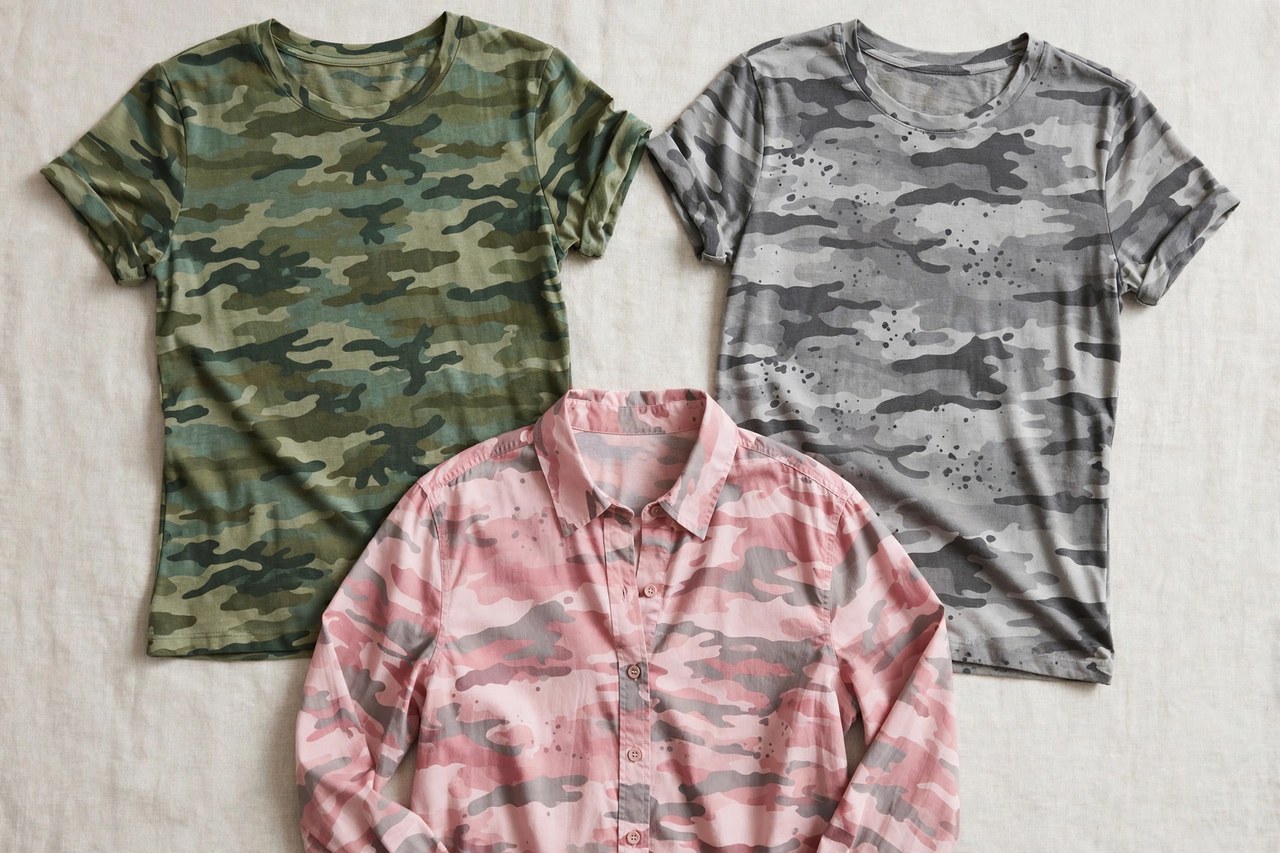
A camouflage shirt is where most women meet the print for the first time, and it is also where camo offers the widest range of expression. The same pattern family can cover a tee from collar to hem, sit as a single bold motif on the chest, fill just a pocket or a sleeve, or appear in a faded wash that reads almost like a texture. Each of those choices changes how loud the shirt is, what it pairs with, and how long it stays in your rotation. Button-front shirts, camp shirts, and flannel overshirts carry camo differently again, with collars, plackets, and pockets interrupting the pattern in ways a plain tee never does. This guide concentrates on the print itself: the difference between all-over and placed designs, how scale and placement behave on the torso, which colorways do what, and how print method affects the feel and life of the shirt. The companion garment guide covers fits and fabrics in depth; here, pattern comes first.
All-Over Prints Versus Placed Prints
An all-over print repeats the camo across the entire shirt, usually printed on fabric before the garment is cut and sewn. It makes the strongest statement and behaves like a patterned fabric, so it pairs best with plain bottoms and layers. Within all-over designs, look at the repeat: a well-planned repeat is hard to spot, while a cheap one shows an obvious grid where the same distinctive shape appears at regular intervals down the body. A placed print, by contrast, is applied to a finished or partly finished shirt in one location — typically a chest motif, sometimes a large back design, a sleeve print, or camo used only inside a graphic. Placed camo is quieter and easier to style, and it lets a plain shirt carry just a hint of the trend. A third option is the panel shirt, where camo fills the body and solid sleeves, or the reverse, giving contrast and a sportier feel. None is better in itself; the choice is simply how much pattern you want to wear.
Scale and Placement on the Torso
On a shirt, scale interacts with the body's landmarks. A mid-scale print keeps its shapes clear of the collar and hem without crowding them, and it reads evenly whether the shirt is worn loose or tucked. Large-scale motifs can look striking on an oversized or boyfriend-style shirt, where there is enough fabric for the shapes to unfold, but on a small fitted tee a huge motif may be cropped so awkwardly that the camo is barely recognizable. Placement deserves a mirror check: a large pale shape centered on the bust or stomach draws the eye exactly there, while an even distribution of light and dark shapes flatters more forgivingly. For button-front shirts, the placket is the test — quality makers align the pattern across the button line so the two fronts form a continuous design, and they cut the pocket from matching fabric so it nearly disappears into the pattern. Misaligned fronts and a clashing pocket are the fastest tells of a rushed camo shirt.
Colorways From Woodland to Pink
Classic woodland remains the default for tees and flannels alike, its greens and browns functioning as a neutral that welcomes denim of every wash, black leggings, and khaki shorts. Digital camo in grey or tan gives shirts a more technical, modern character and suits minimalist wardrobes built on black, white, and grey. Desert colorways lighten summer shirts, while tonal camo — the pattern rendered in two close shades of olive, navy, or burgundy — offers the subtlest option, visible mainly as texture and ideal for anyone camo-curious but print-shy. Fashion colorways transform the shirt entirely: pink camo tees are a perennial favorite worn with white jeans, purple and teal versions read as pure pattern play, and vintage-washed camo, printed to look sun-faded from day one, pairs with everything a faded band tee would. Choose the colorway by the bottoms you already own, not by the shirt alone, and the new piece will slot straight into outfits instead of demanding its own supporting cast.
Styling Camo Shirts and Tees
Keep the rest of the outfit plain and let the shirt carry the pattern. An all-over camo tee needs only jeans or solid shorts and simple shoes; tucking just the front softens the volume and shows the pattern's scale to advantage. Layering calms camo beautifully: a camo shirt worn open over a plain white or black tee, or a camo tee peeking from under a denim or utility jacket in a solid color, gives you pattern in a controlled dose. For a more polished take, a tonal camo button-front tucked into plain trousers with a leather belt reads almost like a textured weave shirt. Avoid doubling prints — camo with stripes, florals, or a second camo almost always looks accidental — and keep logos out of the picture when the shirt itself is already busy. Jewelry and bags in plain leather or simple metal finish the look without competing. Follow the one-pattern rule and a camo shirt becomes one of the hardest-working casual pieces you own.
Related Women's Camouflage Guides
More to Explore on Apparel Search
- Camouflage Apparel Guide
- Camouflage Boots Guide
- Camouflage Bras Guide
- Camouflage Coats Guide
- Camouflage Fashion Blog
- Camouflage Fashion Guide
- Camouflage Robes Guide
- Camouflage Shorts Guide
- Camouflage Skirts Guide
- Camouflage Sleepwear Guide
- Camouflage Underwear Guide
- Camouflage Uniforms Guide
- Clothes
- Hunting Clothing
- Shirt Styles
- Women's Shirts
Looking for Women's Clothing Stores?
This guide helps you choose women's camouflage shirts by print type and colorway. To browse where to buy, visit our women's clothing store directory, where you can find retailers that carry them.