Women's Camouflage Clothing Guide
Wearing the print well — mixing camouflage with other patterns, choosing scale by body area, and toning it down with solids.
Shop Women's Camouflage Clothing Now
Shop Women's Camouflage Clothing on Amazon Shop Women's Camouflage Clothing on eBayThe Amazon and eBay links on this page are affiliate links. If you make a purchase through them, Apparel Search may earn a commission.
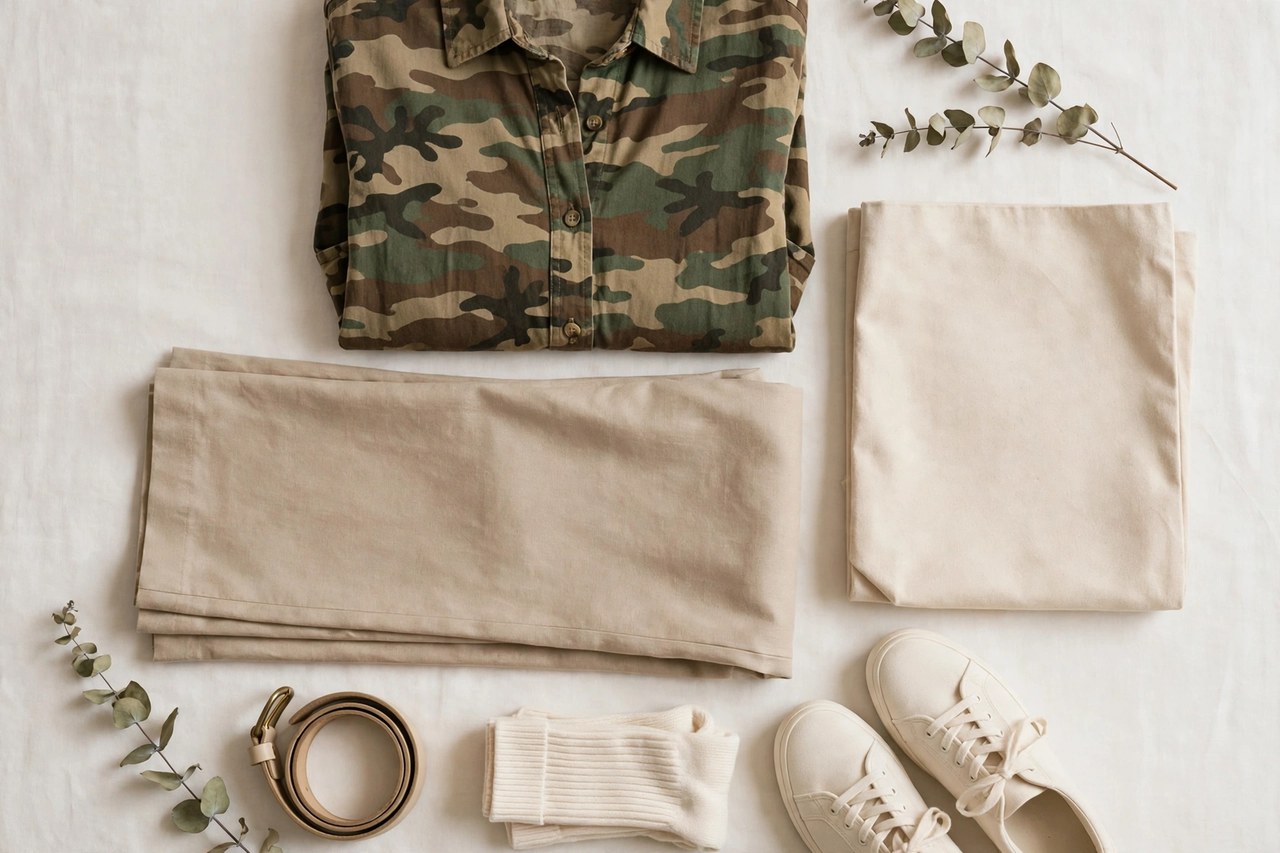
Camouflage-patterned clothing asks a different question from camouflage apparel in general. Apparel is about what exists; clothing, as worn day to day, is about what works together. Camo is a strong print with an irregular rhythm and a palette borrowed from nature, and those two traits decide how it behaves in an outfit. Worn thoughtfully, it acts almost like a neutral, grounding brighter pieces and adding texture to plain ones. Worn carelessly, it fights everything around it. This guide is the practical companion to the pattern overview: how to mix camouflage with other prints without clashing, how to match print scale to the part of the body wearing it, how to use solid colors to turn the volume of the print up or down, and when one camo piece is enough. The garment itself can be anything, a tee, trousers, a skirt, a dress, because the styling logic follows the print, not the item. Master the print and the whole category opens up.
Pattern Mixing Without Clashing
Camo mixes with other patterns better than most bold prints, provided you follow two rules: share a color, and separate the scales. A thin navy stripe works with green woodland camo because both patterns stay in a cool, muted family and the stripe's tight rhythm contrasts with camo's loose blotches. Leopard and camo are a long-standing fashion pairing for the same reason; both are organic, earth-toned, and irregular, so they harmonize instead of competing, especially when one appears only as a small accessory. Florals are trickier but possible when the floral is small-scale and picks up a color from the camo, such as a tan or olive background. What reliably fails is pairing camo with another large, high-contrast print of similar scale, because the eye cannot decide where to rest. When in doubt, keep mixed patterns apart in the outfit, print on top and print on a shoe or bag, with a solid layer between them as a visual buffer.
Matching Scale to Body Area
Print scale should follow the size of the area wearing it. Large areas, trousers, maxi skirts, oversized tops, and coats, can carry a large woodland repeat because there is room for several full blotches, and the pattern reads as a design rather than a fragment. Small areas, a fitted tee, a mini skirt, shorts, or a cropped jacket, suit small to medium repeats; a giant blotch cut in half by every seam looks accidental. Scale also interacts with proportion. A small, dense repeat recedes and is the most slimming and forgiving choice on areas you would rather not emphasize, while a large, high-contrast repeat draws the eye and adds visual volume, which can be useful for balancing a silhouette, for instance bold camo trousers with a plain fitted top. Petite frames generally look best in repeats scaled down across the whole outfit, while taller wearers can mix scales freely. Try the squint test in a mirror: the print should still read as camo, not as random splashes, at arm's length.
Toning the Print Down With Solids
Solid colors are the volume knob for camouflage. Black is the strongest toner: black layers absorb camo's contrast and make even a bright fashion colorway look deliberate and urban. White and cream do the opposite, lifting the print and making it feel fresh and summery, which suits desert and pastel camos particularly well. Denim is camo's natural partner, because blue sits opposite the print's greens and browns on the color wheel in a way that flatters both, and every shade from pale chambray to dark indigo finds a partner somewhere in the camo palette. For a softer effect, pull one quiet color out of the print itself, the tan in a woodland, the grey in an urban camo, and wear that color as your solid layer; the outfit will look coordinated without looking matched. Metallics and very bright solids are the hardest partners, since they compete with the print's energy, so save them for small accessories when you want a deliberate jolt.
One Statement at a Time, and the Double-Camo Exception
The safest camo outfit contains exactly one camouflage garment, worn as the statement, with everything else solid. That formula works for every setting from weekends to creative offices, and it is the right default while you learn how the print behaves with your own wardrobe. Double camo can work, but only in two controlled ways. The first is a true matching set, a top and bottom printed from the same fabric in the same colorway, worn together like a jumpsuit; because the pattern is identical, the eye reads it as one garment. The second is a deliberate contrast, two different camo families, such as desert trousers with an urban grey top, separated by a solid belt or layer and different enough in palette that the mismatch is obviously a choice. What never works is two similar but unmatched camos, which looks like a laundry accident. Accessory-scale camo, a hat, bag, or shoes, does not count against the one-statement rule and is the easiest way to repeat the print's colors elsewhere in the outfit.
Related Women's Camouflage Guides
More to Explore on Apparel Search
- Camouflage Boots Guide
- Camouflage Bras Guide
- Camouflage Coats Guide
- Camouflage Fashion Blog
- Camouflage Hats Guide
- Camouflage Jackets Guide
- Camouflage Robes Guide
- Camouflage Shorts Guide
- Camouflage Skirts Guide
- Camouflage Sleepwear Guide
- Camouflage Underwear Guide
- Camouflage Uniforms Guide
- Camouflage Vest Guide
- Clothes
- Hunting Clothing
- Women's Clothes
- Women's Clothing Stores
- Women's Clothing Wholesalers
Looking for Women's Clothing Stores?
This guide helps you choose women's camouflage clothing by pattern and garment. To browse where to buy, visit our women's clothing store directory, where you can find retailers that carry them.