Adaptive Clothing
Clothing Definitions — definitions of garments and clothing terms from Apparel Search
Search Apparel Search
At a Glance
Definition: Adaptive clothing is clothing designed for people with physical disabilities, older people and people who are infirm, who may have difficulty dressing themselves because they cannot manage closures or lack the range of motion dressing requires.
Also known as: Also called adapted clothing.
Category: Clothing Definitions
Most clothing assumes a wearer who can reach behind their back, pinch a small button through a buttonhole, and lift both arms overhead. Adaptive clothing starts from the opposite assumption. It is designed for people with physical disabilities, for older people, and for people who are infirm — anyone for whom ordinary closures and ordinary ranges of motion are a barrier — and it redesigns the garment so that dressing is possible, comfortable and dignified, whether the wearer dresses alone or with a caregiver's help.
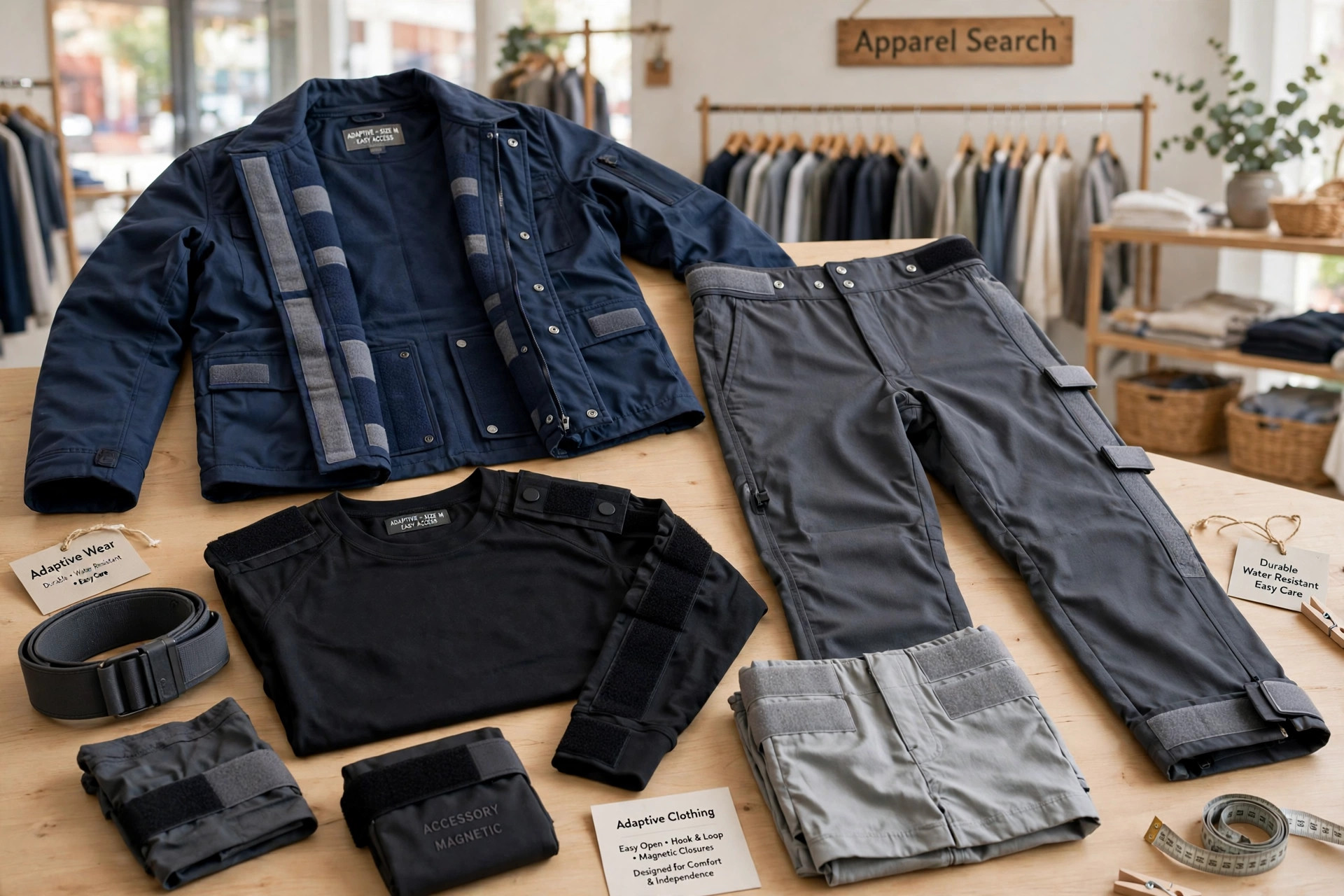
Designing Around the Difficulty
Two obstacles account for most dressing difficulty. The first is the closure itself: buttons and zippers demand grip, pinch strength and two coordinated hands. The second is range of motion: pulling a garment overhead or reaching a back fastening requires movement that injury, illness or age may have taken away. Adaptive design answers both. Garments commonly open at the back, so a caregiver can dress the wearer from behind without lifting arms or forcing joints, and small closures give way to hook-and-loop fastenings that close with a press and open with a pull.
The guiding principle is that the right design depends on the wearer's particular difficulty, so good adaptive ranges are organised by need rather than by garment type alone. A person who cannot lift the arms above shoulder level needs a different solution from a person managing incontinence, and clothing that solves one problem may do nothing for the other. Our fuller adaptive clothing guide and our page on adaptive clothing for seniors work through the options in more detail.
Designs for Specific Conditions
Alzheimer's disease. Dementia associated with Alzheimer's can lead people to disrobe at inappropriate times. Adaptive clothing for Alzheimer's patients typically uses rear closures precisely because they are hard for the wearer to undo unaided, while remaining straightforward for a caregiver to open and close.
Edema. Edema is swelling of the feet and legs, which makes conventional footwear tight and uncomfortable. Adaptive shoes answer with loose fits, adjustable sizing and non-restrictive hook-and-loop closures that accommodate swelling as it changes through the day.
Incontinence. Clothing for people managing incontinence has to survive rigorous, repeated washing without losing shape or function, and adaptive shoes for this group are made to be washable and to resist absorbing moisture.
Stroke. A stroke often causes some degree of paralysis, leaving the wearer unable to work buttons and zippers with the affected hand. Adaptive clothing for stroke recovery relies on hook-and-loop fastenings because they can be managed one-handed. A wider survey of the design features involved is in our adaptive clothing features page.
Independence and Dignity
Across every condition, the aim is the same: to keep as much of dressing as possible in the wearer's own hands. A closure that can be worked one-handed, an opening positioned where a caregiver can help without a struggle, a shoe that adjusts instead of pinching — each of these is a small restoration of independence. Well-designed adaptive clothing also looks like clothing, not equipment: the adaptations are built into ordinary-looking garments so the wearer presents themselves to the world on their own terms.
That combination — practical engineering worn invisibly — is why adaptive design has become a recognised specialism within the clothing industry rather than a sideline, and why the details of fastenings, openings and washability, unglamorous as they sound, are the heart of the subject.
Beyond Closures: Fit for Seated and Assisted Dressing
Closures are only part of the design problem. Garments for people who spend the day seated, for example wheelchair users, are cut differently from standard patterns — higher at the back waist, shaped so fabric does not bunch under the body, and finished with seams placed to avoid pressure points during long sitting. Clothing intended to be put on with a caregiver's help is likewise planned around the helper's hands: openings fall where a second person can reach them, and garments open fully rather than forcing limbs through narrow tubes of cloth.
These details explain why adaptive clothing is a design specialism rather than a size range. Each feature answers a named difficulty, and a garment that answers the wrong difficulty is no help at all — which is why reputable adaptive ranges describe their clothes by the needs they serve, and why buyers should start from the wearer's specific situation rather than from the garment rack.
Common Questions
What is adaptive clothing?
Adaptive clothing is clothing designed for people with physical disabilities, older people and people who are infirm who may have difficulty dressing themselves, because they cannot manipulate closures such as buttons and zippers or lack the full range of motion self-dressing requires.
How does adaptive clothing fasten?
Adaptive clothing typically uses rear-closure designs so a caregiver can dress the wearer more easily, and hook-and-loop (Velcro) fastenings instead of buttons and zippers, because they can be pressed closed and pulled open, often one-handed.
How does adaptive clothing help after a stroke?
Stroke frequently causes varying degrees of paralysis, leaving the wearer unable to operate buttons and zippers. Adaptive clothing for stroke patients uses hook-and-loop fastenings, which can be manipulated more easily with one hand.