Free Embroidery
Embroidery Definitions — definitions of embroidery techniques, stitches and needlework terms from Apparel Search
Free embroidery is the term for any embroidery which is not regulated by the weave of the canvas — the opposite of counted-thread embroidery. It is a form of surface embroidery: the design is placed on the fabric as a drawing rather than derived from the fabric's grid, so lines can curve, taper and cross at any angle the stitcher chooses.
Examples of free embroidery techniques and styles:
Cutwork
Quaker tapestry
| The above article is licensed under the GNU Free Documentation License. From Wikipedia, the free encyclopedia (https://en.wikipedia.org/wiki/free_embroidery). 9/5/06 |
|
|
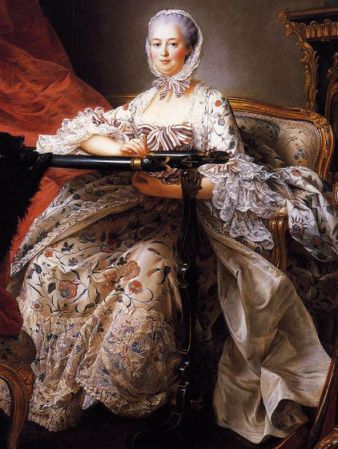 An example of free embroidery: Madame de Pompadour in an elaborately embroidered gown and matching petticoat in the style of the 1760s. |
The Drawing Comes First
Free embroidery transfers the authority for a design from the fabric to a drawing. That single change explains both its strengths and its demands: curves are true curves and shading can follow a painted model, as art needlework's satin-stitch shading did, but the stitcher must first get the design onto the cloth — by drawing, printing, iron-on transfer or prick and pounce — and must then judge spacing, direction and stitch length by eye throughout, with no grid to keep the work regular. Where counted work can be reproduced exactly from a chart by a stranger, free work carries the maker's handwriting; two stitchers given the same outline will produce visibly different pieces, which the Arts and Crafts movement counted as the point of the exercise.
Free Does Not Mean Unstructured
The category gathers techniques with strong internal rules of their own. Appliqué is governed by edge control, stumpwork by the engineering of raised forms over wire and padding, and cutwork by the need to secure an edge before the fabric beside it is cut away. What they share is only the negative condition — none of them counts threads to place its stitches. In practice most substantial pieces mix the regimes: a crewel hanging is free in its outlines but borrows counted regularity for a trellis filling; the Quaker tapestry is free embroidery whose lettering needed a newly invented stitch to turn tight curves. Free and counted are best read as two poles of method that real work moves between, not as two separate crafts.
Where Beginners Meet It
Most people meet free embroidery first, because it asks for the least equipment: a design, a hoop, a needle and thread, with no counted fabric to buy and no chart to follow. Sampler practice in free work teaches stitch direction and length — the judgment the technique depends on — whereas counted work teaches accuracy against a grid. The two trainings produce different habits, and teachers often sequence them deliberately: free embroidery to learn what stitches do, counted embroidery to learn to place them exactly.
Common Questions
What makes embroidery free?
Freedom from the fabric weave. In counted-thread embroidery every stitch is placed by counting threads; in free embroidery the stitcher follows a design applied to the surface, so a stem can curve in a smooth sweep and a petal can be any size, regardless of the threads underneath.
Which styles are free embroidery?
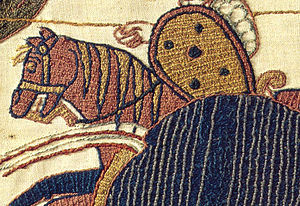
Appliqué, art needlework, crewel embroidery, cutwork, Jacobean embroidery, stumpwork and whitework include free embroidery, and the Bayeux tapestry and Quaker tapestry are worked as free embroidery. Much free embroidery is also surface embroidery, since the pattern is worked on top of the foundation fabric.
Does free embroidery use different stitches?
It uses the same stitch vocabulary — stem, chain, satin, couched and knotted stitches — but places them by the drawn design rather than by a count. Crewel embroidery is the classic case: a free technique whose stitches follow a design outline applied to the fabric.
More to Explore
- counted-thread embroidery
- surface embroidery
- Applique
- Art needlework
- Bayeux tapestry
- Crewel embroidery
- Jacobean embroidery
- Stumpwork
- Whitework
- Embroidery
- Embroidery Stitch Definitions
- Drawn Thread Work
- Sewing Definition
- Sewing Needles
- Sewing Machinery Definition
- fabric Definition
- fiber Definition
- GNU Free Documentation License
- https://en.wikipedia.org/wiki/free_embroidery
- Embroidery Machinery Directory