Stumpwork
Embroidery Definitions — embroidery and needlework definitions from Apparel Search
Search Apparel Search
At a Glance
Definition: Stumpwork is a style of embroidery in which the stitched figures stand raised above the surface of the ground fabric, giving the work a three-dimensional effect.
Category: Embroidery Definitions
Stumpwork is a style of embroidery in which the figures do not lie flat in the cloth but stand up from it, so the finished piece has genuine depth. Two constructions produce that relief. Forms that need to bend, overhang or cast a shadow are stitched separately around wire and then fixed into the ground fabric, while forms that are essentially mounds are built up on the ground itself with padding and then covered over with stitches. Between them, the two methods let a stitcher model leaves, wings, petals, figures and fruit in the round on a flat piece of cloth.
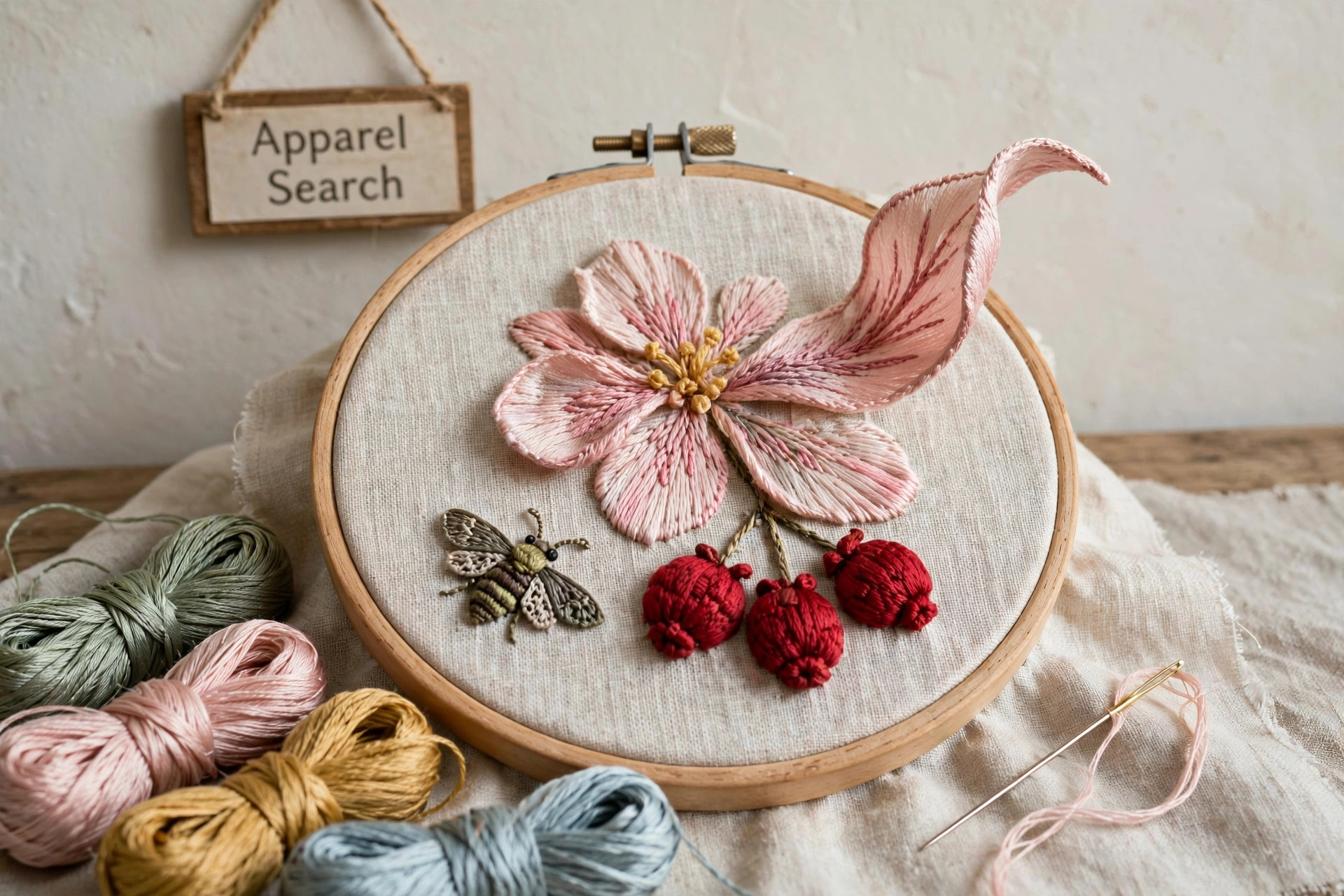
Built on Wire: Detached Forms
The detached method starts away from the main piece. A shape such as a leaf, an insect wing or a flower petal is embroidered over a fine wire outline, the wire giving the finished form its edge and its ability to hold a pose. Once complete, the form is cut free and attached to the body of the work by pushing its wires through the background fabric and fastening them firmly on the reverse, so the petal or wing can be angled away from the surface and throw a real shadow. Small rounded objects take a third route: beads wrapped in thread stand in for berries and other fruits, and for the bodies of insects and animals, giving a hard, crisp roundness that soft padding cannot match.
Built on Padding: Forms Raised in Place
Where a shape belongs firmly on the ground, it is padded instead. Layers of felt are stitched down one over another, each layer smaller than the one beneath, building a smooth graduated mound; a skin of embroidery stitches is then worked over the felt until none of it shows. This is the usual construction for tree trunks, for the bases of flowers and for human figures — anything whose volume rises directly out of the scene rather than projecting from it. Because relief only reads against flatness, skilled stumpwork reserves these raised elements for the focal points of a design and keeps the surrounding work in flatter surface stitches, and the ground fabric itself must be strong enough to carry both the planted wires and the padded weight without sagging.
Caskets, Gardens and the Modern Still Life
In its historical heyday the technique decorated household goods of many kinds, most famously the caskets made to hold jewellery, whose panels carried whole garden scenes in relief — trees, animals and people modelled in three dimensions, dressed in elaborate costumes complete with hair and hats. Many fine surviving examples are held by the Victoria and Albert Museum in London. The modern repertoire is quieter: still lifes of flowers, fruit and insects are the popular subjects now, and the designer Jane Nicholas, author of several books on stumpwork, is among those who have shaped its present-day practice.
Puff Embroidery: The Machine Descendant
Production embroidery on automated machines borrows the raised silhouette in a simplified form called puff embroidery. A sheet of foam rubber, cut larger than the intended shape, is laid over the garment fabric and the design is stitched through it; the needle perforations slice the foam around the edge of the shape, and when the surplus foam is weeded away the portion trapped beneath the stitches remains, doming the design upward. The result is the bold raised lettering and motifs seen on baseball caps, sweatshirts and jackets, typically carrying company logos or team mascots. It is a stumpwork effect rather than stumpwork itself: the definition is candid that the intricate, detached detail of the hand technique is not achievable this way. Compare the plainer categories this page sits among in the embroidery stitch definitions, and see counted-thread embroidery and drawn thread work for the flat techniques stumpwork is usually combined with.
Common Questions
How are the raised shapes in stumpwork made?
Two ways. Detached forms such as leaves, insect wings and flower petals are stitched around pieces of wire, then applied to the work by piercing the background fabric with the wires and securing them tightly. Padded forms are built on the ground from felt layers sewn one upon another in increasingly smaller sizes and then covered with embroidery stitches.
What was stumpwork used for historically?
It decorated a variety of household goods, including caskets used to store jewellery, many fine examples of which can be seen in the Victoria and Albert Museum in London. Motifs of the period were garden scenes with three-dimensional trees, animals and people in elaborate costumes, including hair and hats.
What is puff embroidery?
Puff embroidery is a modern production subcategory worked on automated machines. A layer of foam rubber larger than the intended shape is placed on the material and embroidered over, so the needle penetrations cut the foam around the shape; the excess is weeded away, leaving foam trapped under the stitches for a raised effect. It appears on baseball caps, sweatshirts and jackets for logos and mascots, but lacks the intricate design of true stumpwork.