Knit Fabric Designer Job Description
Designing the cloth itself — yarns, loop structures and stitch patterns that become jersey, rib and sweater knits at the mill
A knit fabric designer designs fabric, not garments. Working for knitting mills, textile companies and the fabric divisions of large brands, this designer decides what a knitted cloth will be before any garment designer touches it: which yarns, in which fibres and counts, looped into which structures — jersey, rib, interlock, jacquard, cable and a hundred variations — at what weight, stretch and finish. Every t-shirt, sweatshirt and sweater begins as someone's fabric decision, and the knit fabric designer's swatches are where those decisions are made, sampled and sold to the garment trade. This page explains the mill-side design job: part textile engineering, part colour and pattern craft.
More Design Job Descriptions by Letter:
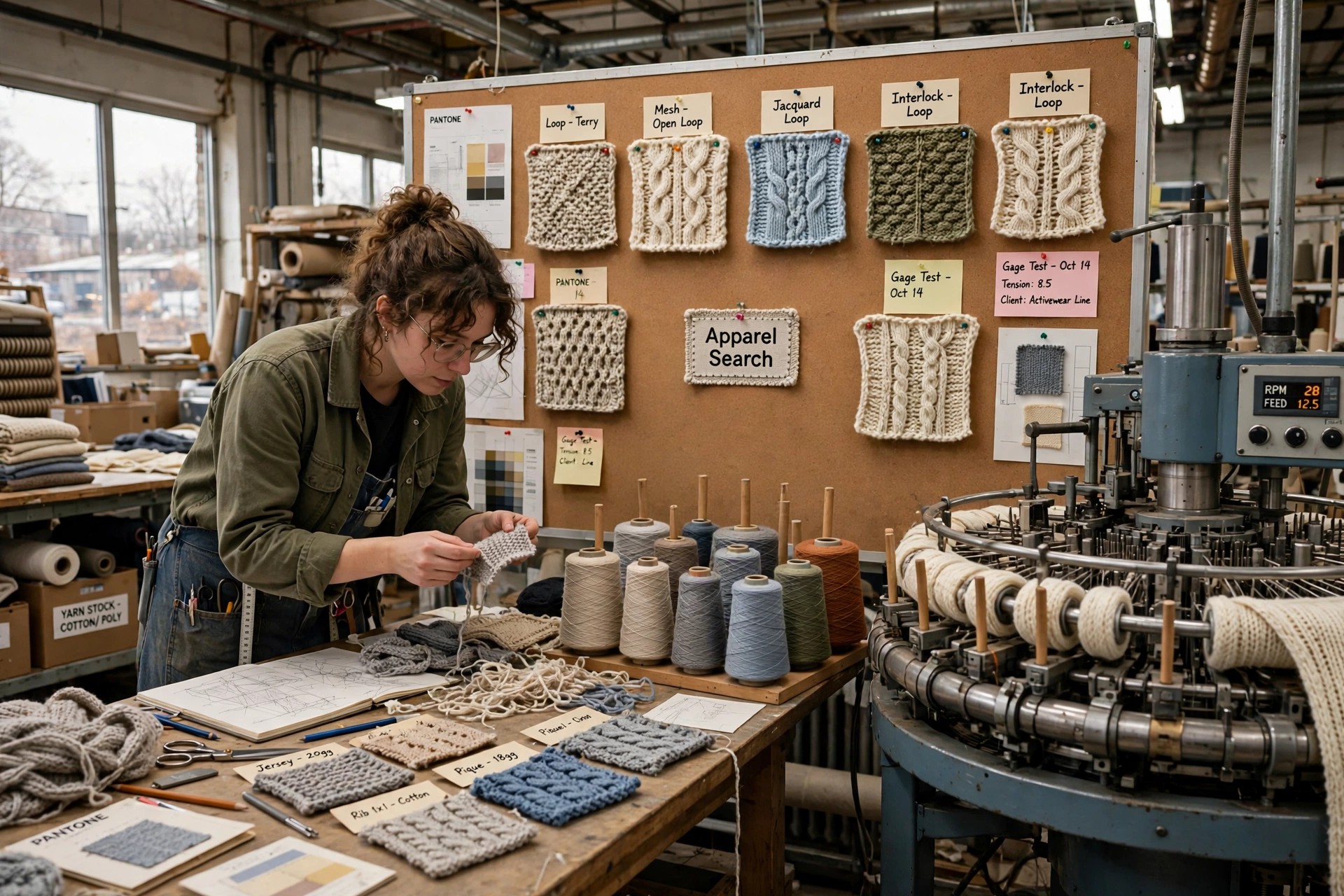
What a Knit Fabric Designer Does
The design cycle starts with direction: the mill's customers — garment brands and manufacturers — need new knitted fabrics each season, and the designer develops collections of fabric ideas to offer them. That means selecting yarns by fibre, count and twist, choosing machine gauges and stitch structures, and knitting trial swatches that show how each idea looks, stretches, drapes and washes. Colour work runs through everything: yarn-dyed stripes and jacquards are designed stitch by stitch, piece-dyed fabrics are developed with the dye house, and each fabric is costed as it is designed, because a beautiful cloth no garment maker can afford stays a swatch.
Sampling is the designer's daily medium. Trials come off circular and flat knitting machines in small lengths, are finished — washed, dyed, brushed, printed or given performance treatments — and are reviewed against the brief: weight per square metre, stretch and recovery, shrinkage, pilling behaviour and hand feel. The designer adjusts yarn, structure or finish and resamples until the fabric performs as designed. Approved fabrics are written up as full specifications, with yarn, structure, machine settings and finishing route recorded so the mill can reproduce the cloth in bulk exactly as sampled.
Structures, Yarns and Machine Knowledge
Knitted fabric is loops, and the designer's vocabulary is the ways loops can be organised. Weft knits — jersey, rib, interlock — are built course by course from one yarn system; warp knits such as tricot and raschel run lengthwise and behave differently again. Stitch choices change everything a garment maker cares about: rib pulls in and recovers, interlock lies flat and stable, jacquard carries pattern in the structure itself, and tuck and miss stitches build texture and weight. The knit fabric designer thinks in these structures the way a garment designer thinks in silhouettes, and combines them with yarn effects — slub, marl, space-dyed, metallic — to create fabrics that are new without being impractical.
Machine knowledge bounds the imagination productively. Gauge decides the fineness of cloth a machine can knit; cylinder diameter and feeder counts shape stripes and repeats; electronic jacquard and modern programming widen what is possible season by season. Designers work closely with knitting technicians, often programming or directing the programming of their own designs, and learn which ideas the mill's machinery can produce at commercial speed. A fabric that can only be knitted slowly, or that ladders and curls in bulk, is a failed design however handsome the swatch — production realism is part of the craft.
Skills and Abilities the Role Requires
Textile knowledge comes first and is deeper here than anywhere else in design: yarn construction and fibre behaviour, dyeing and finishing effects on knits, and the testing language of weight, stretch, recovery and shrinkage by which fabrics are judged and bought. Colour and pattern skill sit on top of that foundation, since much of the commercial value of a new knit is its colour story and its surface. Increasingly, knit programming and fabric CAD — simulating structures and colourways on screen before sampling — are core tools that speed development and cut wasted trials.
Commercial awareness is the other half. The designer presents fabric collections to garment brands, listens for what their ranges need, watches which swatches customers request repeatedly, and feeds that evidence into the next development round. Mills sell fabric by the development pipeline as much as by the warehouse, and a designer whose fabrics are adopted into garments season after season is the mill's most valuable creative asset. Organisation matters too: hundreds of trials, versions and specifications must be tracked so any sampled fabric can be found, re-knitted and quoted.
Qualifications, Training and Career Path
Knit fabric designers typically train in textile design, knitwear technology or fashion textiles, with the strongest courses teaching knitting machinery hands-on alongside design: students who have programmed machines and knitted their own structures arrive employable. Some designers cross from garment knitwear design, bringing customer knowledge with them, and deepen their mill-side machine and yarn knowledge in post. Portfolios for these roles show fabric, not garments: swatch collections with structures explained, yarn and finish choices justified, and evidence of designing to a customer's brief and price.
Careers develop toward senior fabric designer and fabric development management, heading a mill's design room or a brand's fabric research team, with specialisms opening in technical and performance knits, sustainable yarn development and jacquard design. Others become fabric consultants to brands, or move into fabric sourcing and development roles inside large retailers. It is a quieter design career than garment fashion — the public never learns the designer's name — but every successful garment that begins with the cloth begins here.
Common Questions
How is a knit fabric designer different from a knitwear designer?
The knit fabric designer designs the cloth — yarns, loop structures, weight and finish — usually for a mill that sells fabric to garment makers. The knitwear designer designs finished garments, such as sweaters, using fabrics and yarns others have developed.
What structures does a knit fabric designer work with?
The weft-knit family — jersey, rib, interlock, piqué, fleece and jacquard — and warp knits such as tricot and raschel, varying yarn, gauge, stitch and finish to control stretch, weight, drape, texture and pattern in the finished cloth.
How do you become a knit fabric designer?
Through textile design or knitwear technology study that includes hands-on knitting machinery, or by crossing from garment knitwear design. Portfolios should show fabric development — swatches with structures, yarns and finishes explained — rather than finished garments.
More to Explore
- Fashion Schools and Education
- Fashion Careers
- Fashion Job Description Directory
- Employment Search Engines
- Fabric Mill Directory
- Fabric Mills
- Retail Fabric Stores
- Knitting — Definition
- Fabric Definitions
- Graphic Designers Guide
- Merchandising Clothing
- Fashion Artists Guide
- Computer Assisted Design
- CAD Services