Knitwear Designer Job Description
Designing finished knit garments — sweaters and knitted clothing shaped by stitch, yarn and fit from the first swatch
A knitwear designer designs finished knitted garments: sweaters, cardigans, knitted dresses, tops and accessories. The craft differs from woven garment design at the root, because a knitted garment is not cut from stable cloth — it is built loop by loop, and its shape can be knitted into the panels themselves. Stitch is simultaneously the knitwear designer's fabric, pattern and decoration, and yarn choice decides the garment's warmth, weight, drape and price before a single sketch is drawn. Specialists are employed by knitwear brands, fashion labels with knit categories, and manufacturers who design for retailers. This page explains how knitted garments are designed and developed, stitch by stitch.
More Design Job Descriptions by Letter:
What a Knitwear Designer Does
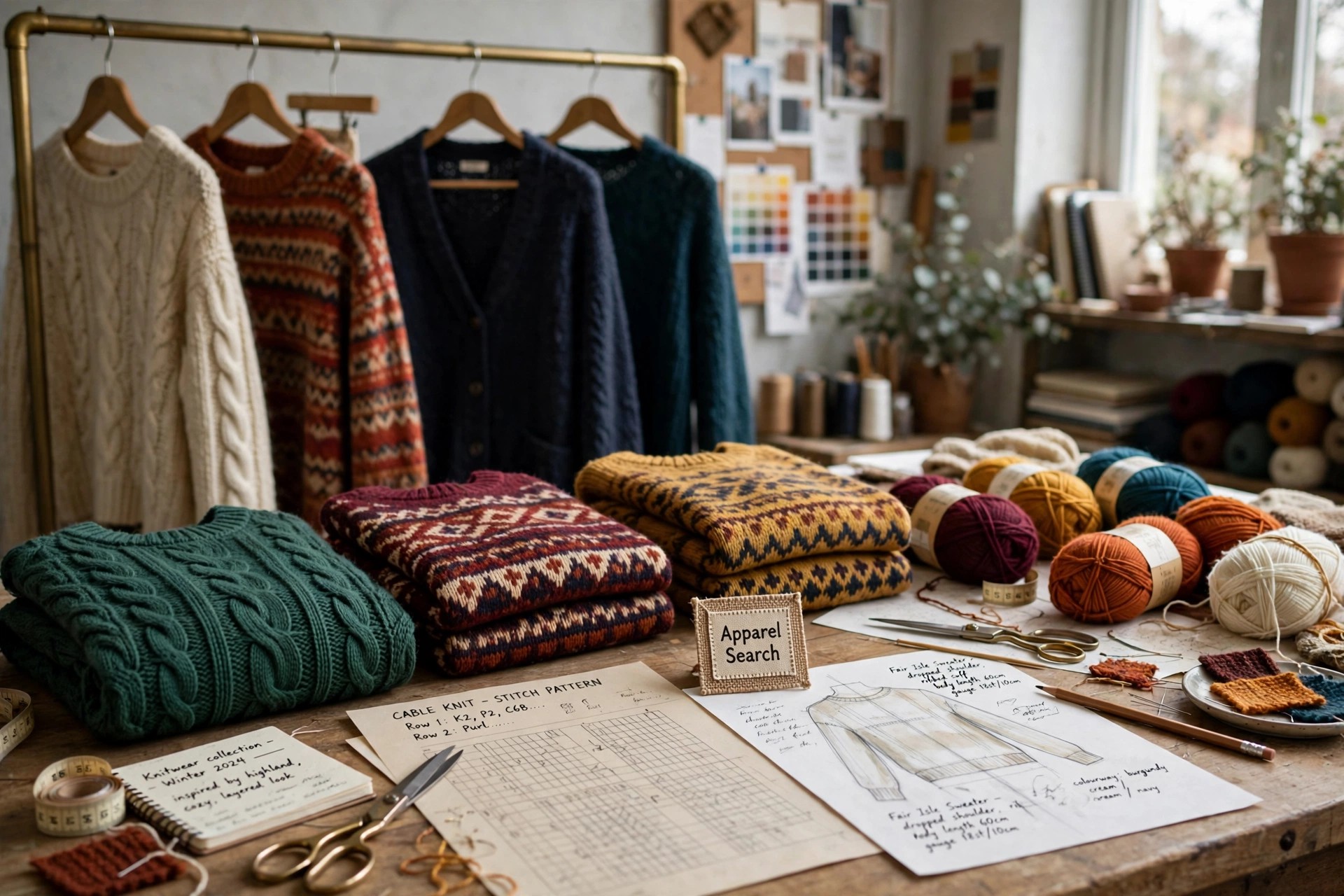
The season begins with yarn and stitch, not silhouette alone. The designer selects yarns — fibre, weight, twist and colour — and develops stitch ideas on swatches: cables, ribs, Fair Isle and intarsia colourwork, lace stitches, textured patterns and fine-gauge plains, each swatch a small proof of how the finished garment will look and behave. Silhouettes are designed around what the stitches do well, sketches and colourways are presented at range reviews, and chosen styles move into development with stitch charts, measurements and construction instructions that a knitting factory can follow.
Development divides into two manufacturing routes the designer must know equally well. Fully-fashioned knitwear is knitted to shape, panel by panel, with increases and decreases forming the garment and seams linked by hand or machine — the quality route, economical with yarn and rich in craft detail. Cut-and-sew knitwear is knitted as fabric lengths, cut like woven cloth and overlocked together — faster and cheaper, used for much jersey and fleece as well as sweater production. The designer specifies which route each style takes, fits the resulting samples, corrects stitch, tension and measurements, and approves pre-production standards before bulk knitting begins.
Stitch, Gauge and Yarn: the Knitwear Toolkit
Gauge — stitches and rows per inch — is the knitwear designer's scale of fineness, and it governs everything from how a cable reads to how a garment drapes. Fine-gauge knits in high-twist yarns make smooth, dressy sweaters; chunky gauges in lofty yarns make the textured pieces that carry a winter range. The designer matches gauge to yarn and stitch with constant swatching, because a stitch that blooms beautifully in one yarn collapses in another, and tension — how tightly the fabric is knitted — is specified and checked on every sample, since a half-size drift in tension changes the garment's measurements across the whole production.
Yarn knowledge is the other toolkit half. Fibres behave differently in the loop: wool recovers and breathes, cotton hangs heavy and can grow, acrylic holds colour cheaply, and blends trade qualities against each other and against cost. The designer also plans colourwork technically — Fair Isle carries floats behind the fabric, intarsia needs a yarn supply per colour block, stripes must align at seams — and writes all of it into the specification, with stitch charts drawn or programmed so clearly that a factory on another continent produces the intended garment, not an interpretation of it.
Skills and Abilities the Role Requires
The defining skill is thinking in loops: visualising how stitches will form a fabric, how that fabric will hang as a garment, and how shaping, edging and trims — ribbed cuffs, neckbands, button stands — finish it. Hand-knitting or machine-knitting experience, even at student level, builds that instinct faster than any lecture, and most knitwear designers swatch constantly with their own hands. Drawing and CAD skills present the ideas, but the portfolio that hires is full of knitted evidence: swatches, stitch development and garments whose construction the designer can explain.
Precision is the supporting virtue. Knitwear specifications are measurements, tensions, stitch counts and charts; an error multiplies across every panel the factory knits. The designer also needs the standard range skills — costing awareness, since yarn is expensive and waste in fully-fashioned knitting is designed out stitch by stitch; fitting skill on stretch garments that move with the body; and clear communication with technicians and factories, often through agents and across languages, about a product that is unusually hard to describe in words alone.
Qualifications, Training and Career Path
Knitwear designers usually hold fashion knitwear, textile or fashion design qualifications, with dedicated knitwear courses — teaching machine knitting, stitch design and garment construction together — the most direct preparation. Entry runs through assistant knitwear designer posts, swatching, charting and sample-chasing for a senior designer while building factory and yarn knowledge. Portfolios for knitwear roles are judged on knitted work: stitch invention, colourwork, garment development and the technical clarity of the specifications behind them.
Progression leads to senior knitwear designer and to heading a knit category or a specialist knitwear label, with freelance careers designing collections for manufacturers and retailers well established in this specialism. Skills transfer into textile and fabric development, technical design for knit categories, and yarn-company design studios that publish patterns and promote fibres. Knitwear rewards patience and precision with unusual creative depth: the designer controls the garment at the level of the individual loop, and no other clothing craft offers quite that intimacy with the material.
Common Questions
What is the difference between fully-fashioned and cut-and-sew knitwear?
Fully-fashioned panels are knitted to the garment's shape, with stitches increased and decreased to form each piece before linking. Cut-and-sew knitwear is knitted as fabric, then cut and sewn like woven cloth — faster and cheaper, with the trade-off in shaping detail and yarn waste.
Does a knitwear designer need to know how to knit?
Not to production standard, but real knitting knowledge is close to essential: designers who have knitted by hand or machine understand stitch behaviour, tension and shaping from the inside, and their specifications and swatch directions are markedly better for it.
How is a knitwear designer different from a knit fabric designer?
The knitwear designer designs finished garments — sweaters and knitted clothing — choosing stitches and yarns for a wearable product. The knit fabric designer designs cloth itself, usually for a mill, specifying structures and finishes for fabric that garment makers will buy.
More to Explore
- Fashion Schools and Education
- Fashion Careers
- Fashion Job Description Directory
- Employment Search Engines
- Fabric Mill Directory
- Fabric Mills
- Retail Fabric Stores
- Knitting — Definition
- Fabric Definitions
- Graphic Designers Guide
- Merchandising Clothing
- Fashion Artists Guide
- Computer Assisted Design
- CAD Services