Information Technology Job Description
Keeping a fashion company's systems running — support, networks and the everyday technology of stores and head office
Information technology staff keep a fashion company's everyday technology working. Every part of an apparel business now runs on systems — tills and stock lookup in stores, design and product-lifecycle software at head office, e-commerce and warehouse platforms behind the scenes — and IT professionals install, support and maintain the computers, networks, accounts and applications the staff of the company depend on. The work ranges from a help-desk technician resetting access for a store manager to systems administrators and support analysts who keep the shared infrastructure reliable through the trading day.
More Miscellaneous Job Descriptions by Letter:
Support Work: The Help Desk and the User
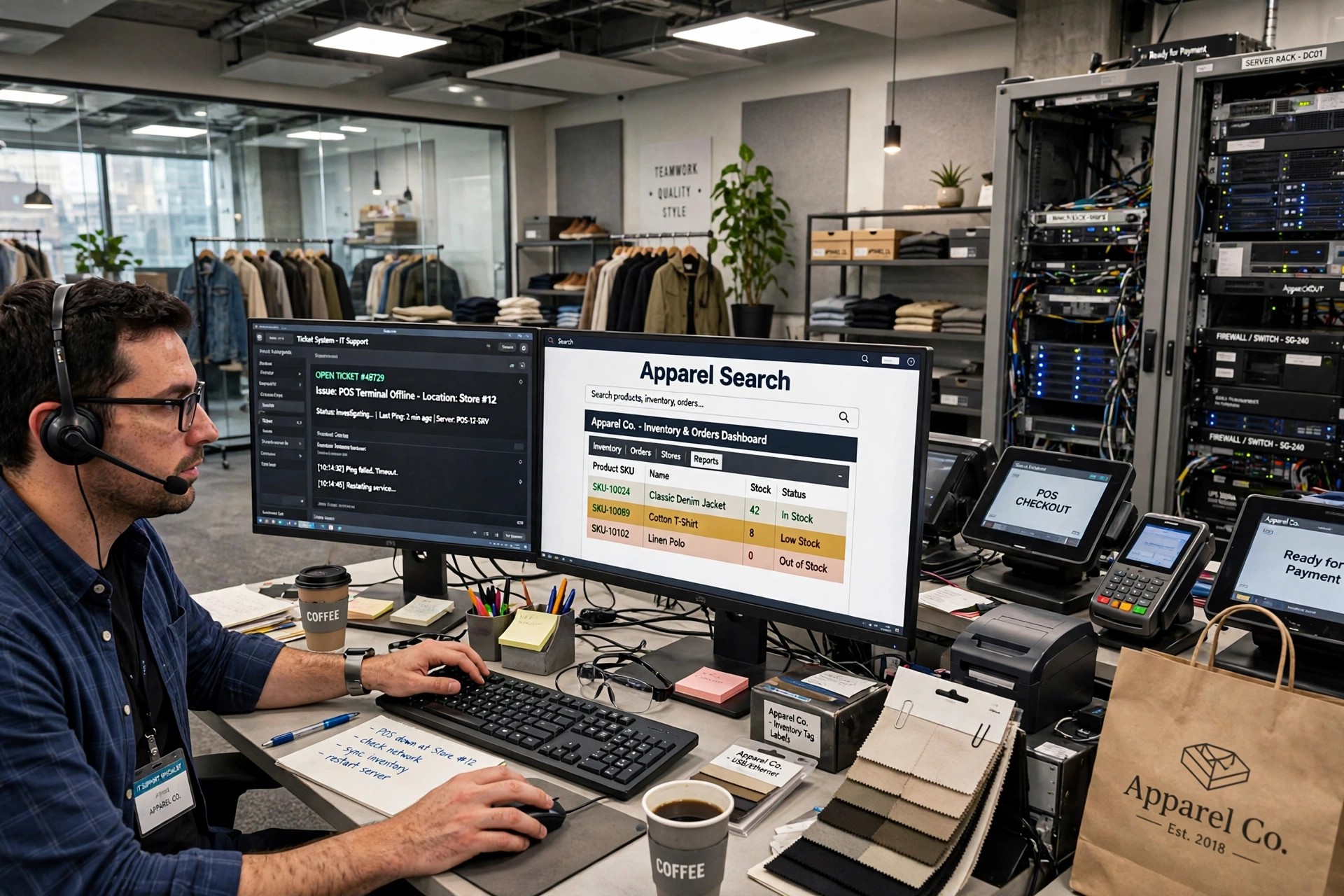
Support is where most IT careers in fashion begin and where the department earns its reputation. Technicians log and resolve requests from every corner of the business: a till that will not open in a store, a buyer locked out before a range meeting, a printer down in the sample room, a warehouse scanner failing in peak week. Good support triages by business impact — a trading store outranks a cosmetic fault — fixes what can be fixed remotely, visits when hardware demands it, and records every case so recurring faults become visible as problems to solve permanently rather than tickets to repeat.
Behind individual cases sits the user lifecycle IT owns end to end. New starters receive accounts, equipment, email and access to exactly the systems their role requires; movers have access adjusted as they change jobs; leavers are closed down promptly and completely. That discipline is both service and security: in a business handling customer payment data and commercially sensitive range information, the accuracy of who can reach what is an IT responsibility that auditors test and attackers probe.
Systems, Networks and Store Technology
The infrastructure remit covers the company's networks, servers, cloud services, telephones and endpoints — laptops, desktops, mobile devices, in-store terminals and scanners — patched, backed up and monitored so failures are usually found by IT before users find them. Fashion gives this work its own geography: a head office, design studios, distribution centres, retail stores and sometimes showrooms in several regions and time zones, all expected to behave as one company system, with seasonal peaks that punish any weak point in the chain.
IT also carries the business applications day to day: account administration and first-line support for point-of-sale, e-commerce, merchandising, inventory and finance systems, coordination with the software vendors who supply them, testing of updates before they reach trading, and training notes that help staff use systems properly. This general IT role is distinct from executive technology leadership, which sets strategy, and from store-systems development, which builds and improves the in-store platforms themselves — general IT operates, supports and connects the whole estate those roles decide and build.
Skills and Abilities the Role Requires
Technical breadth with diagnostic method is the core: operating systems, networks, hardware, common business applications and cloud services, approached with the troubleshooter's discipline of isolating causes rather than swapping parts at random. Fashion IT rewards people who learn the business systems as well as the infrastructure — the support analyst who understands how a stock file moves between warehouse, store and website resolves the interesting problems and becomes difficult to replace.
Service temperament decides careers as much as technique. IT staff explain faults and fixes in plain language to colleagues under trading pressure, stay courteous with users who report the same fault weekly, document what they did, and escalate honestly when a problem outruns them. Reliability is the quiet headline: systems work is trusted in proportion to how rarely the business has to think about it, and peak-season availability — evenings, weekends, the holiday surge — is part of the professional bargain in retail technology.
Qualifications, Training and Career Path
Routes into IT support include information-technology and computer-science study, vendor and industry certifications in operating systems, networks and cloud platforms, apprenticeships, and moves from technically inclined store or warehouse roles where the business systems were learned as a user. Employers weigh demonstrable troubleshooting and current certifications heavily at entry level, then promote on systems knowledge and service record; security awareness is now expected at every level rather than treated as a specialism.
Progression runs from help-desk and desktop support through systems administration, network and infrastructure engineering, and application support specialisation, to IT management — leading the support operation and its vendors — with branches into cybersecurity, e-commerce platform teams and business systems analysis. Senior strategists set technology direction from that foundation, but the ladder's credibility is built at the support desk: executives in this field are remembered for whether the systems, and the people depending on them, were looked after.
Common Questions
What does an IT professional do in a fashion company?
They keep the company's technology running: help-desk support for staff, computers, networks, accounts and access, store and head-office systems, backups and security basics, and coordination with software vendors — across head office, warehouses and stores.
How is general IT different from a CIO or store systems role?
General IT operates and supports the whole technology estate day to day. The CIO sets technology strategy at executive level, and store-systems developers build the in-store platforms specifically; IT support and administration connect and maintain all of it for the people who use it.
What qualifications do fashion IT jobs require?
Typically IT study or apprenticeships plus current certifications in operating systems, networks or cloud services, with employers weighting proven troubleshooting skill and knowledge of retail business systems — tills, inventory and e-commerce — highly.
More to Explore
- Fashion Employment Agencies
- Employment Search Engines
- Fashion Job Description Directory
- Fashion Directory
- Fashion Industry News
- Fashion Schools and Education
- Fashion Careers
- Apparel Industry Links
- Apparel Search Technology
- Fashion Industry Software
- Technology Innovation Clothing
- Technology Custom Fit Clothing