Inventory Flow Manager Job Description
Moving stock through the business — inbound flow, allocation timing and replenishment that keeps stores selling
An inventory flow manager is responsible for how stock moves through a fashion business — not whether the record of it is accurate, but whether the garments themselves are in the right place at the right time. Clothing arrives from suppliers in seasonal waves, passes through distribution centres, and must reach stores and online fulfilment in the sizes and quantities each location can sell, before the selling window closes. The flow manager plans and steers that movement: scheduling inbound deliveries, sequencing work through the warehouse, timing allocations and replenishment, and clearing the blockages that leave stock sitting in a depot while a store shelf stands empty.
More Miscellaneous Job Descriptions by Letter:
Inbound Flow and the Distribution Centre
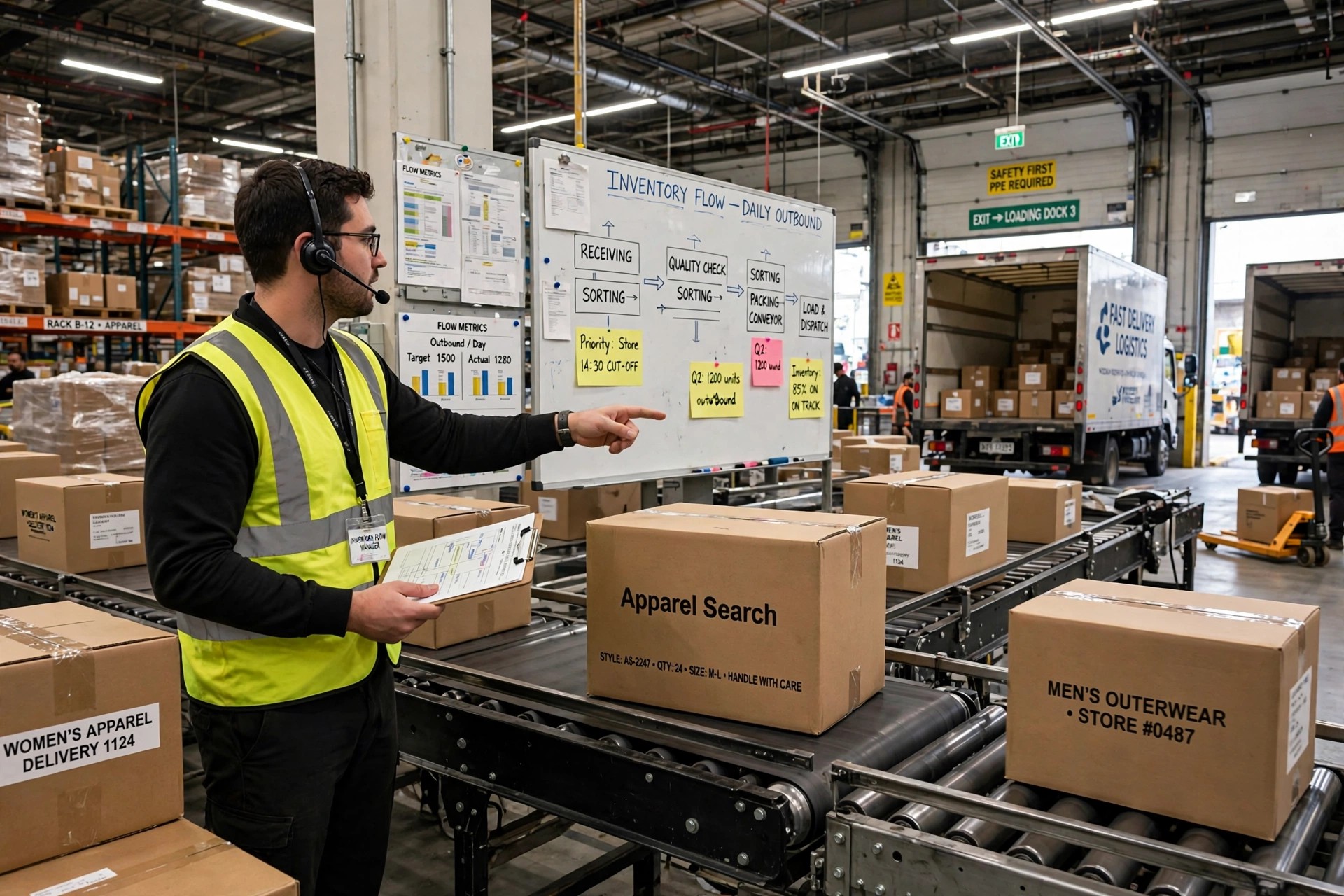
The flow begins before goods arrive. Flow managers schedule supplier deliveries against the distribution centre's capacity — dock doors, labour, processing equipment — so that a season's launches do not land in a single unprocessable week. Inbound stock is prioritised on arrival by commercial urgency: the promoted line and the replenishment of a bestseller jump the queue ahead of continuity stock with weeks of cover, and the flow manager makes those calls daily with buying and merchandising, because warehouse sequence is a trading decision wearing overalls.
Inside the centre, the manager owns throughput: how cartons are received, checked, sorted, picked and dispatched, and where the queues form. They balance the centre's workload across the week and the season, arrange overtime or temporary labour ahead of peaks they can see coming in the delivery schedule, and protect dispatch cut-offs so store deliveries and online orders leave on the vehicles that keep their promises. When flow stalls — a late container, a conveyor fault, a carrier failure — the flow manager re-plans around it and tells stores and customer service what to expect, early and honestly.
Allocation Timing and Replenishment Flow
Outbound flow is the role's trading half. New ranges are allocated to stores in initial quantities the flow manager releases in waves — enough to launch the look credibly, held back enough to correct the size and store mix once real sales show which locations sell what. Replenishment then runs continuously behind it: bestsellers are re-flowed from centre stock to the stores selling through them, slow stock is eased back or transferred between stores toward demand, and markdown and clearance stock is flowed out of prime space before the next season needs the room.
Timing is the discipline that separates flow from mere movement. Stock delivered to a store too early consumes backroom space and working capital and ages before its promotion; stock delivered late misses the weather, the event or the advertising that would have sold it. Flow managers read sell-through and stock-cover reports alongside the delivery calendar, accelerating, delaying or re-routing flow as trading changes — a heatwave, a celebrity moment, a competitor's closure two doors down. Their measures are availability and freshness: the right sizes on the rail during the selling peak, without a stockroom behind it groaning with the wrong ones.
Skills and Abilities the Role Requires
Operational planning is the core skill: reading a delivery schedule, a warehouse's real capacity and a store network's demand as one system, and sequencing work so all three agree. Flow managers need the supply-chain systems fluency to do it — warehouse management, allocation and replenishment tools, transport scheduling — and the analytical habit of watching flow indicators daily: goods-in backlog, pick completion, dispatch performance, store availability and weeks of cover by department.
The temperament is calm, commercial urgency. Flow problems arrive as other people's emergencies — an empty bestseller rail on Saturday, a launch range stuck at the port — and the manager's value lies in re-planning fast without pretending the constraint away. Communication runs constantly in three directions: suppliers and carriers about what is coming, warehouse teams about what matters today, and stores and merchandisers about what they will receive and when. Fashion knowledge sharpens every one of those conversations, because seasons, sizes and selling windows are the content being flowed.
Qualifications, Training and Career Path
Flow managers typically grow from distribution, allocation, merchandising or supply-chain roles: warehouse team leaders and supervisors, allocators and replenishment analysts, and transport planners all feed the role, as do supply-chain and logistics graduates entering through operations programmes. Employers train managers in the company's warehouse and allocation systems and promote on demonstrated throughput and availability results; understanding both the warehouse floor and the store's stockroom — the two ends of the flow — is the experience combination the role most rewards.
Progression runs to distribution centre management, supply-chain management and head of logistics roles, and sideways into merchandising operations where allocation strategy is set. In larger fashion groups the flow function connects upward to global supply-chain leadership spanning factories, freight and regional networks. It suits operators who think in movement rather than piles: where inventory control asks whether the stock record is true, the flow manager's satisfaction is a network where stock is never stuck, never late and never piled where it cannot sell.
Common Questions
What does an inventory flow manager do?
They manage the movement of stock through the business: scheduling supplier deliveries into the distribution centre, sequencing warehouse processing, timing allocations of new ranges to stores, running replenishment behind sales, and clearing blockages so stock reaches the right place in its selling window.
How is inventory flow different from inventory control?
Flow is about movement and timing — where stock is going and when it arrives. Control is about accuracy — whether the recorded stock matches the physical stock. Flow managers depend on accurate records, but they are measured on availability and throughput, not count accuracy.
What background do inventory flow managers come from?
Usually operations: warehouse supervision, allocation and replenishment analysis, transport planning or supply-chain graduate routes, promoted on throughput, availability and delivery results, with systems training from the employer.