Forecast Analyst Job Description — Fashion
Predicting what shoppers will want next season — demand forecasting built on trends, seasonality and the fashion calendar
A fashion forecast analyst answers the hardest question in the apparel business: what will people want to buy, months before they buy it? Clothing is ordered long before it is sold — fabrics are committed, factories are booked and ranges are planned against a season that has not happened yet — and the forecast analyst is the person who turns trend research, last year's sales and the rhythm of the fashion calendar into numbers the business can order against. Get the forecast right and the right styles are on the rail when demand peaks; get it wrong and the season ends in markdowns or empty shelves.
More Planning Job Descriptions by Letter:
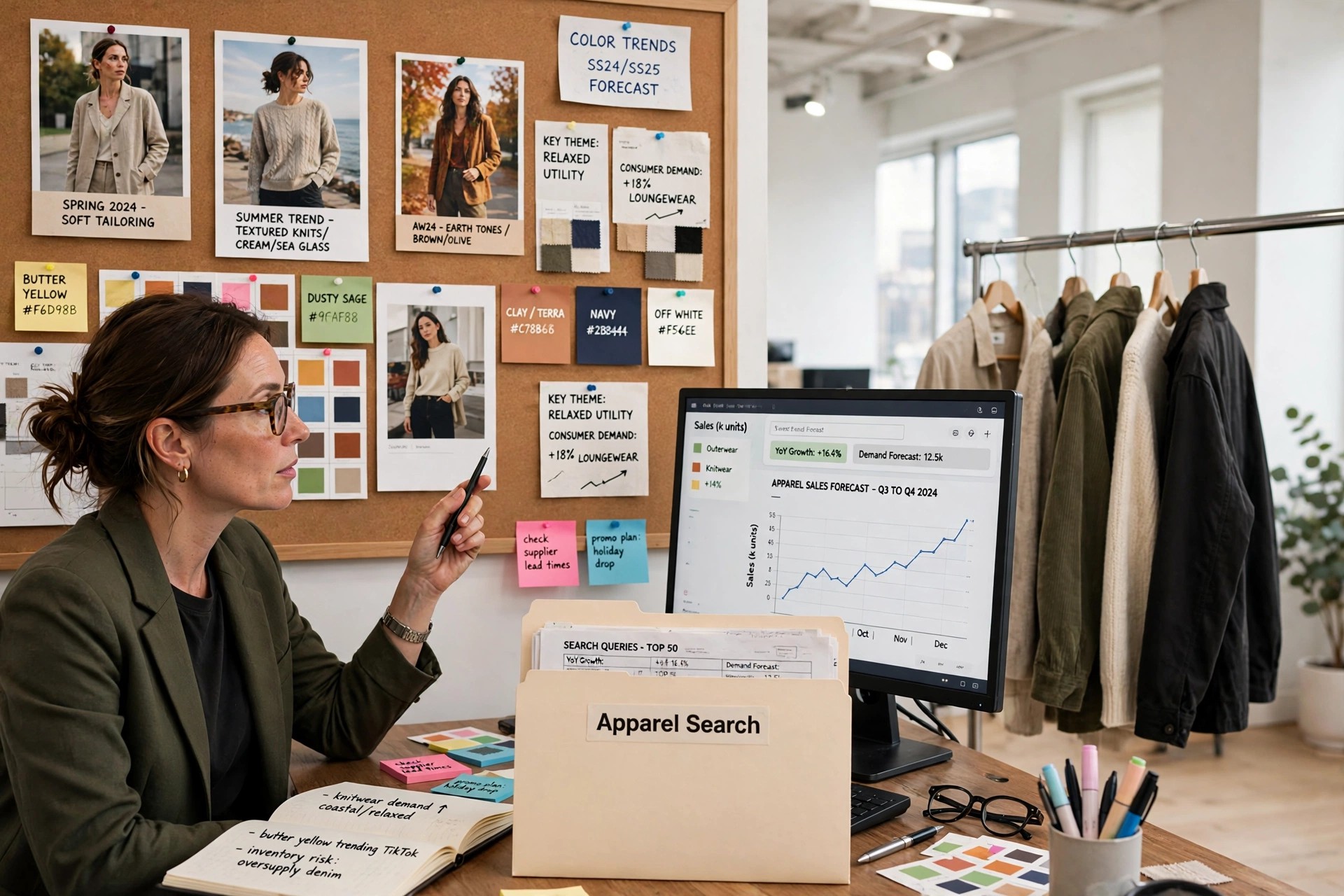
Forecasting Demand from Trends and Seasonality
The core of the work is building a demand forecast for upcoming seasons, usually by category first and then down to style, color and size. The analyst starts from history — what sold, in which weeks, at what price, under which promotions — and then adjusts that history for everything history cannot see: the trends the design team is backing, the colors rising through the market, a colder or warmer season pattern, a major event or holiday shift in the calendar, and the company's own plans to open stores, push a category or drop a line. Fashion demand is unusually trend-sensitive, so two seasons with identical weather can sell very differently because a silhouette moved.
Seasonality gives the forecast its shape. Apparel demand runs in waves — coats crest in autumn, swimwear in early summer, party dresses in December — and the fashion calendar fixes the moments when new ranges land, when promotions run and when clearance clears the floor for the next drop. The analyst maps those waves week by week for each category, because a forecast that is right for the season but wrong for the month still strands stock. Trend input is weighed, not just copied: a look all over the runways may suit a contemporary brand's customer or miss a classic brand's customer entirely, and judging that fit is where a fashion forecaster earns the title over a general statistician.
Working with Buyers, Planners and Designers
A forecast is a shared number, and producing it is a social as much as an analytical process. The analyst presents expected demand to buyers and merchandise planners, defends the assumptions behind it — the trend calls, the growth rates, the promotional effects — and revises it as the table pushes back with knowledge of their own: a fabric that could not be sourced, a price point that changed, a store group that performed oddly last year. The agreed forecast then drives open-to-buy budgets, order quantities and the depth bought in each size and color, so the analyst's work is visible later in every rail that is full or empty.
Forecasting does not end when the orders are placed. Through the season the analyst tracks early sales against the forecast — the first two weeks of a style's life say a great deal about its thirteenth — and calls out the deviations while there is still time to act: chase a winner with a reorder, pull forward a promotion on a slow line, shift marketing support toward the categories beating their numbers. After the season, the misses are reviewed honestly. Which assumption failed, and was it knowable? That review discipline is what makes next year's forecast better rather than merely different.
Skills and Abilities the Role Requires
The analyst needs a genuine feel for fashion allied to real numerical strength — a combination employers describe constantly and find rarely. On the number side: comfort with large sales datasets, spreadsheet modeling, forecasting methods from moving averages to regression-style approaches, and the judgment to know when a model's output is nonsense because the inputs changed meaning. On the fashion side: fluency in the market's trend sources, an eye for which movements are commercial and which are noise, and enough category knowledge to know that denim, dresses and outerwear do not forecast alike.
Communication carries equal weight. A forecast nobody believes is a spreadsheet, not a forecast, so the analyst learns to explain uncertainty plainly — what would have to be true for the high case, what the downside looks like — and to present a range with a recommendation rather than a single fragile number. Accuracy is tracked and discussed openly in good planning teams, which takes a particular temperament: confidence to commit to a call, and the grace to dissect it afterwards when the season disagrees.
Qualifications, Training and Career Path
Forecast analysts typically hold a degree in fashion merchandising, business, statistics, economics or a related field, and many arrive from assistant buyer, allocator or merchandise planning roles where they learned the categories from the inside. Employers look for demonstrated analytical work — planning projects, retail math fluency, advanced spreadsheet skills and familiarity with planning or business-intelligence software — more than for any single credential. Knowledge of the company's customer, gained on the shop floor or in junior planning posts, is treated as a forecasting asset in its own right.
The career path runs upward through planning: senior forecast analyst, demand planning manager and head of planning roles, where the forecasts cover whole divisions and the assumptions are argued at executive level. Analysts also move sideways into merchandise planning, buying support and range planning, carrying their demand view with them, or toward the trend and market-intelligence side of the industry, where the same trend judgment is sold as research. It is a role for people who love fashion enough to study it and numbers enough to distrust a hunch — including their own.
Common Questions
What does a fashion forecast analyst actually forecast?
Customer demand for coming seasons: how much of each category, style, color and size the business can expect to sell, week by week, so buyers and planners can set budgets and order quantities before the season begins.
How is fashion forecasting different from trend forecasting?
Trend forecasting identifies what will look right — silhouettes, colors, fabrics, moods. Demand forecasting, this role, turns those signals plus sales history and seasonality into quantities: units, sizes and timing that orders can be placed against.
What background do fashion forecast analysts come from?
Usually a degree in fashion merchandising, business, statistics or economics, often via assistant buyer, allocation or junior planning roles. Employers prize proven analytical work, retail math and deep category knowledge over any single qualification.
More to Explore
References & Further Reading
More Job Description Categories
- Buying Job Descriptions
- Design Job Descriptions
- Marketing & PR Job Descriptions
- Miscellaneous Job Descriptions
- Planning & Allocation Job Descriptions (current)
- Production & Sourcing Job Descriptions
- Sales & Selling Job Descriptions
- Transportation & Warehouse Job Descriptions