Forecast Analyst Job Description — Inventory
Keeping stock at the level trade requires — forecasting inventory needs, replenishment signals and availability
Where some forecasters ask what customers will want, the inventory forecast analyst asks a colder question: how much stock will the business be holding, where will it be sitting, and will it be enough? This analyst projects inventory levels across stores, distribution centers and online channels, week by week, so that garments are available when shoppers reach for them without capital piling up in slow stockrooms. It is forecasting pointed at the balance sheet as much as the sales floor — availability protected on one side, overstock and markdown risk held down on the other.
More Planning Job Descriptions by Letter:
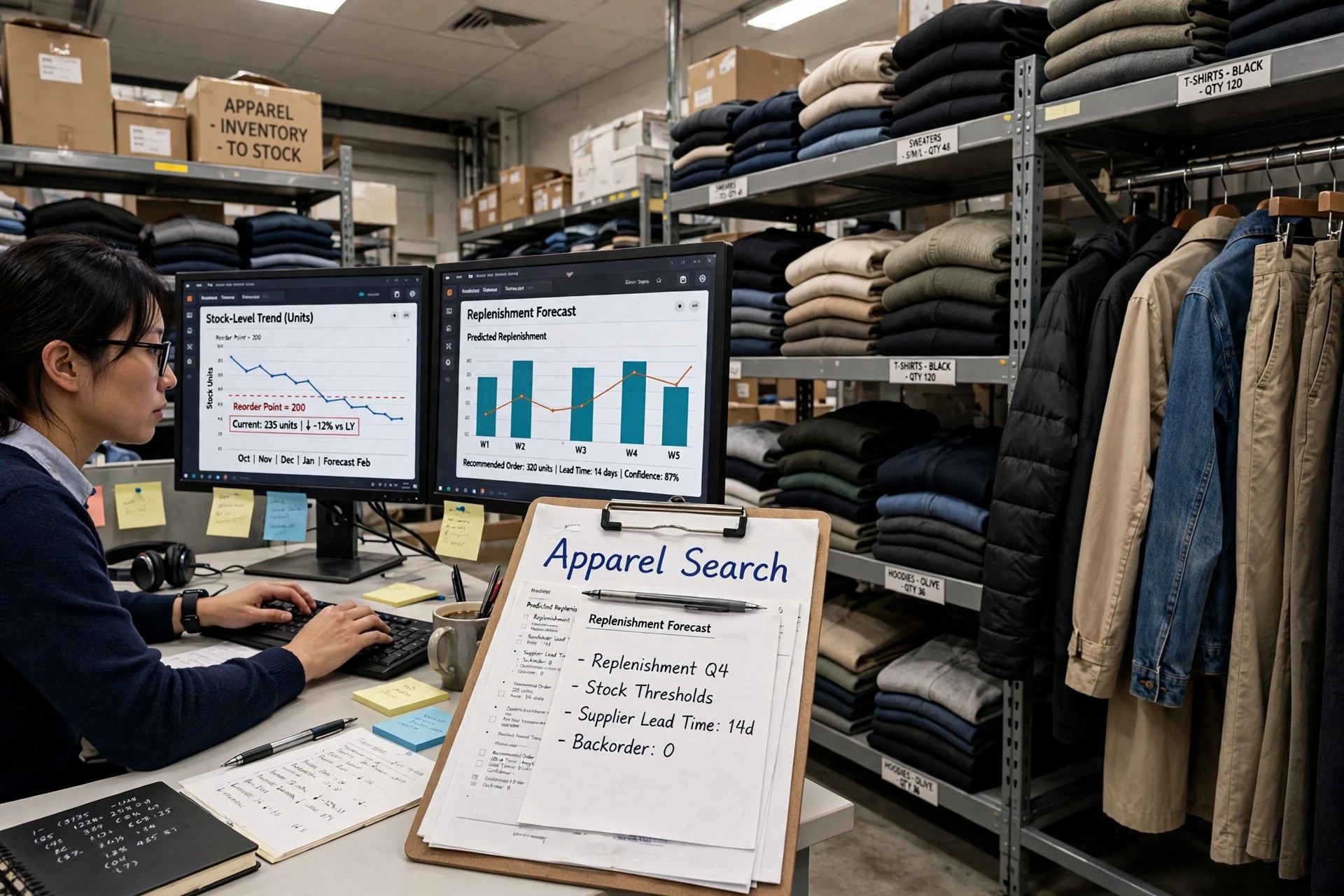
Projecting Stock Levels and Replenishment Signals
The daily material is the stock position: units on hand by style, size and location, units on order, goods in transit, and the rate at which each line is actually selling. From those inputs the analyst projects where inventory lands in four, eight or thirteen weeks if nothing changes — which sizes of a core jean run dry in the northern stores, which distribution center is quietly accumulating a slow coat line, which online pool needs feeding before a promoted weekend. A projection is only useful early, so the analyst learns to read depletion curves rather than totals: a style can look healthy in aggregate while its best sizes are already gone.
Replenishment is where the projection becomes action. For continuing lines — basics, core denim, underwear, schoolwear — the analyst maintains the signals that trigger reorders: rate-of-sale thresholds, weeks-of-cover targets and safety stock levels set high enough to absorb a late shipment or a sudden demand spike, low enough that the warehouse is not financing last season's optimism. Lead times rule these calculations. A replenishment signal that fires today may produce stock in six weeks from a domestic supplier or four months from an overseas factory, and the forecast must therefore see further ahead than the selling season it protects.
Availability, Service Levels and the Cost of Being Wrong
Both directions of error are expensive, and they are expensive differently. Under-forecast and the cost shows up immediately: broken size ranges, out-of-stock bestsellers, online orders cancelled, customers who bought the competitor's version instead. Over-forecast and the cost arrives slowly and then all at once: stockrooms and warehouses full of aging garments, working capital trapped in inventory, and a clearance season that trains customers to wait for discounts. The inventory analyst's craft is holding those two risks in balance line by line, because the right cover for a fashion-forward dress is measured in weeks and for a white t-shirt in months.
The work connects directly to the physical business. The analyst works with distribution and warehouse teams on inbound flow — when purchase orders land, whether the building can receive and process a peak week — and with store operations on the stock already sitting in the wrong places, recommending transfers that put sizes where they sell instead of marking them down where they do not. Allocation teams, planners and buyers all consume the analyst's availability reporting, and a clear stock-risk report, early, is often the difference between a quiet correction and a seasonal problem.
Skills and Abilities the Role Requires
This is the most systems-heavy corner of fashion forecasting. The analyst lives in inventory and replenishment software, queries sales and stock databases, and builds projections that join demand rates to lead times, pack sizes and minimum order quantities. Spreadsheet fluency is assumed; comfort with the logic of reorder points and safety stock formulas is the real requirement, together with the skepticism to audit the data — a stock file that says forty units where the shelf holds four will poison every projection built on it, and good analysts verify against physical reality through counts and store feedback.
Judgment about variability matters as much as arithmetic. Demand for a replenished basic is fairly predictable; demand for a fashion line is not, and the analyst sets protection levels accordingly rather than applying one rule to the whole range. The role also needs translators: buyers who think in styles, warehouse managers who think in cartons and finance teams who think in cash all need the same stock position explained in their own terms, and the analyst who can do that gets heard when a difficult call — cut the reorder, or back the line — has to be made.
Qualifications, Training and Career Path
Employers typically ask for a degree in supply chain management, business, statistics, operations or a related discipline, or equivalent experience built in inventory control, allocation or distribution roles. Many inventory forecast analysts have physically handled the stock they now project — stockroom, warehouse or store inventory work teaches what a size curve looks like when it breaks — and employers value that grounding alongside the analytical credentials. Training centers on the company's replenishment and planning systems, its supplier lead-time structures and its availability targets.
Progression leads to senior inventory analyst and inventory or supply planning manager posts, where the projections cover whole channels and the safety stock policies themselves are set rather than applied. Sideways moves reach allocation management, distribution planning and supply chain analysis, and the role is also a recognized route into broader demand and supply planning leadership, because it teaches the discipline the rest of planning depends on: knowing, precisely and early, what the business actually holds.
Common Questions
What does an inventory forecast analyst do?
They project stock levels across stores, warehouses and online channels, set safety stock and replenishment triggers for continuing lines, and warn planners early when sizes or lines are heading for stockouts or overstock.
How is this different from a fashion forecast analyst?
Direction of view. The fashion forecast analyst predicts customer demand from trends and seasonality. The inventory forecast analyst starts from stock on hand, stock on order and selling rates, and projects availability — whether the right units will physically be in the right place.
What is safety stock, in this role?
The buffer held above expected need to absorb late deliveries and demand spikes. Setting it is a core judgment of the role: too little and bestsellers run out; too much and capital sits in slow inventory heading for markdown.
More to Explore
References & Further Reading
More Job Description Categories
- Buying Job Descriptions
- Design Job Descriptions
- Marketing & PR Job Descriptions
- Miscellaneous Job Descriptions
- Planning & Allocation Job Descriptions (current)
- Production & Sourcing Job Descriptions
- Sales & Selling Job Descriptions
- Transportation & Warehouse Job Descriptions