Oven Operator Job Description
Running the industrial ovens that cure prints, dry fabrics and heat-set garments — heat, timing and safety in the finishing department
In textile printing and finishing, the oven is where the work becomes permanent. Prints that enter a curing oven as wet ink leave it fixed and washable; dyed and printed fabrics are dried there; synthetic garments are heat-set into their final shape and dimensions. The oven operator runs that equipment — industrial conveyor dryers and curing ovens, stenter and heat-setting plant — and owns the temperature, timing and safety discipline on which both product quality and the department’s safety record depend.
More Production Job Descriptions by Letter:
Running Curing, Drying and Heat-Setting Equipment
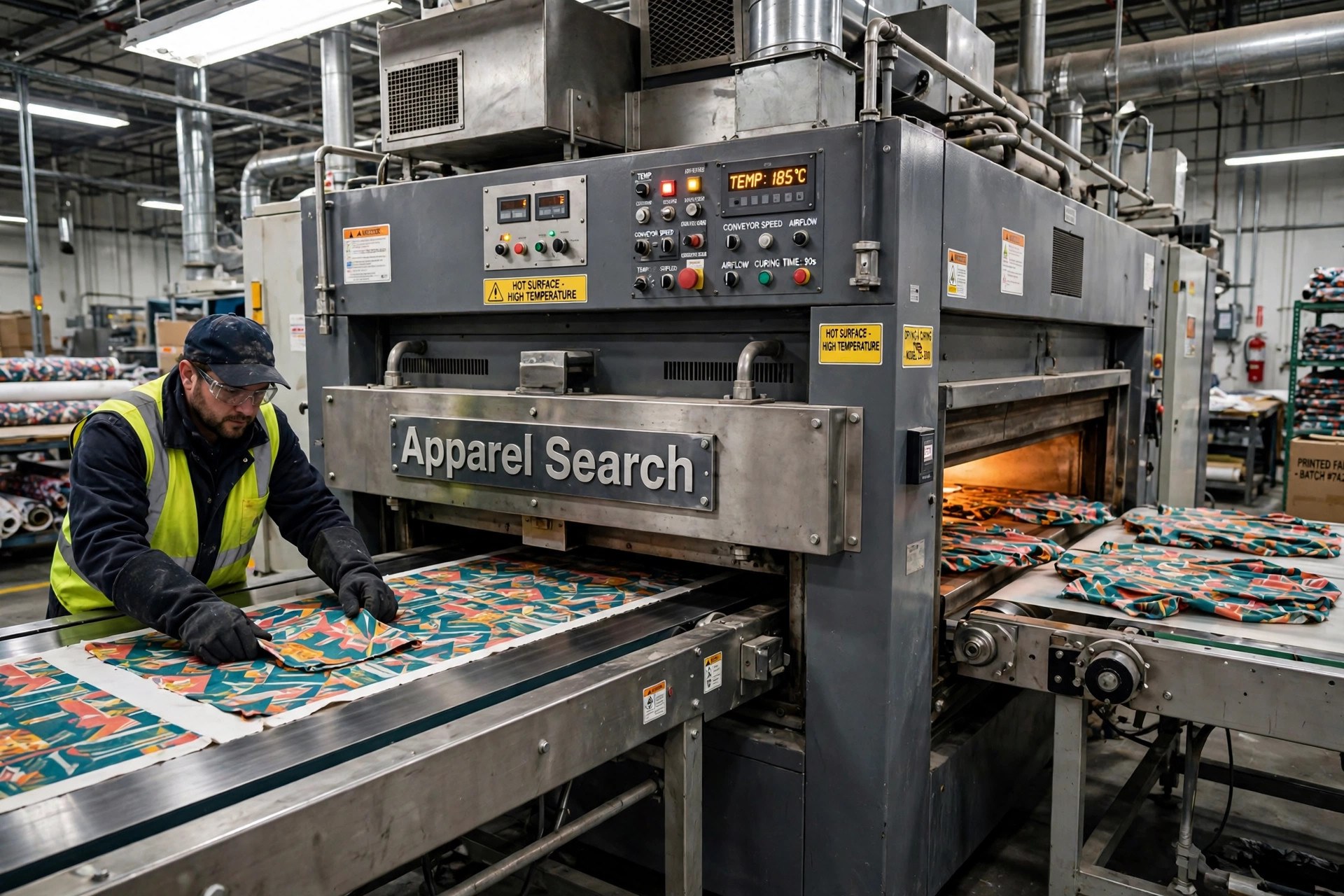
The operator’s day is set by the production running through the department. In a print shop, garments and panels arrive from the presses and are laid flat on the conveyor belt, spaced so heat reaches every print evenly, then travel through the heated chamber for a set time at a set temperature. The operator chooses and verifies those settings for each job: plastisol, water-based and specialty inks cure at different temperatures, fabric types scorch or shrink at different thresholds, and thick prints need more dwell than thin ones. Undercured work fails later — cracking or washing out at the customer — while overheated work is ruined on the spot.
In fabric finishing the same principles run at larger scale: ovens and stenters dry fabric after dyeing or printing, heat-set polyester and other synthetics so garments keep their dimensions, and cure resin and coating finishes. The operator sets chamber temperatures zone by zone, belt or pin-frame speed, and airflow, then monitors the run continuously, because a few degrees of drift across a long roll becomes a claim. Start-up, shutdown and changeover routines — purging, warm-up to stable temperature, cleaning filters and belts — are done by the book every time, not from memory and mood.
Quality Checks and Process Records
Oven work is verified, not assumed. Operators test cured prints with stretch and wash checks, confirm dried fabric is dry through rather than surface-dry, watch for scorching, yellowing, glazing and shine on heat-sensitive cloth, and check heat-set goods against width and shrinkage targets. A hand or a test strip is never the thermometer of record: settings are proven with temperature strips, probes and the machine’s own instruments, and any out-of-tolerance result stops the run rather than passing quietly down the line.
Records matter because faults surface late. The operator logs jobs, settings, temperatures and faults run by run, so that if a print fails in wash testing or a fabric roll fails inspection, the department can trace exactly what conditions it passed through. The operator also handles the first level of machine care: clearing jams without defeating guards, cleaning lint — a genuine fire risk around heat — reporting belt tracking, burner and fan faults to maintenance early, and keeping the oven’s surroundings free of the fabric, paper and solvent clutter that heat turns dangerous.
Heat, Safety and the Working Environment
This is hot work, and its safety rules are absolute. Operators wear the protective equipment the plant specifies, treat every chamber, duct and freshly exited garment as hot until proven otherwise, and never reach into a moving belt or an energised chamber. Lockout procedures govern cleaning and jam clearance on powered equipment; gas-fired plant adds burner, ventilation and alarm checks to the start of every shift. Heat exhaustion is a real occupational risk, managed with hydration, rotation and honest reporting of symptoms — by oneself and for workmates.
The environment is a finishing or printing department: standing work, radiant heat near the ovens, the noise of fans and conveyors, and shift patterns that follow production, including nights in busy plants. Operators work within a team — printers, dyers, finishers and quality staff on either side of the oven — and the pace is the line’s pace: the oven sits mid-process, so its stoppages starve everything after it and flood everything before it, which is why steady, unhurried competence is valued over drama.
Skills, Training and Career Path
Oven operators are usually trained on the job, entering from general factory, printing or finishing work and qualifying machine by machine under experienced operators. What employers look for is reliability, numerical care with settings and logs, a practical feel for fabric and print behaviour, and unshakeable safety habits. A background in screen printing, dyeing or textile finishing shortens training, and formal certificates in textile processing or machine operation help where they exist, but the department’s own sign-off on each oven is the credential that counts.
Experience widens the work: senior operators run the largest plant, own the settings library for standard jobs, train new operators and deputise for the supervisor. From there, paths lead to finishing or print department supervision, production management, quality and testing roles where process records are second nature, or maintenance work for operators who develop the mechanical side. In an industry that increasingly prints and finishes close to its markets, a proven oven operator’s skills transfer between print shops, dye houses and finishing plants without translation.
Common Questions
What does an oven operator do in a textile factory?
Runs industrial ovens and dryers that cure printed inks, dry dyed and printed fabrics and heat-set synthetic garments: setting temperatures and belt speeds for each job, loading and monitoring runs, testing results, keeping process records and following strict heat-safety procedures.
What happens if a print is undercured or overheated?
Undercured ink cracks, fades or washes out when the customer launders the garment. Overheating scorches or yellows fabric, distorts prints and can shrink garments out of tolerance. The operator’s temperature and dwell settings, proven with tests, are what prevent both.
How do you become an oven operator?
Usually by on-the-job training in a print shop, dye house or finishing plant, qualifying on each oven under experienced operators. Reliability, care with settings and records, and strong safety habits matter most; printing or finishing experience shortens the training.
More to Explore
Printing and Finishing Resources
References & Further Reading
More Job Description Categories
- Buying Job Descriptions
- Design Job Descriptions
- Marketing & PR Job Descriptions
- Miscellaneous Job Descriptions
- Planning & Allocation Job Descriptions
- Production & Sourcing Job Descriptions (current)
- Sales & Selling Job Descriptions
- Transportation & Warehouse Job Descriptions