Production Associate Job Description
The junior production role — running smaller orders end to end under a manager's eye
The production associate is the first rung of the production ladder where the work becomes your own. Where the production assistant supports the whole team's tasks, the associate is given a defined slice of the range — a group of styles, often repeats, basics or smaller orders — and runs it end to end: raising the purchase orders, following the critical path, handling routine approvals, talking to the factories, and delivering finished goods on the agreed date. A manager sets the priorities and rescues the exceptions, but the associate's orders are the associate's responsibility, and everyone in the department knows whose styles they are.
More Production Job Descriptions by Letter:
Owning Orders End to End
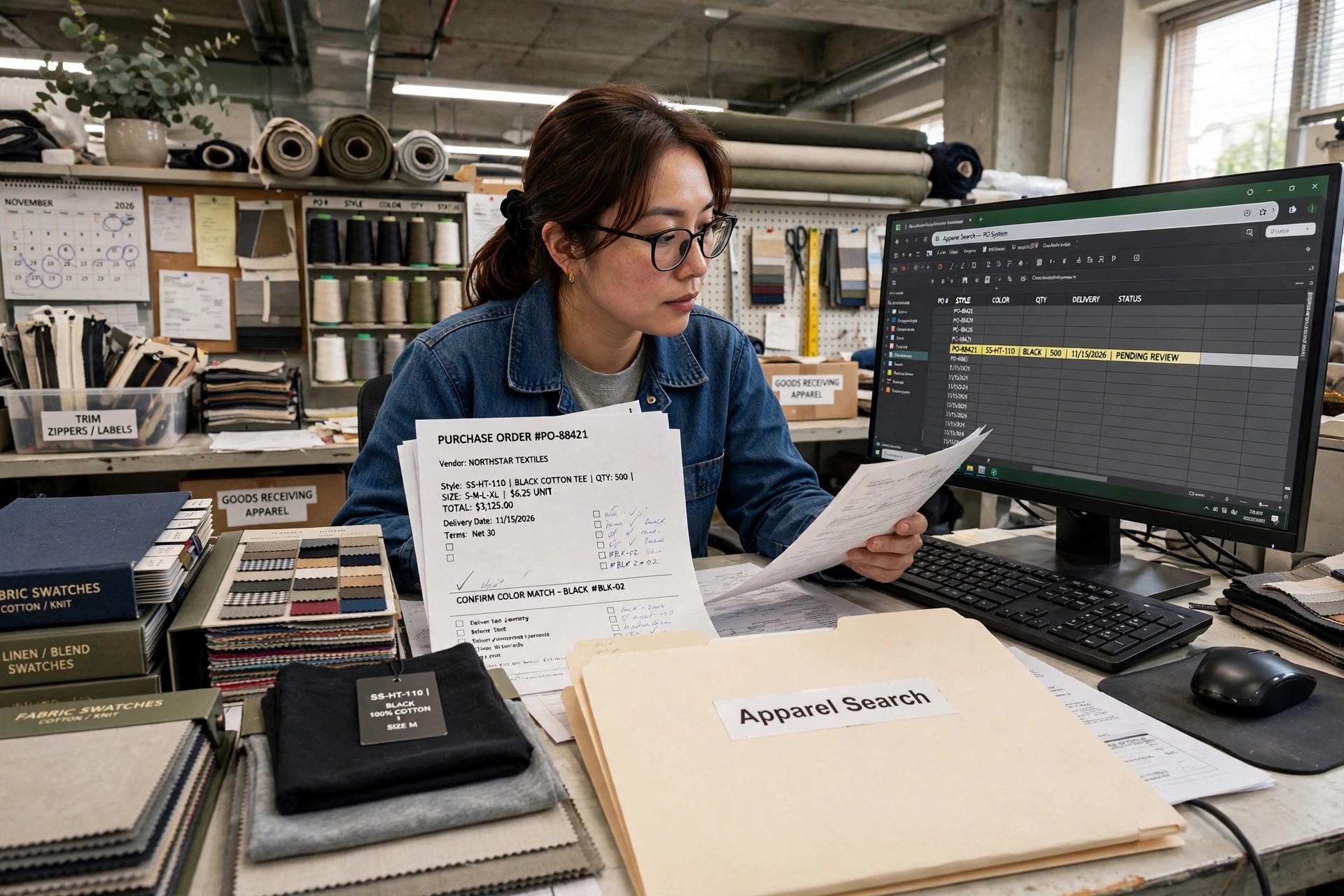
An associate's styles begin at the order. Working from the confirmed costing and specification, the associate raises accurate purchase orders — style, colour, size ratio, quantity, price, delivery date and factory — and checks them against the buy plan before they are issued, because an error typed here is manufactured there. As production proceeds, the associate follows the order's critical path: fabric and trim readiness, sample and approval status, cutting, sewing progress and the ex-factory date, updating the work-in-progress record that the whole department plans around.
Ownership means the associate sees their orders whole. They know which of their styles are healthy, which are drifting, and which need a decision today; they keep the delivery schedule honest rather than hopeful; and when a style completes, they close it properly — quantities reconciled, documents filed, lessons noted — rather than letting it fade off the tracker. Repeats and continuity lines suit associate ownership precisely because their patterns are known, which frees the associate to learn the management of production rather than the surprises of development.
Factory Communication and Routine Approvals
The associate is a factory's daily contact for their styles. Production updates are requested and chased in the factory's working rhythm, questions from the sewing floor — a construction detail, a label position, a packing instruction — are answered from the tech pack or escalated with the relevant facts assembled, and every commitment is confirmed in writing. Associates learn the diplomacy of the relationship early: factories serve many customers, and the customer whose paperwork is clear, whose questions are batched and whose promises are kept gets their problems solved first.
Routine approvals sit with the associate too: lab dips within an agreed tolerance, trim submissions matching an approved standard, pre-production samples on repeat styles, and carton and labelling checks against the packing specification. Judgment is bounded and that is deliberate — anything outside tolerance, off-standard or commercially significant goes to the coordinator or manager with the associate's recommendation attached. Knowing exactly where your authority ends is itself a production skill, and associates are assessed on it.
Problems, Priorities and Escalation
Even small orders generate problems: fabric arriving late to the factory, a trim substitution proposed, a delivery splitting into two shipments, quantities coming up short at final inspection. The associate's job is to detect these early — while they are still cheap — quantify what they mean for the delivery, and bring solutions rather than alarms: an air-freight quote for the shortfall, a revised split the warehouse can accept, a substitute trim with a sample attached. Managers promote associates who surface trouble early with options; they remember the ones whose orders fail silently.
Prioritisation across a style group is the associate's daily puzzle. Everything cannot be chased at once, so the associate works from delivery dates and risk: the style shipping in ten days with an unapproved sample outranks the style shipping in ten weeks with fabric on the water. Coordinators set the department-wide picture, but within their own group the associate is expected to know — and to be able to defend — what they are working on first, and why.
Skills, Qualifications and Career Path
Associates are usually promoted production assistants or hired with a year or two in a related role — buying admin, merchandising assistance, factory office work — and employers test for the same core: numerical accuracy, tracker and spreadsheet fluency, clear written communication across cultures and time zones, and enough garment knowledge to read a tech pack and a sample intelligently. A fashion or textiles qualification supports the application; a record of orders delivered on time outweighs it.
The recognised next step is production coordinator, where the same skills scale from one style group to the whole order book's tracking and scheduling. Associates who develop commercial strength move toward production management; those who prefer the product itself move toward product development. The associate years decide which direction fits, because they are the first years in which a production professional is judged on outcomes — styles delivered, dates kept, problems solved — rather than on tasks completed.
Common Questions
What does a production associate do in apparel?
Runs a defined group of styles or smaller orders end to end: raises purchase orders, tracks work in progress against the critical path, handles routine approvals and daily factory communication, and delivers the orders on their agreed dates.
How is a production associate different from a production assistant?
The assistant supports the whole team's tasks — samples, data, filing, parcels. The associate owns a slice of the range personally: their styles, their factory conversations, their delivery dates, with a manager handling only priorities and exceptions.
What comes after production associate?
Production coordinator is the standard next step — the same discipline applied to tracking and scheduling across the full order book. Commercially minded associates progress toward production manager roles.
More to Explore
The Production Ladder
References & Further Reading
More Job Description Categories
- Buying Job Descriptions
- Design Job Descriptions
- Marketing & PR Job Descriptions
- Miscellaneous Job Descriptions
- Planning & Allocation Job Descriptions
- Production & Sourcing Job Descriptions (current)
- Sales & Selling Job Descriptions
- Transportation & Warehouse Job Descriptions