Production Manager Job Description
Owning a production department's results — orders, factories, cost, quality and delivery
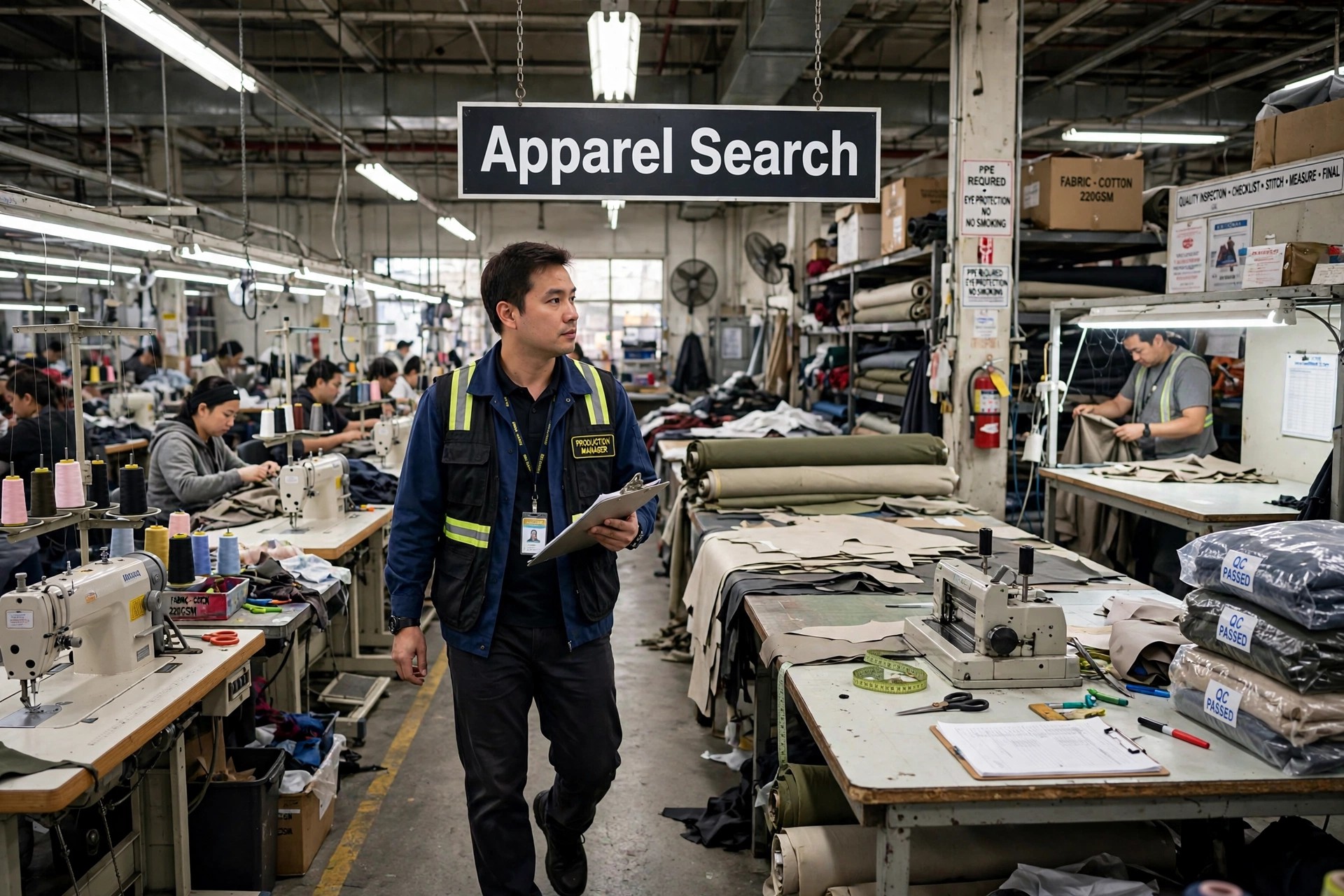
The production manager owns results. Where coordinators track orders and associates run their style groups, the manager is accountable for a whole department or product area delivering its ranges on time, at target cost, to the agreed quality — and leads the team of coordinators and associates who do the daily work. The manager places the department's orders with the right factories, negotiates the prices and terms, decides the recoveries when production goes wrong, and answers upward for the area's performance. It is the pivotal production role: senior enough to commit the company commercially, close enough to the work to know exactly what a factory can and cannot do.
More Production Job Descriptions by Letter:
Placing Orders and Managing Factories
The manager decides where the department's production goes. Matching orders to factories is a judgment of capability, capacity, cost and trust: the factory that sews the department's core product beautifully may be wrong for its new category, and the cheapest quote is expensive if the goods arrive after the selling season. The manager builds the area's factory relationships deliberately — visiting, reviewing performance season by season, developing promising partners and exiting those who repeatedly fail — because the order book can only ever be as reliable as the factories holding it.
Negotiation is the manager's commercial craft. Prices are built from costings the manager understands garment by garment — fabric, trim, make time, overhead — so concessions are traded knowingly: volume for price, delivery flexibility for priority, consolidated orders for better terms. Payment terms, claims for defective or late goods, and the settlement of the disputes every season produces are all negotiated by the manager, whose signature is the one factories organise their own planning around.
Delivery, Quality and the Department's Numbers
The manager reviews the whole order book's health: critical paths slipping, inspections failing, capacity colliding — and intervenes where coordinators' recoveries are not enough. Air freight budgets are spent by the manager's decision, orders are moved between factories by the manager's authority, and delivery promises to buying and retail teams are re-made, when they must be, by the manager in person rather than discovered by the customer. The manager's weekly numbers — on-time percentage, cost variance against target, quality claim rate — are the department's report card, and improving them systemically, rather than heroically each week, is the job's real test.
Quality accountability sits here too. The manager sets the area's inspection regime, reviews failure patterns for root causes — a construction that cannot be sewn at speed, a factory whose training has slipped, a specification that invites error — and changes the system that produced the fault, not only the batch that contains it. Factories learn a manager's standard within one season, and departments run for years on the reputation of what their manager will and will not accept.
Leading the Production Team
Coordinators and associates do the department's daily work, and the manager makes them effective: allocating style groups and order volumes fairly, coaching associates through their first factory negotiations, reviewing coordinators' forecasts with a sceptical, supportive eye, and building the coverage that keeps orders moving through holidays and resignations. Hiring judgment matters — production teams are small, and one unreliable hire is visible in every delivery the department makes.
The manager also represents production to the rest of the business: in range planning, where delivery reality must shape buying ambition early; in trading meetings, where stock positions are explained honestly; and upward to the production director, with the area's performance, risks and needs reported in numbers. The manager who brings solutions with budgets attached gets heard; the one who brings only problems gets managed.
Skills, Qualifications and Career Path
Production managers are almost always experienced coordinators or senior associates first, with a record across several seasons and product types. The skills stack is the ladder's full set — critical path discipline, costing and negotiation, factory knowledge, quality systems — plus the two the manager's chair adds: commercial judgment under accountability, and team leadership. Garment technology, fashion business or supply chain qualifications support applications, and larger employers increasingly expect systems and data fluency as production reporting automates.
Advancement runs to senior production manager and head of production roles, and onward to production director, where one area's ownership becomes the whole company's strategy. Managers also move sideways into sourcing leadership, technical and quality direction, or country and sourcing office management overseas — postings that suit managers whose factory relationships and judgment are their capital. Within the ladder described in this category, the manager's chair is where a production career stops being about orders and starts being about outcomes.
Common Questions
What does a production manager do in apparel?
Owns a production department or product area's results: places orders with factories, negotiates prices and terms, holds delivery, cost and quality accountability, decides recoveries, and leads the coordinators and associates who run the daily work.
How is a production manager different from a coordinator?
The coordinator tracks and forecasts across the order book and mounts recoveries. The manager owns the outcomes — factory placement, commercial negotiation, team leadership and the department's numbers — and decides the recoveries coordinators propose.
What experience do production managers need?
Several seasons as a coordinator or senior associate, across product types, with proven costing, negotiation and factory knowledge. The step into management adds commercial accountability and team leadership to that base.
More to Explore
Production Management
References & Further Reading
More Job Description Categories
- Buying Job Descriptions
- Design Job Descriptions
- Marketing & PR Job Descriptions
- Miscellaneous Job Descriptions
- Planning & Allocation Job Descriptions
- Production & Sourcing Job Descriptions (current)
- Sales & Selling Job Descriptions
- Transportation & Warehouse Job Descriptions