Production Director Job Description
Setting production strategy across ranges and regions — capacity, cost, risk and the supply base
The production director sets the strategy that everyone else in production executes. Sitting above the managers who run departments and product areas, the director decides where and how a company's clothing will be made: which sourcing regions and factory partners carry which product, how capacity is secured across seasons, what cost and lead-time targets the supply base must hit, and how production risk — political, logistical, financial, ethical — is spread and managed. It is a board-facing role measured in years and ranges rather than orders and weeks, and its decisions commit the company long before the first garment is cut.
More Production Job Descriptions by Letter:
Production Strategy and the Supply Base
The director's central asset is the supply base itself: the portfolio of factories and sourcing regions through which the company's ranges are made. Building it means matching product to place — knitwear where knit expertise and machinery sit, tailoring where the hand skills are, basics where scale drives cost — and balancing cost against lead time, capability and risk. A supply base concentrated in one region is cheap until the day it is not, and the director's diversification decisions, taken calmly years ahead, are what stand between the company and a crisis it cannot sew its way out of.
Capacity strategy runs with it. The director negotiates the company's position with its key factories — forecast commitments, capacity reservations, development investment — and decides which relationships are strategic partnerships to deepen and which are transactional to rotate. Factory performance data, audit results and cost benchmarking feed those calls, and the director is accountable for the supply base as a whole performing: not one good factory, but a portfolio that delivers every season's range at target margin and acceptable risk.
Budgets, Costs and Commercial Accountability
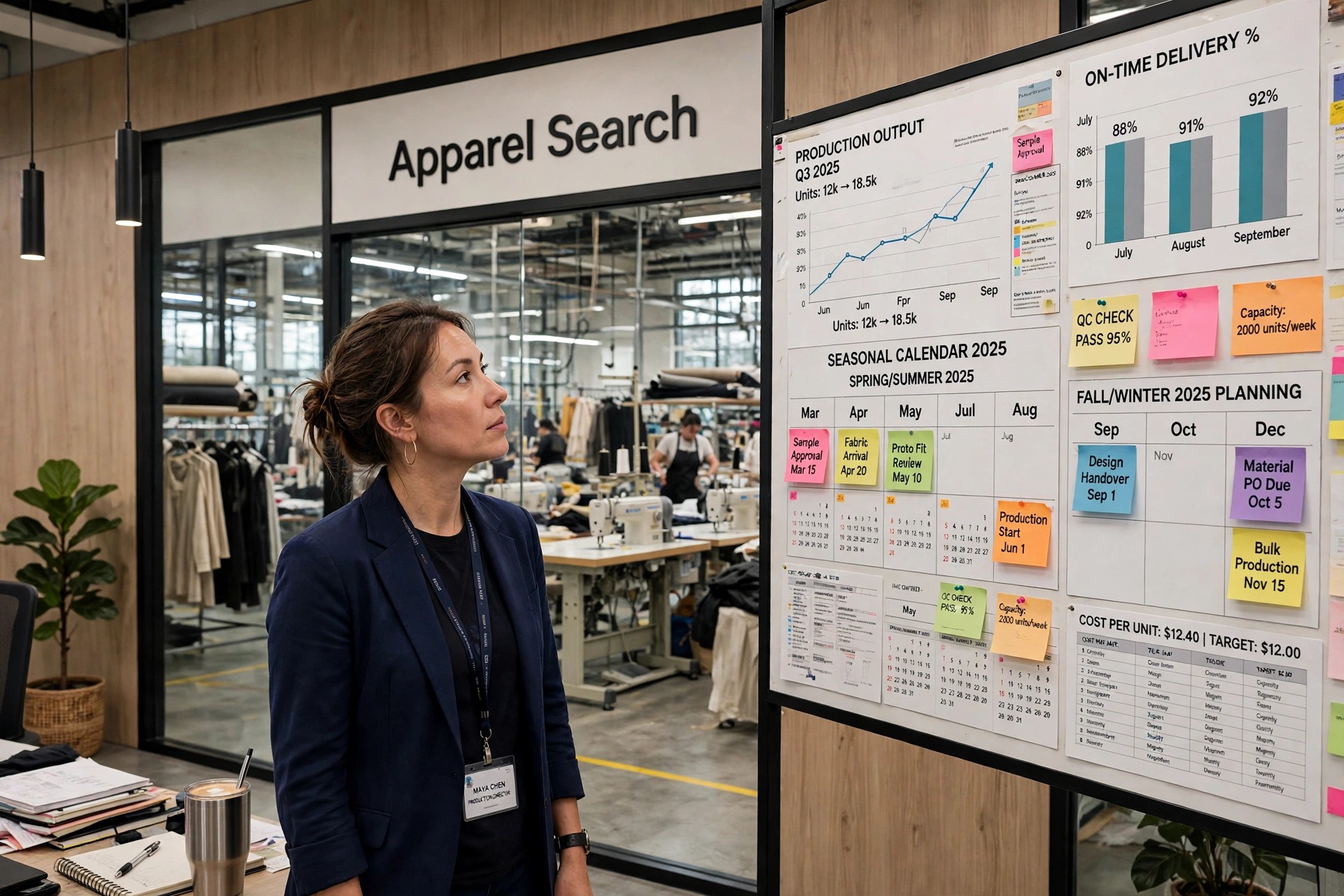
Production at this level is a budget. The director owns the production function's costs — departmental budgets, sampling and development spend, freight strategy, duty optimisation, and the cost-of-goods targets each season's range must achieve. Margin pressure arrives from the board as a number and leaves the director's office as decisions: a region rebalanced, a construction standardised, a freight policy changed from air-default to sea-planned. The director defends those numbers with evidence, reporting production performance — on-time delivery, quality claims, cost variance, compliance status — at executive level.
Commercial judgment at director level is long-range. A cheaper factory that fails twice costs more than the saving; a slightly dearer partner whose development work wins a season's key product pays for a decade. Directors weigh total cost — defects, delays, markdowns on late goods, management time — against quoted price, and set the costing frameworks inside which managers and coordinators then negotiate order by order.
Risk, Compliance and Leadership
The director carries production risk for the company. Social and environmental compliance of the supply base, product safety, sanctions and trade-rule exposure, currency and freight volatility, single points of failure in fabric or trim supply — these are mapped, owned and mitigated at director level, with audit and technical teams' findings landing on the director's desk. When a factory fails an audit or a region closes its ports, it is the director who answers the board's question: what does this mean for the season, and what are we doing about it?
Leadership completes the role. The director builds the production function's senior team — production managers, heads of technical and planning — sets its standards and succession, and represents production in the company's senior decisions on range planning, market entry and growth. The director's calendar is meetings, factory visits and reviews rather than trackers and samples, but the authority in those rooms rests on a career that once ran orders: directors who have done the coordinator's and manager's work know which reports to doubt, and their factories know it too.
Skills, Qualifications and Career Path
Production directors are formed over fifteen or more years across the production ladder — coordination, production management, sourcing leadership — usually across more than one product type and sourcing region. Employers look for strategic and financial literacy on top of deep production knowledge: supply chain economics, trade and customs fundamentals, negotiation at principal level, and the executive communication to hold a board's confidence. Business or supply chain degrees and postgraduate study support senior appointments, but the decisive evidence is a record of ranges delivered, supply bases built and crises handled.
The role is close to the top of the production profession. From production director, paths lead to vice president of production or sourcing, chief supply chain or operations officer roles, and general management of sourcing offices and subsidiaries. Some directors move to the supply side as executives of manufacturing groups, taking their customer knowledge with them. It is the destination of the ladder that begins with the production assistant's sample log — every rung of which is described in this category.
Common Questions
What does a production director do?
Directs production strategy for the whole business: which regions and factories make which product, capacity and supply base decisions, production budgets and cost targets, risk and compliance oversight, and leadership of the production function's senior team.
How is a production director different from a production manager?
A manager owns a department or product area and its current orders. A director owns the strategy those orders sit inside — the supply base, the regions, the budgets and the long-term risk position — across multiple areas and seasons.
How do you become a production director?
Over a long production career: coordinator and production manager roles, usually across several product types and sourcing regions, building the strategic, financial and negotiation record that senior appointments require.
More to Explore
Production Leadership
References & Further Reading
More Job Description Categories
- Buying Job Descriptions
- Design Job Descriptions
- Marketing & PR Job Descriptions
- Miscellaneous Job Descriptions
- Planning & Allocation Job Descriptions
- Production & Sourcing Job Descriptions (current)
- Sales & Selling Job Descriptions
- Transportation & Warehouse Job Descriptions